Download Mendeley
Structural Basis for Bacterial Quorum Sensing-mediated Oxalogenesis.
Oh, J., Goo, E., Hwang, I., Rhee, S.(2014) J Biol Chem 289: 11465-11475
- PubMed: 24616091 Search on PubMedSearch on PubMed Central
- DOI: https://doi.org/10.1074/jbc.M113.543462
- Primary Citation Related Structures:
4NNA, 4NNB, 4NNC - PubMed Abstract:
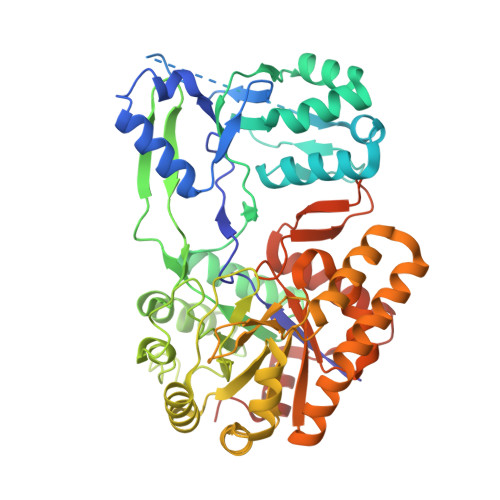
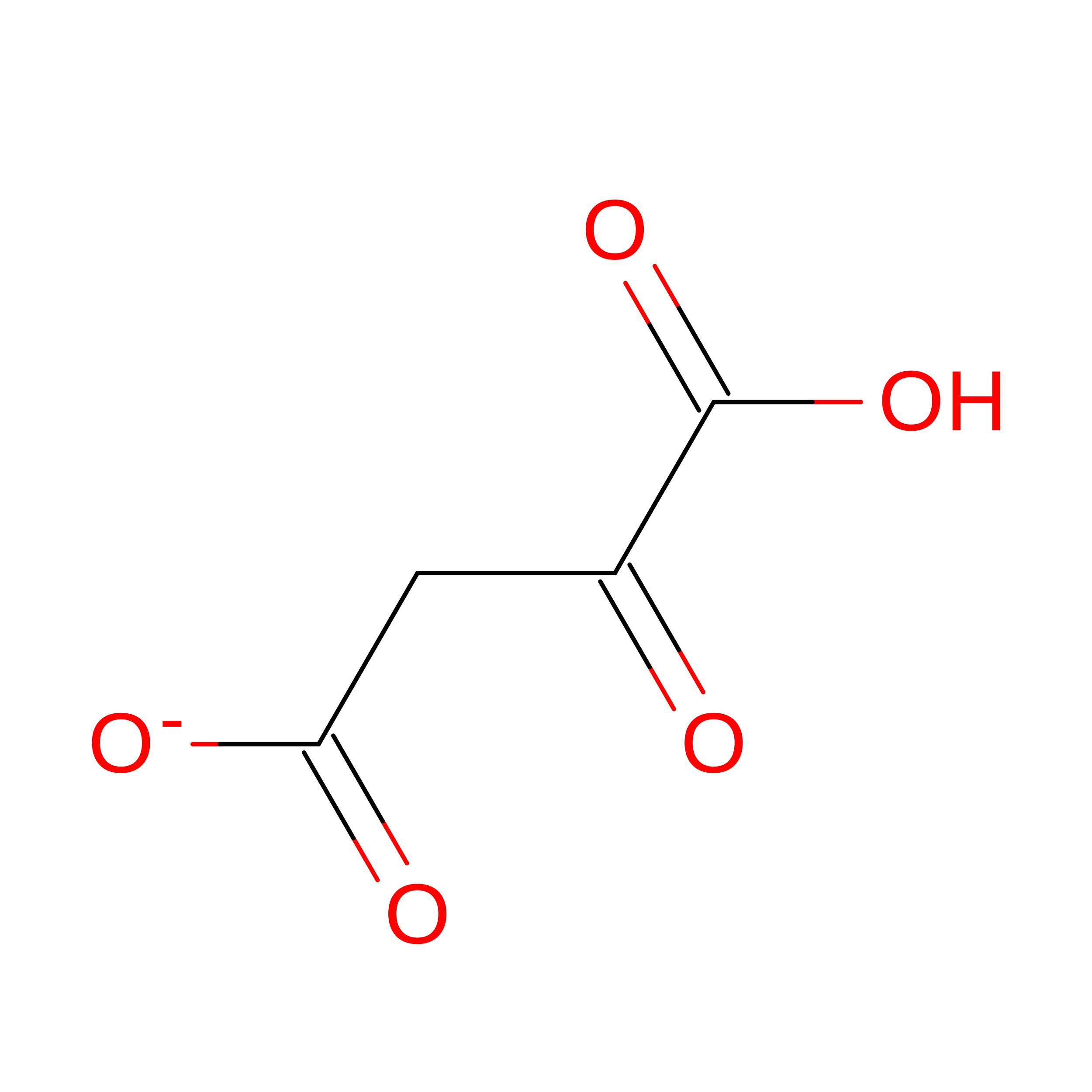
The Burkholderia species utilize acetyl-CoA and oxaloacetate, substrates for citrate synthase in the TCA cycle, to produce oxalic acid in response to bacterial cell to cell communication, called quorum sensing. Quorum sensing-mediated oxalogenesis via a sequential reaction by ObcA and ObcB counteracts the population-collapsing alkaline pH of the stationary growth phase. Thus, the oxalic acid produced plays an essential role as an excreted public good for survival of the group. Here, we report structural and functional analyses of ObcA, revealing mechanistic features distinct from those of citrate synthase. ObcA exhibits a unique fold, in which a (β/α)8-barrel fold is located in the C-domain with the N-domain inserted into a loop following α1 in the barrel fold. Structural analyses of the complexes with oxaloacetate and with a bisubstrate adduct indicate that each of the oxaloacetate and acetyl-CoA substrates is bound to an independent site near the metal coordination shell in the barrel fold. In catalysis, oxaloacetate serves as a nucleophile by forming an enolate intermediate mediated by Tyr(322) as a general base, which then attacks the thioester carbonyl carbon of acetyl-CoA to yield a tetrahedral adduct between the two substrates. Therefore, ObcA catalyzes its reaction by combining the enolase and acetyltransferase superfamilies, but the presence of the metal coordination shell and the absence of general acid(s) produces an unusual tetrahedral CoA adduct as a stable product. These results provide the structural basis for understanding the first step in oxalogenesis and constitute an example of the functional diversity of an enzyme for survival and adaptation in the environment.
- Department of Agricultural Biotechnology and Seoul National University, Seoul 151-921, Korea.
Organizational Affiliation: