4NK4 | pdb_00004nk4

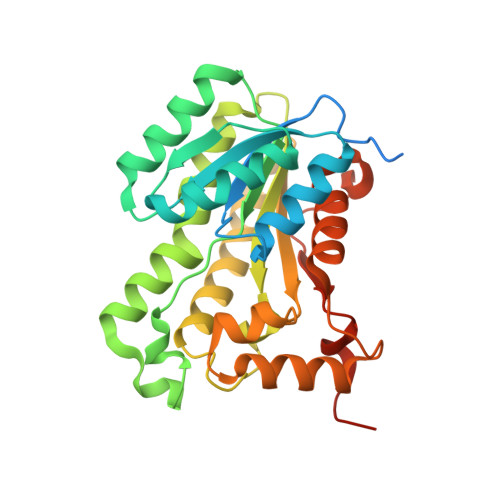
Crystal structure of FabI from Candidatus Liberibacter asiaticus


Experimental Data Snapshot

  • Method: X-RAY DIFFRACTION
  • Resolution: 1.70 Å
  • R-Value Free: 
    0.201 (Depositor), 0.198 (DCC) 
  • R-Value Work: 
    0.174 (Depositor), 0.172 (DCC) 
  • R-Value Observed: 
    0.174 (Depositor) 

Starting Model: experimental
View more details

wwPDB Validation 3D Report Full Report

Validation slider image for 4NK4

This is version 1.3 of the entry. See complete history

Literature

Crystal structures and kinetic properties of enoyl-acyl carrier protein reductase I from Candidatus Liberibacter asiaticus.

Jiang, L.Gao, Z.Li, Y.Wang, S.Dong, Y.

(2014) Protein Sci 23: 366-377

  • DOI: https://doi.org/10.1002/pro.2418
  • Primary Citation Related Structures: 
    4NK4, 4NK5

  • PubMed Abstract: 

    Huanglongbing (HLB) is a destructive citrus disease. The leading cause of HLB is Candidatus Liberibacter asiaticus. Fatty acid biosynthesis is essential for bacterial viability and has been validated as a target for the discovery of novel antibacterial agents. Enoyl-acyl carrier protein reductase (also called ENR or FabI and a product of the fabI gene) is an enzyme required in a critical step of bacterial fatty acid biosynthesis and has attracted attention as a target of novel antimicrobial agents. We determined the crystal structures of FabI from Ca. L. asiaticus in its apoform as well as in complex with b-nicotinamide adenine dinucleotide (NAD) at 1.7 and 2.7 Å resolution, respectively, to facilitate the design and screening of small molecule inhibitors of FabI. The monomeric ClFabI is highly similar to other known FabI structures as expected; however, unlike the typical tetramer, ClFabI exists as a hexamer in crystal, whereas as dimer in solution, on the other hand, the substrate binding loop which always disordered in apoform FabI structures is ordered in apo-ClFabI. Interestingly, the structure of ClFabI undergoes remarkable conformational change in the substrate-binding loop in the presence of NAD. We conclude that the signature sequence motif of FabI can be considered as Gly-(Xaa)5-Ser-(Xaa)n-Val-Tyr-(Xaa)6-Lys-(Xaa)n-Thr instead of Tyr-(Xaa)6-Lys. We have further identified isoniazid as a competitive inhibitor with NADH.


  • Organizational Affiliation
    • Ministry of Education Key Laboratory of Plant Biology, Department of Horticulture and Forestry, Huazhong Agricultural University, Wuhan 430070, China.

Macromolecule Content 

  • Total Structure Weight: 199.26 kDa 
  • Atom Count: 13,342 
  • Modeled Residue Count: 1,547 
  • Deposited Residue Count: 1,806 
  • Unique protein chains: 1

Macromolecules

Find similar proteins by:|  3D Structure
Entity ID: 1
MoleculeChains  Sequence LengthOrganismDetailsImage
Enoyl-[acyl-carrier-protein] reductase [NADH]
A, B, C, D, E
A, B, C, D, E, F
301Candidatus Liberibacter asiaticusMutation(s): 0 
Gene Names: WSI_01645
EC: 1.3.1.9

Small Molecules

Ligands 1 Unique
IDChains Name / Formula / InChI Key2D Diagram3D Interactions
PEG

Query on PEG


Download:Ideal Coordinates CCD File
G [auth A]
H [auth B]
I [auth B]
J [auth C]
K [auth C]
G [auth A],
H [auth B],
I [auth B],
J [auth C],
K [auth C],
L [auth D],
M [auth E],
N [auth E],
O [auth F],
P [auth F]
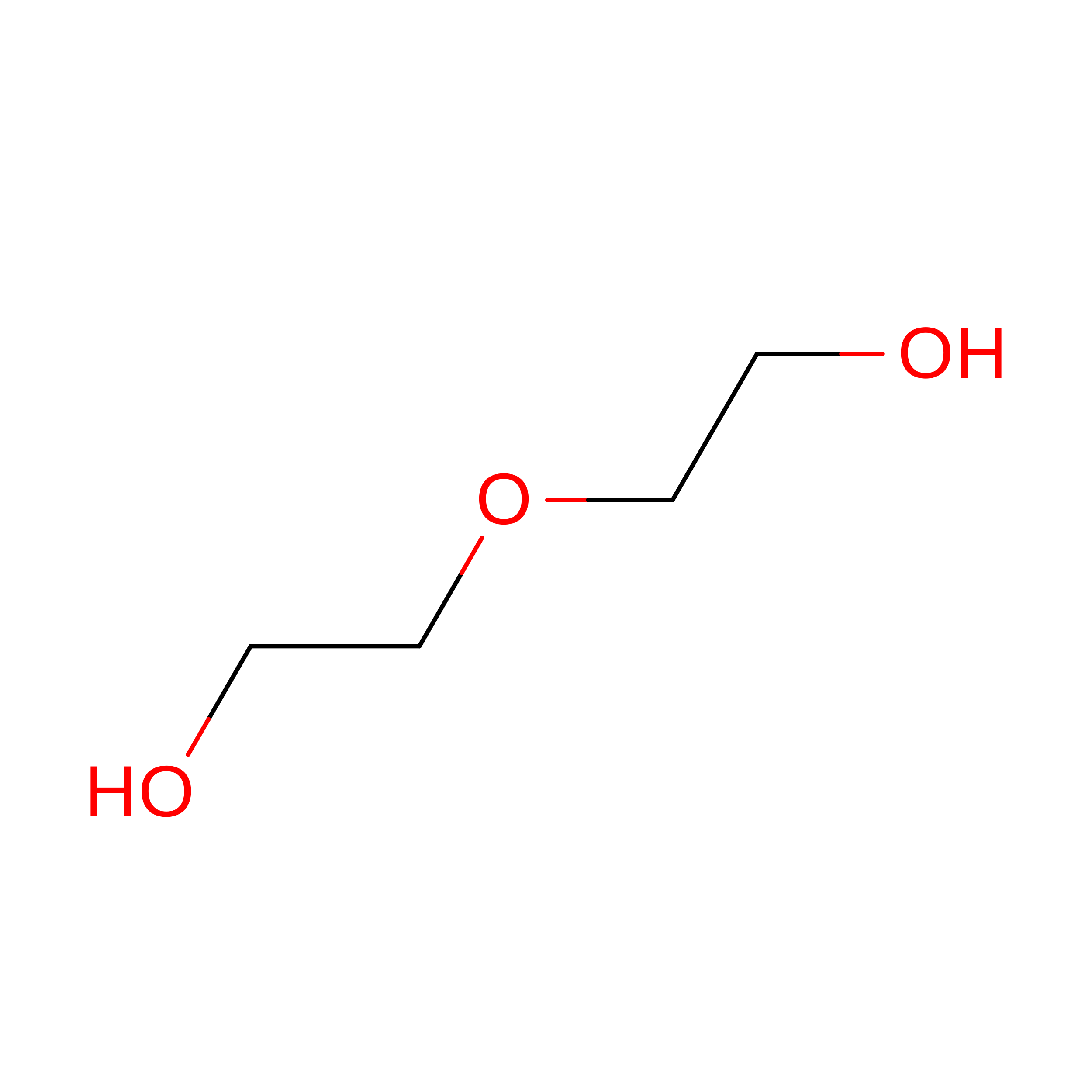
DI(HYDROXYETHYL)ETHER
C4 H10 O3
MTHSVFCYNBDYFN-UHFFFAOYSA-N

Experimental Data & Validation

Experimental Data

  • Method: X-RAY DIFFRACTION
  • Resolution: 1.70 Å
  • R-Value Free:  0.201 (Depositor), 0.198 (DCC) 
  • R-Value Work:  0.174 (Depositor), 0.172 (DCC) 
  • R-Value Observed: 0.174 (Depositor) 
Space Group: P 32 2 1
Unit Cell:
Length ( Å )Angle ( ˚ )
a = 203.488α = 90
b = 203.488β = 90
c = 81.764γ = 120
Software Package:
Software NamePurpose
MAR345data collection
PHASERphasing
PHENIXrefinement
HKL-2000data reduction
HKL-2000data scaling

Structure Validation

View Full Validation Report


Entry History 

Deposition Data

Revision History  (Full details and data files)

  • Version 1.0: 2014-02-12
    Type: Initial release
  • Version 1.1: 2014-04-09
    Changes: Database references
  • Version 1.2: 2017-11-22
    Changes: Refinement description
  • Version 1.3: 2023-09-20
    Changes: Data collection, Database references, Derived calculations, Refinement description