4ND8 | pdb_00004nd8

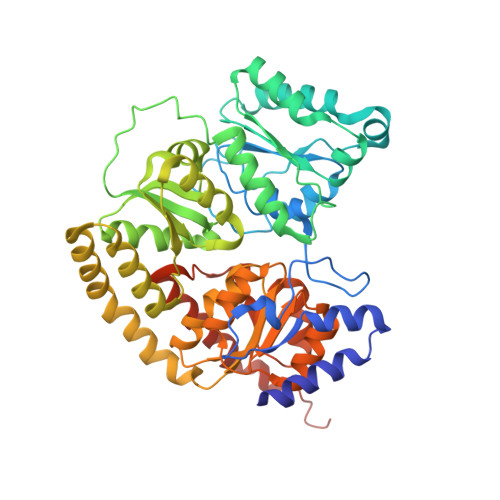
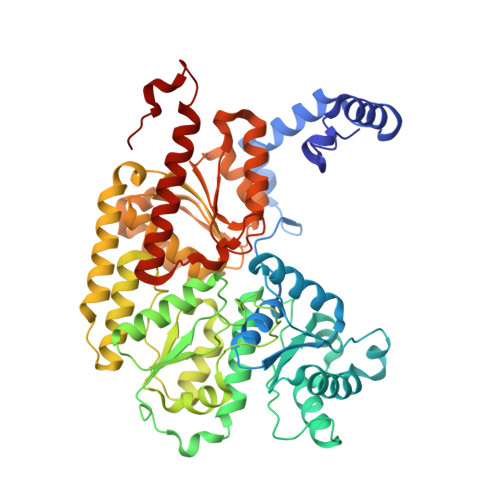
Av Nitrogenase MoFe Protein High pH Form


Experimental Data Snapshot

  • Method: X-RAY DIFFRACTION
  • Resolution: 2.00 Å
  • R-Value Free: 
    0.204 (Depositor), 0.204 (DCC) 
  • R-Value Work: 
    0.156 (Depositor), 0.158 (DCC) 
  • R-Value Observed: 
    0.159 (Depositor) 

Starting Model: experimental
View more details

wwPDB Validation 3D Report Full Report

Validation slider image for 4ND8

Ligand Structure Quality Assessment 


This is version 1.2 of the entry. See complete history

Literature

Turnover-Dependent Inactivation of the Nitrogenase MoFe-Protein at High pH.

Yang, K.Y.Haynes, C.A.Spatzal, T.Rees, D.C.Howard, J.B.

(2014) Biochemistry 53: 333-343

  • DOI: https://doi.org/10.1021/bi4014769
  • Primary Citation Related Structures: 
    4ND8

  • PubMed Abstract: 

    Proton uptake accompanies the reduction of all known substrates by nitrogenase. As a consequence, a higher pH should limit the availability of protons as a substrate essential for turnover, thereby increasing the proportion of more highly reduced forms of the enzyme for further study. The utility of the high-pH approach would appear to be problematic in view of the observation reported by Pham and Burgess [(1993) Biochemistry 32, 13725-13731] that the MoFe-protein undergoes irreversible protein denaturation above pH 8.65. In contrast, we found by both enzyme activity and crystallographic analyses that the MoFe-protein is stable when incubated at pH 9.5. We did observe, however, that at higher pHs and under turnover conditions, the MoFe-protein is slowly inactivated. While a normal, albeit low, level of substrate reduction occurs under these conditions, the MoFe-protein undergoes a complex transformation; initially, the enzyme is reversibly inhibited for substrate reduction at pH 9.5, yet in a second, slower process, the MoFe-protein becomes irreversibly inactivated as measured by substrate reduction activity at the optimal pH of 7.8. The final inactivated MoFe-protein has an increased hydrodynamic radius compared to that of the native MoFe-protein, yet it has a full complement of iron and molybdenum. Significantly, the modified MoFe-protein retains the ability to specifically interact with its nitrogenase partner, the Fe-protein, as judged by the support of ATP hydrolysis and by formation of a tight complex with the Fe-protein in the presence of ATP and aluminum fluoride. The turnover-dependent inactivation coupled to conformational change suggests a mechanism-based transformation that may provide a new probe of nitrogenase catalysis.


  • Organizational Affiliation
    • Division of Chemistry and Chemical Engineering 114-96, California Institute of Technology , Pasadena, California 91125, United States.

Macromolecule Content 

  • Total Structure Weight: 233.24 kDa 
  • Atom Count: 17,675 
  • Modeled Residue Count: 1,998 
  • Deposited Residue Count: 2,030 
  • Unique protein chains: 2

Macromolecules

Find similar proteins by:|  3D Structure
Entity ID: 1
MoleculeChains  Sequence LengthOrganismDetailsImage
Nitrogenase molybdenum-iron protein alpha chain
A, C
492Azotobacter vinelandiiMutation(s): 0 
EC: 1.18.6.1
UniProt
Find proteins for P07328 (Azotobacter vinelandii)
Explore P07328 
Go to UniProtKB:  P07328
Entity Groups
Sequence Clusters30% Identity50% Identity70% Identity90% Identity95% Identity100% Identity
UniProt GroupP07328
Sequence Annotations
Expand
Reference Sequence
Find similar proteins by:|  3D Structure
Entity ID: 2
MoleculeChains  Sequence LengthOrganismDetailsImage
Nitrogenase molybdenum-iron protein beta chain
B, D
523Azotobacter vinelandiiMutation(s): 0 
EC: 1.18.6.1
UniProt
Find proteins for P07329 (Azotobacter vinelandii)
Explore P07329 
Go to UniProtKB:  P07329
Entity Groups
Sequence Clusters30% Identity50% Identity70% Identity90% Identity95% Identity100% Identity
UniProt GroupP07329
Sequence Annotations
Expand
Reference Sequence

Small Molecules

Ligands 4 Unique
IDChains Name / Formula / InChI Key2D Diagram3D Interactions
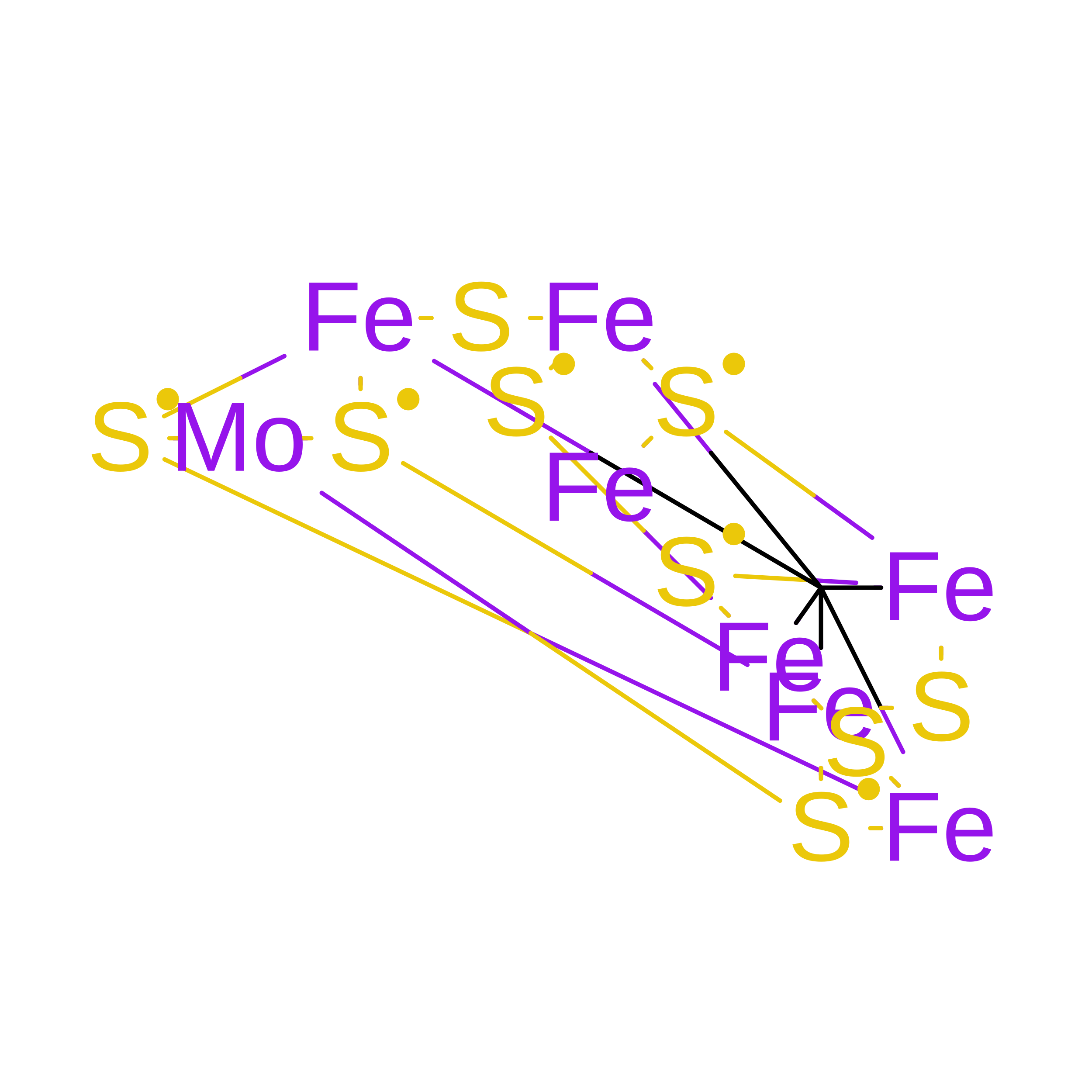
ICS

Query on ICS


Download:Ideal Coordinates CCD File
F [auth A],
J [auth C]
iron-sulfur-molybdenum cluster with interstitial carbon
C Fe7 Mo S9
DDQFAOMIVKLFON-UHFFFAOYSA-N
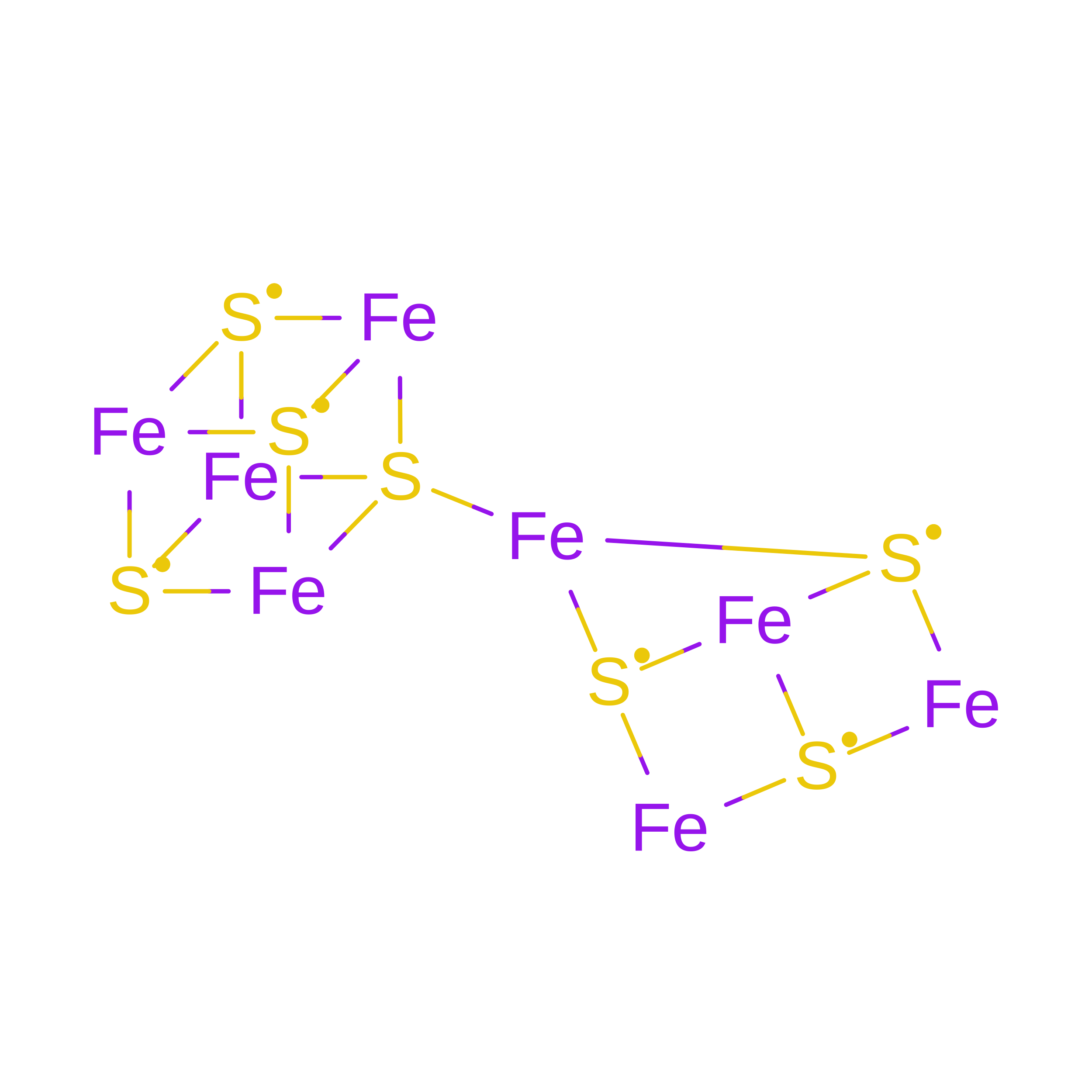
1CL

Query on 1CL


Download:Ideal Coordinates CCD File
G [auth A],
K [auth C]
FE(8)-S(7) CLUSTER, OXIDIZED
Fe8 S7
JKVMXLBGZBULKV-UHFFFAOYSA-N
HCA

Query on HCA


Download:Ideal Coordinates CCD File
E [auth A],
I [auth C]
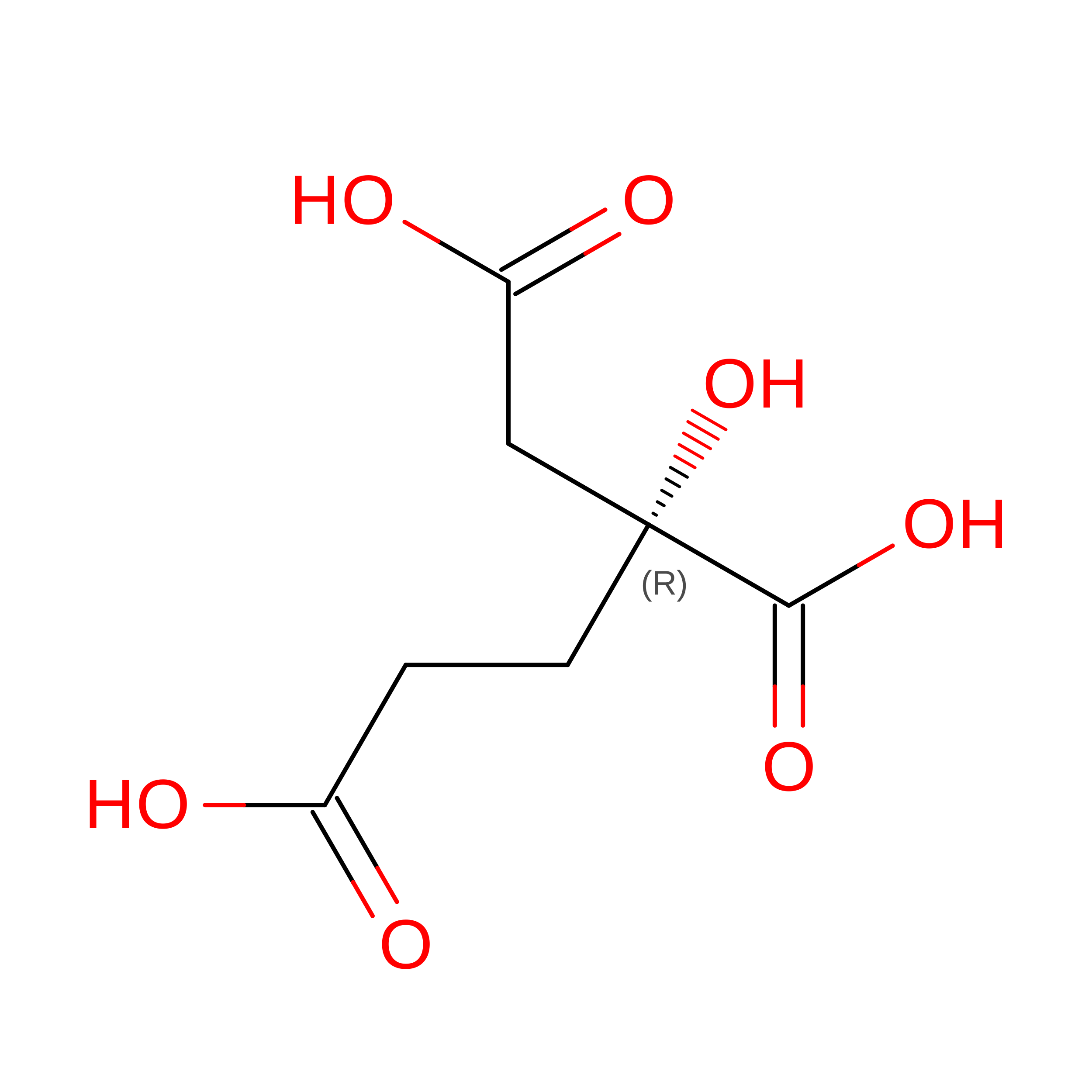
3-HYDROXY-3-CARBOXY-ADIPIC ACID
C7 H10 O7
XKJVEVRQMLKSMO-SSDOTTSWSA-N
FE

Query on FE


Download:Ideal Coordinates CCD File
H [auth B],
L [auth D]
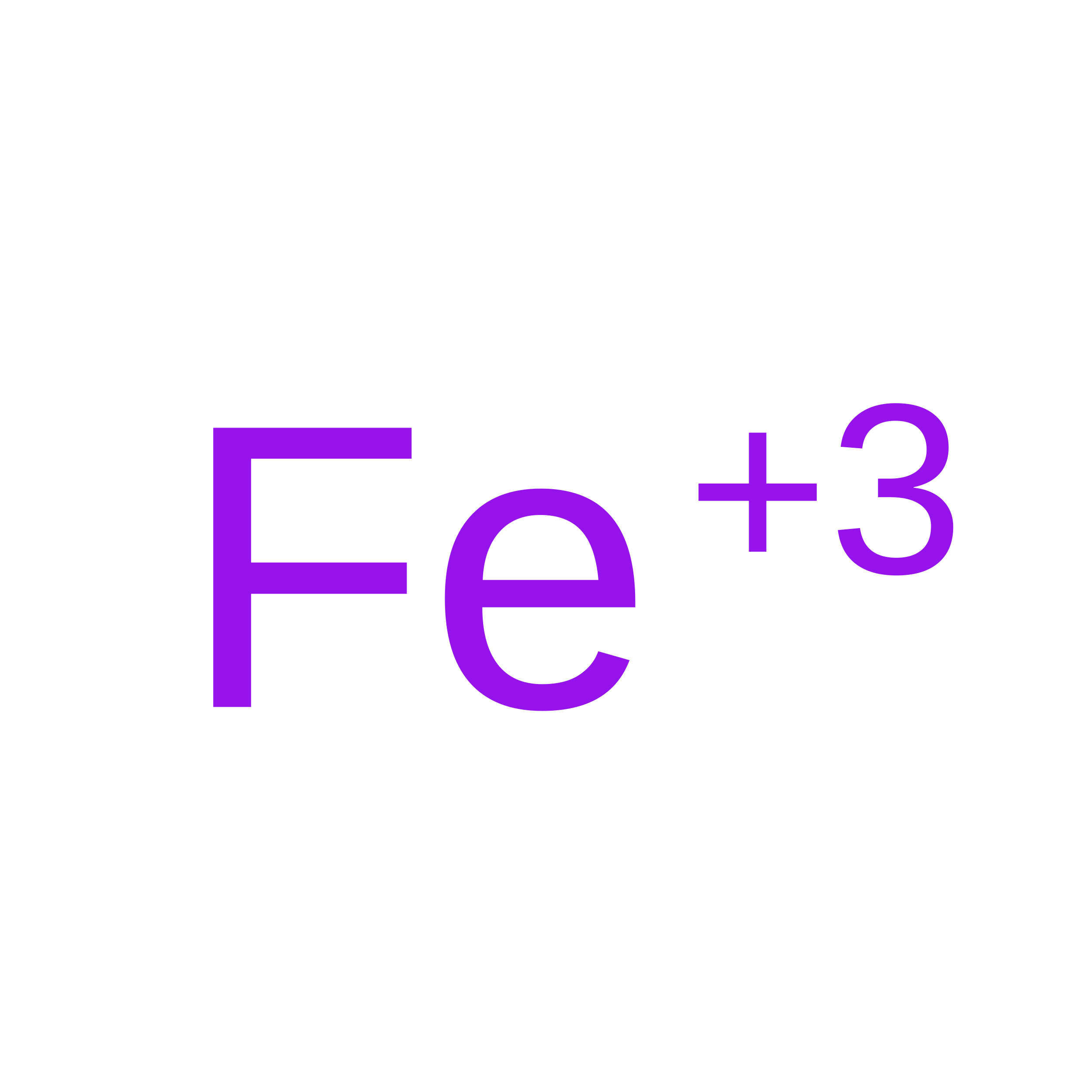
FE (III) ION
Fe
VTLYFUHAOXGGBS-UHFFFAOYSA-N

Experimental Data & Validation

Experimental Data

  • Method: X-RAY DIFFRACTION
  • Resolution: 2.00 Å
  • R-Value Free:  0.204 (Depositor), 0.204 (DCC) 
  • R-Value Work:  0.156 (Depositor), 0.158 (DCC) 
  • R-Value Observed: 0.159 (Depositor) 
Space Group: P 1 21 1
Unit Cell:
Length ( Å )Angle ( ˚ )
a = 76.527α = 90
b = 127.915β = 108.9
c = 107.082γ = 90
Software Package:
Software NamePurpose
SCALAdata scaling
PHASERphasing
PHENIXrefinement
PDB_EXTRACTdata extraction
Blu-Icedata collection
XDSdata reduction
MOLREPphasing

Structure Validation

View Full Validation Report


Ligand Structure Quality Assessment 


Entry History 

Deposition Data

Revision History  (Full details and data files)

  • Version 1.0: 2014-01-15
    Type: Initial release
  • Version 1.1: 2014-02-05
    Changes: Database references
  • Version 1.2: 2023-09-20
    Changes: Data collection, Database references, Derived calculations, Refinement description