4NCS | pdb_00004ncs

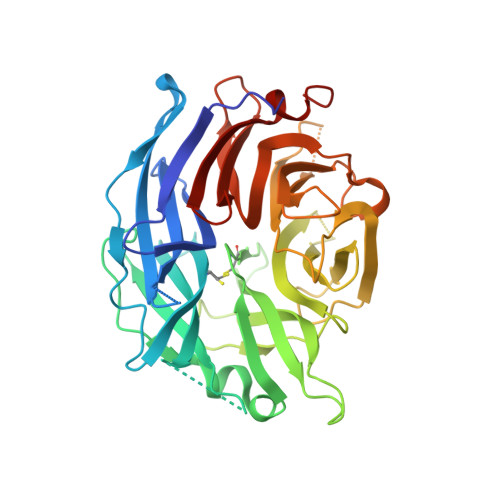
Human sialidase 2 in complex with 2,3-difluorosialic acid (covalent intermediate)


Experimental Data Snapshot

  • Method: X-RAY DIFFRACTION
  • Resolution: 2.20 Å
  • R-Value Free: 
    0.225 (Depositor), 0.225 (DCC) 
  • R-Value Work: 
    0.161 (Depositor), 0.170 (DCC) 
  • R-Value Observed: 
    0.164 (Depositor) 

Starting Model: experimental
View more details

wwPDB Validation 3D Report Full Report

Validation slider image for 4NCS

Ligand Structure Quality Assessment 


This is version 1.5 of the entry. See complete history

Literature

Tuning mechanism-based inactivators of neuraminidases: mechanistic and structural insights.

Buchini, S.Gallat, F.X.Greig, I.R.Kim, J.H.Wakatsuki, S.Chavas, L.M.Withers, S.G.

(2014) Angew Chem Int Ed Engl 53: 3382-3386

  • DOI: https://doi.org/10.1002/anie.201309675
  • Primary Citation Related Structures: 
    4NC5, 4NCS

  • PubMed Abstract: 

    3-Fluorosialosyl fluorides are inhibitors of sialidases that function by the formation of a long-lived covalent active-site adduct and have potential as therapeutics if made specific for the pathogen sialidase. Surprisingly, human Neu2 and the Trypanosoma cruzi trans-sialidase are inactivated more rapidly by the reagent with an equatorial fluorine at C3 than by its axial epimer, with reactivation following the same pattern. To explore a possible stereoelectronic basis for this, rate constants for spontaneous hydrolysis of the full series of four 3-fluorosialosyl fluorides were measured, and ground-state energies for each computed. The alpha (equatorial) anomeric fluorides hydrolyze more rapidly than their beta anomers, consistent with their higher ground-state energies. However ground-state energies do not explain the relative spontaneous reactivities of the 3-fluoro-epimers. The three-dimensional structures of the two 3-fluoro-sialosyl enzyme intermediates of human Neu2 were solved, revealing key stabilizing interactions between Arg21 and the equatorial, but not the axial, fluorine. Because of changes in geometry these interactions will increase at the transition state, likely explaining the difference in reaction rates.


  • Organizational Affiliation
    • Department of Chemistry, University of British Columbia, Vancouver, B. C., V6T 1Z1 (Canada).

Macromolecule Content 

  • Total Structure Weight: 42.89 kDa 
  • Atom Count: 3,071 
  • Modeled Residue Count: 350 
  • Deposited Residue Count: 382 
  • Unique protein chains: 1

Macromolecules

Find similar proteins by:|  3D Structure
Entity ID: 1
MoleculeChains  Sequence LengthOrganismDetailsImage
Sialidase-2382Homo sapiensMutation(s): 2 
Gene Names: NEU2
EC: 3.2.1.18
UniProt & NIH Common Fund Data Resources
Find proteins for Q9Y3R4 (Homo sapiens)
Explore Q9Y3R4 
Go to UniProtKB:  Q9Y3R4
PHAROS:  Q9Y3R4
GTEx:  ENSG00000115488 
Entity Groups
Sequence Clusters30% Identity50% Identity70% Identity90% Identity95% Identity100% Identity
UniProt GroupQ9Y3R4
Sequence Annotations
Expand
Reference Sequence

Small Molecules

Ligands 2 Unique
IDChains Name / Formula / InChI Key2D Diagram3D Interactions
FSR

Query on FSR


Download:Ideal Coordinates CCD File
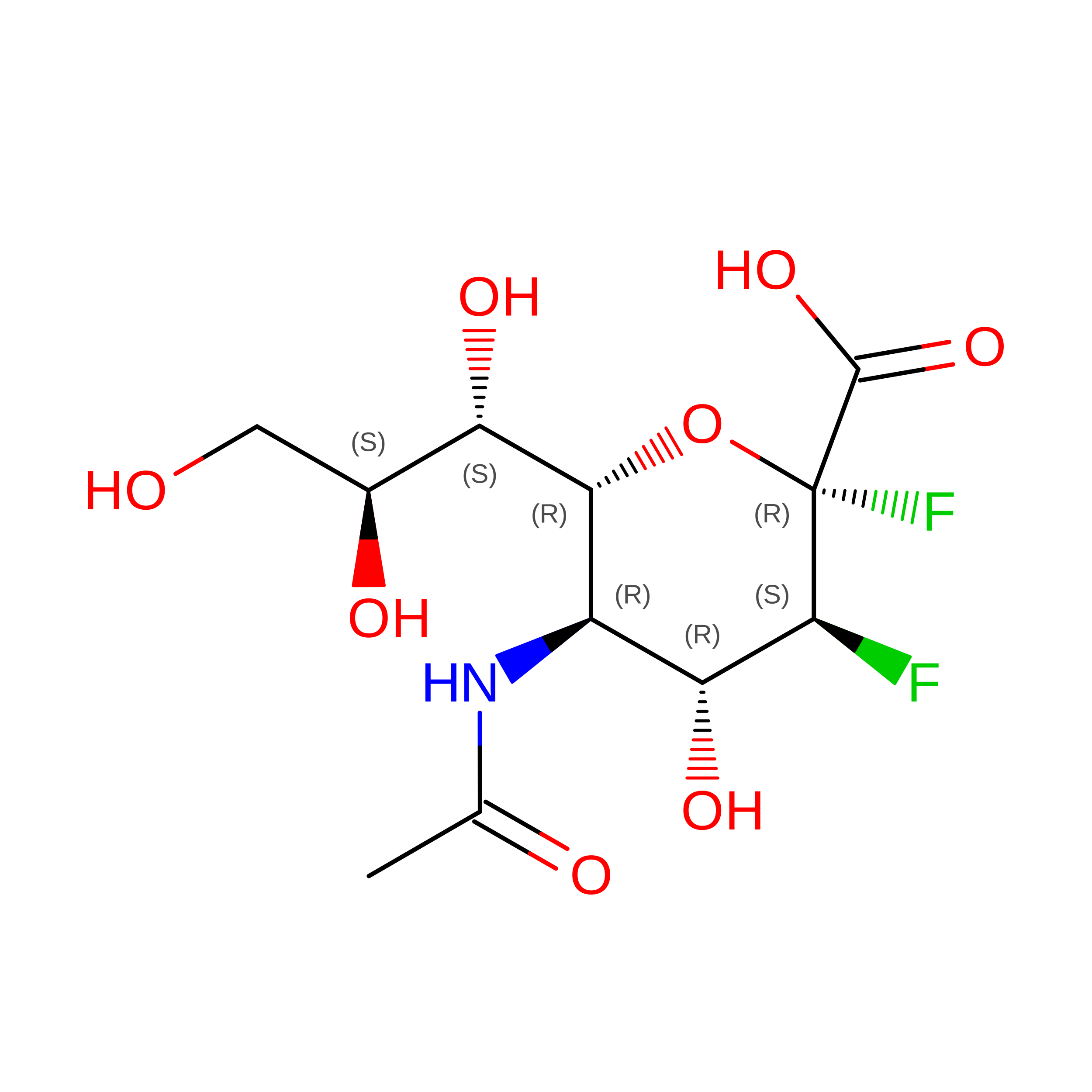
B [auth A](2S,3S,4R,5R,6R)-5-acetamido-2,3-bis(fluoranyl)-4-oxidanyl-6-[(1S,2S)-1,2,3-tris(oxidanyl)propyl]oxane-2-carboxylic acid
C11 H17 F2 N O8
HMALKZAXODOYOP-JVUHFKPCSA-N
PO4

Query on PO4


Download:Ideal Coordinates CCD File
C [auth A],
D [auth A]
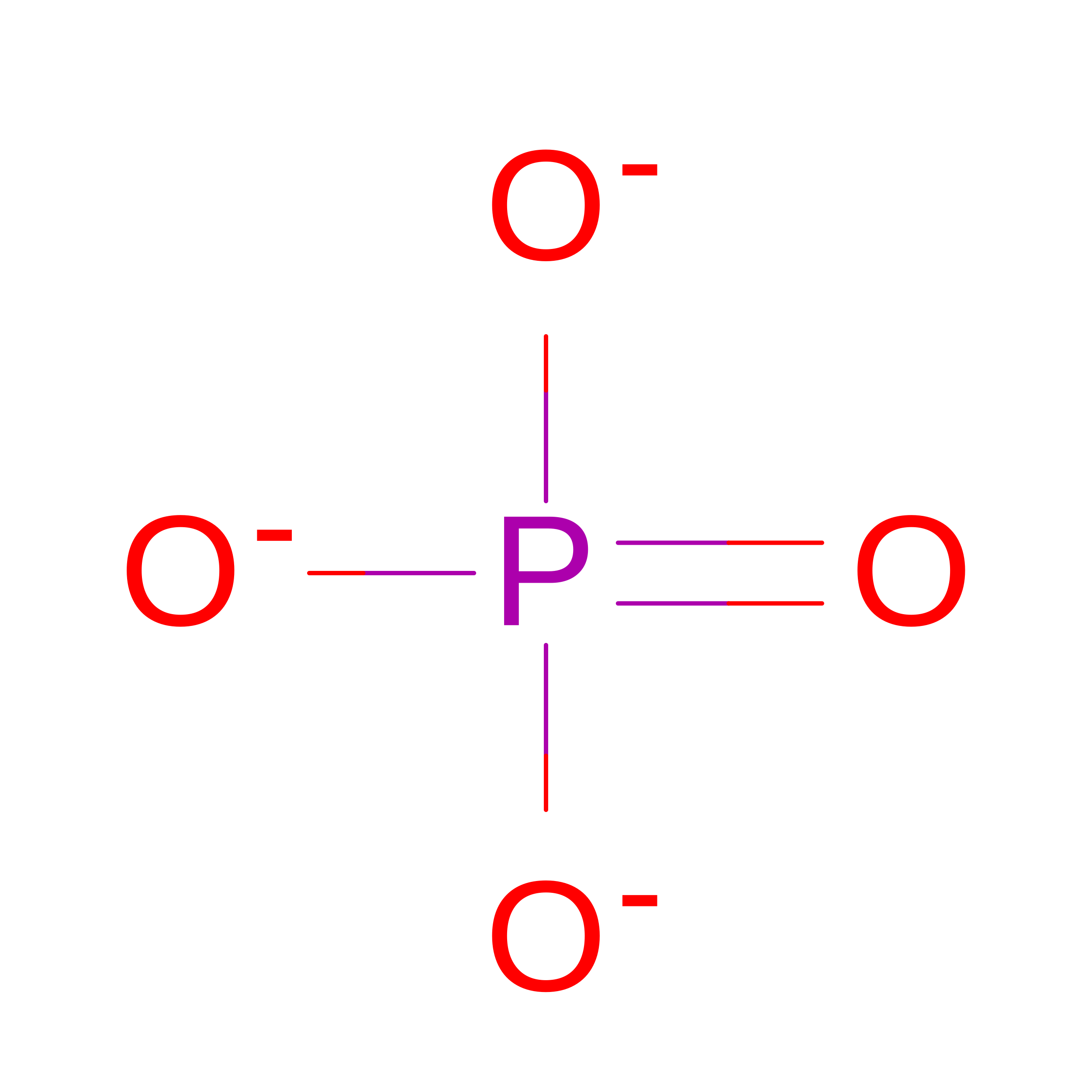
PHOSPHATE ION
O4 P
NBIIXXVUZAFLBC-UHFFFAOYSA-K

Experimental Data & Validation

Experimental Data

  • Method: X-RAY DIFFRACTION
  • Resolution: 2.20 Å
  • R-Value Free:  0.225 (Depositor), 0.225 (DCC) 
  • R-Value Work:  0.161 (Depositor), 0.170 (DCC) 
  • R-Value Observed: 0.164 (Depositor) 
Space Group: C 2 2 21
Unit Cell:
Length ( Å )Angle ( ˚ )
a = 88.144α = 90
b = 88.256β = 90
c = 92.684γ = 90
Software Package:
Software NamePurpose
MOLREPphasing
REFMACrefinement
HKL-2000data reduction
SCALEPACKdata scaling

Structure Validation

View Full Validation Report


Ligand Structure Quality Assessment 


Entry History 

Deposition Data

Revision History  (Full details and data files)

  • Version 1.0: 2013-12-25
    Type: Initial release
  • Version 1.1: 2014-04-02
    Changes: Database references
  • Version 1.2: 2017-11-15
    Changes: Refinement description
  • Version 1.3: 2020-07-29
    Type: Remediation
    Reason: Carbohydrate remediation
    Changes: Advisory, Data collection, Database references, Derived calculations
  • Version 1.4: 2023-09-20
    Changes: Data collection, Database references, Refinement description
  • Version 1.5: 2024-11-06
    Changes: Structure summary