4MXV | pdb_00004mxv

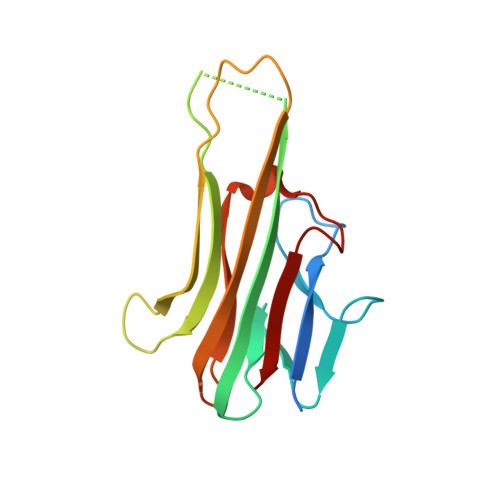
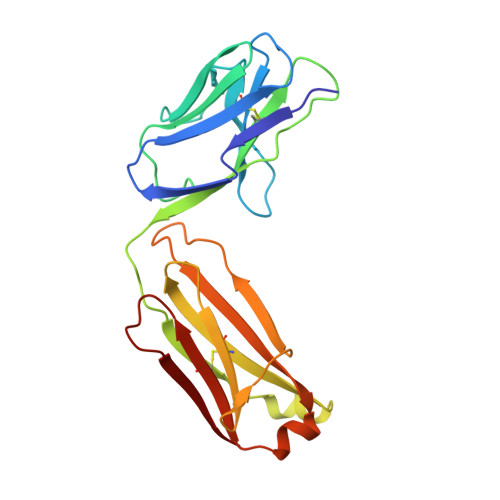
Structure of Lymphotoxin alpha bound to anti-LTa Fab


Experimental Data Snapshot

  • Method: X-RAY DIFFRACTION
  • Resolution: 3.20 Å
  • R-Value Free: 
    0.235 (Depositor), 0.233 (DCC) 
  • R-Value Work: 
    0.177 (Depositor), 0.179 (DCC) 
  • R-Value Observed: 
    0.181 (Depositor) 

Starting Models: experimental
View more details

wwPDB Validation 3D Report Full Report

Validation slider image for 4MXV

This is version 1.4 of the entry. See complete history

Literature

Dimerization of LT beta R by LT alpha 1 beta 2 is necessary and sufficient for signal transduction.

Sudhamsu, J.Yin, J.Chiang, E.Y.Starovasnik, M.A.Grogan, J.L.Hymowitz, S.G.

(2013) Proc Natl Acad Sci U S A 110: 19896-19901

  • DOI: https://doi.org/10.1073/pnas.1310838110
  • Primary Citation Related Structures: 
    4MXV, 4MXW

  • PubMed Abstract: 

    Homotrimeric TNF superfamily ligands signal by inducing trimers of their cognate receptors. As a biologically active heterotrimer, Lymphotoxin(LT)α1β2 is unique in the TNF superfamily. How the three unique potential receptor-binding interfaces in LTα1β2 trigger signaling via LTβ Receptor (LTβR) resulting in lymphoid organogenesis and propagation of inflammatory signals is poorly understood. Here we show that LTα1β2 possesses two binding sites for LTβR with distinct affinities and that dimerization of LTβR by LTα1β2 is necessary and sufficient for signal transduction. The crystal structure of a complex formed by LTα1β2, LTβR, and the fab fragment of an antibody that blocks LTβR activation reveals the lower affinity receptor-binding site. Mutations targeting each potential receptor-binding site in an engineered single-chain variant of LTα1β2 reveal the high-affinity site. NF-κB reporter assays further validate that disruption of receptor interactions at either site is sufficient to prevent signaling via LTβR.


  • Organizational Affiliation
    • Departments of Structural Biology and Immunology, Genentech, Inc., South San Francisco, CA 94080.

Macromolecule Content 

  • Total Structure Weight: 189.81 kDa 
  • Atom Count: 12,881 
  • Modeled Residue Count: 1,678 
  • Deposited Residue Count: 1,743 
  • Unique protein chains: 3

Macromolecules

Find similar proteins by:|  3D Structure
Entity ID: 1
MoleculeChains  Sequence LengthOrganismDetailsImage
Lymphotoxin-alphaA,
B,
C [auth D]
157Homo sapiensMutation(s): 0 
Gene Names: LTATNFBTNFSF1
UniProt & NIH Common Fund Data Resources
Find proteins for P01374 (Homo sapiens)
Explore P01374 
Go to UniProtKB:  P01374
PHAROS:  P01374
GTEx:  ENSG00000226979 
Entity Groups
Sequence Clusters30% Identity50% Identity70% Identity90% Identity95% Identity100% Identity
UniProt GroupP01374
Sequence Annotations
Expand
Reference Sequence
Find similar proteins by:|  3D Structure
Entity ID: 2
MoleculeChains  Sequence LengthOrganismDetailsImage
anti-Lymphotoxin alpha antibody light chainD [auth E],
F [auth L],
H [auth X]
211Homo sapiensMutation(s): 0 
Find similar proteins by:|  3D Structure
Entity ID: 3
MoleculeChains  Sequence LengthOrganismDetailsImage
anti-Lymphotoxin alpha antibody heavy chainE [auth F],
G [auth H],
I [auth Y]
213Homo sapiensMutation(s): 0 

Experimental Data & Validation

Experimental Data

  • Method: X-RAY DIFFRACTION
  • Resolution: 3.20 Å
  • R-Value Free:  0.235 (Depositor), 0.233 (DCC) 
  • R-Value Work:  0.177 (Depositor), 0.179 (DCC) 
  • R-Value Observed: 0.181 (Depositor) 
Space Group: P 41 21 2
Unit Cell:
Length ( Å )Angle ( ˚ )
a = 209.847α = 90
b = 209.847β = 90
c = 130.142γ = 90
Software Package:
Software NamePurpose
ADSCdata collection
PHASERphasing
PHENIXrefinement
HKL-2000data reduction
HKL-2000data scaling

Structure Validation

View Full Validation Report


Entry History 

Deposition Data

Revision History  (Full details and data files)

  • Version 1.0: 2013-11-13
    Type: Initial release
  • Version 1.1: 2013-12-11
    Changes: Database references
  • Version 1.2: 2013-12-18
    Changes: Database references
  • Version 1.3: 2023-09-20
    Changes: Data collection, Database references, Refinement description
  • Version 1.4: 2024-10-09
    Changes: Structure summary