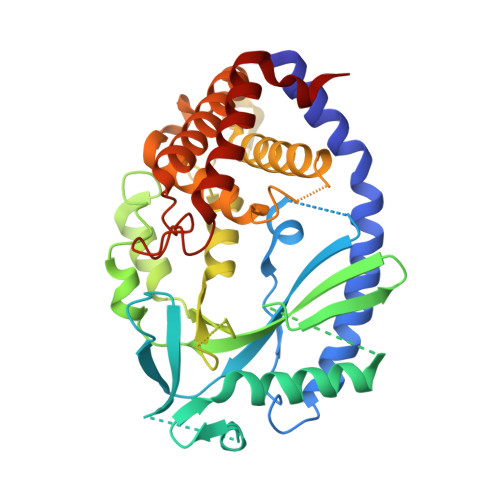
4MKP | pdb_00004mkp

Crystal structure of human cGAS apo form


Experimental Data Snapshot

  • Method: X-RAY DIFFRACTION
  • Resolution: 1.95 Å
  • R-Value Free: 
    0.252 (Depositor), 0.253 (DCC) 
  • R-Value Work: 
    0.204 (Depositor), 0.207 (DCC) 
  • R-Value Observed: 
    0.207 (Depositor) 

Starting Model: experimental
View more details

wwPDB Validation 3D Report Full Report

Validation slider image for 4MKP

This is version 1.1 of the entry. See complete history

Literature

Structural and Functional Analyses of DNA-Sensing and Immune Activation by Human cGAS

Kato, K.Ishii, R.Goto, E.Ishitani, R.Tokunaga, F.Nureki, O.

(2013) PLoS One 8: e76983-e76983

  • DOI: https://doi.org/10.1371/journal.pone.0076983
  • Primary Citation Related Structures: 
    4MKP

  • PubMed Abstract: 

    The detection of cytosolic DNA, derived from pathogens or host cells, by cytosolic receptors is essential for appropriate host immune responses. Cyclic GMP-AMP synthase (cGAS) is a newly identified cytosolic DNA receptor that produces cyclic GMP-AMP, which activates stimulator of interferon genes (STING), resulting in TBK1-IRF3 pathway activation followed by the production of type I interferons. Here we report the crystal structure of human cGAS. The structure revealed that a cluster of lysine and arginine residues forms the positively charged DNA binding surface of human cGAS, which is important for the STING-dependent immune activation. A structural comparison with other previously determined cGASs and our functional analyses suggested that a conserved zinc finger motif and a leucine residue on the DNA binding surface are crucial for the DNA-specific immune response of human cGAS, consistent with previous work. These structural features properly orient the DNA binding to cGAS, which is critical for DNA-induced cGAS activation and STING-dependent immune activation. Furthermore, we showed that the cGAS-induced activation of STING also involves the activation of the NF-κB and IRF3 pathways. Our results indicated that cGAS is a DNA sensor that efficiently activates the host immune system by inducing two distinct pathways.


  • Organizational Affiliation
    • Department of Biophysics and Biochemistry, Graduate School of Science, The University of Tokyo, Bunkyo-ku, Tokyo, Japan ; Global Research Cluster, RIKEN, Wako, Saitama, Japan.

Macromolecule Content 

  • Total Structure Weight: 42.61 kDa 
  • Atom Count: 2,660 
  • Modeled Residue Count: 322 
  • Deposited Residue Count: 364 
  • Unique protein chains: 1

Macromolecules

Find similar proteins by:|  3D Structure
Entity ID: 1
MoleculeChains  Sequence LengthOrganismDetailsImage
Cyclic GMP-AMP synthase364Homo sapiensMutation(s): 0 
Gene Names: MB21D1
EC: 2.7.7 (PDB Primary Data), 2.7.7.86 (UniProt)
UniProt & NIH Common Fund Data Resources
Find proteins for Q8N884 (Homo sapiens)
Explore Q8N884 
Go to UniProtKB:  Q8N884
PHAROS:  Q8N884
GTEx:  ENSG00000164430 
Entity Groups
Sequence Clusters30% Identity50% Identity70% Identity90% Identity95% Identity100% Identity
UniProt GroupQ8N884
Sequence Annotations
Expand
Reference Sequence

Small Molecules

Ligands 1 Unique
IDChains Name / Formula / InChI Key2D Diagram3D Interactions
ZN

Query on ZN


Download:Ideal Coordinates CCD File
B [auth A]ZINC ION
Zn
PTFCDOFLOPIGGS-UHFFFAOYSA-N

Experimental Data & Validation

Experimental Data

  • Method: X-RAY DIFFRACTION
  • Resolution: 1.95 Å
  • R-Value Free:  0.252 (Depositor), 0.253 (DCC) 
  • R-Value Work:  0.204 (Depositor), 0.207 (DCC) 
  • R-Value Observed: 0.207 (Depositor) 
Space Group: P 21 21 2
Unit Cell:
Length ( Å )Angle ( ˚ )
a = 123.546α = 90
b = 48.311β = 90
c = 59.565γ = 90
Software Package:
Software NamePurpose
PHENIXrefinement
PDB_EXTRACTdata extraction
HKL-2000data collection
HKL-2000data reduction
HKL-2000data scaling
MOLREPphasing

Structure Validation

View Full Validation Report


Entry History 

Deposition Data

Revision History  (Full details and data files)

  • Version 1.0: 2013-10-30
    Type: Initial release
  • Version 1.1: 2023-11-08
    Changes: Data collection, Database references, Derived calculations, Refinement description