4MEG | pdb_00004meg

In vitro evolved glmS ribozyme triple mutant, magnesium ion complex


Experimental Data Snapshot

  • Method: X-RAY DIFFRACTION
  • Resolution: 3.10 Å
  • R-Value Free: 
    0.252 (Depositor), 0.257 (DCC) 
  • R-Value Work: 
    0.197 (Depositor), 0.196 (DCC) 
  • R-Value Observed: 
    0.197 (Depositor) 

Starting Model: experimental
View more details

wwPDB Validation 3D Report Full Report

Validation slider image for 4MEG

This is version 1.2 of the entry. See complete history

Literature

An in vitro evolved glmS ribozyme has the wild-type fold but loses coenzyme dependence.

Lau, M.W.Ferre-D'Amare, A.R.

(2013) Nat Chem Biol 9: 805-810

  • DOI: https://doi.org/10.1038/nchembio.1360
  • Primary Citation Related Structures: 
    4MEG, 4MEH

  • PubMed Abstract: 

    Uniquely among known ribozymes, the glmS ribozyme-riboswitch requires a small-molecule coenzyme, glucosamine-6-phosphate (GlcN6P). Although consistent with its gene-regulatory function, the use of GlcN6P is unexpected because all of the other characterized self-cleaving ribozymes use RNA functional groups or divalent cations for catalysis. To determine what active site features make this ribozyme reliant on GlcN6P and to evaluate whether it might have evolved from a coenzyme-independent ancestor, we isolated a GlcN6P-independent variant through in vitro selection. Three active site mutations suffice to generate a highly reactive RNA that adopts the wild-type fold but uses divalent cations for catalysis and is insensitive to GlcN6P. Biochemical and crystallographic comparisons of wild-type and mutant ribozymes show that a handful of functional groups fine-tune the RNA to be either coenzyme or cation dependent. These results indicate that a few mutations can confer new biochemical activities on structured RNAs. Thus, families of structurally related ribozymes with divergent function may exist.


  • Organizational Affiliation
    • National Heart, Lung and Blood Institute, Bethesda, Maryland, USA.

Macromolecule Content 

  • Total Structure Weight: 49.93 kDa 
  • Atom Count: 2,960 
  • Modeled Residue Count: 139 
  • Deposited Residue Count: 153 
  • Unique nucleic acid chains: 2

Macromolecules

Find similar nucleic acids by:  (by identity cutoff) 
Entity ID: 1
MoleculeChains LengthOrganismImage
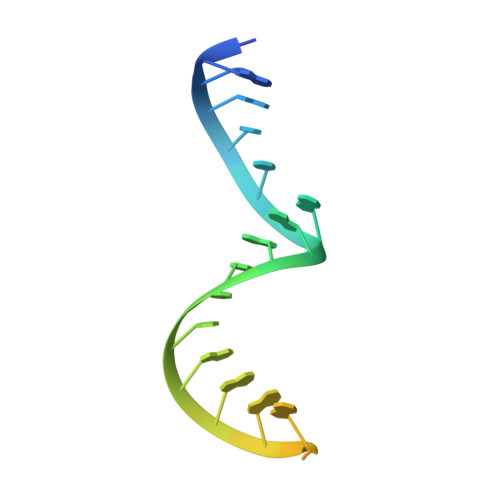
glmS triple mutant ribozyme27N/A
Sequence Annotations
Expand
Reference Sequence
Find similar nucleic acids by:  (by identity cutoff) 
Entity ID: 2
MoleculeChains LengthOrganismImage
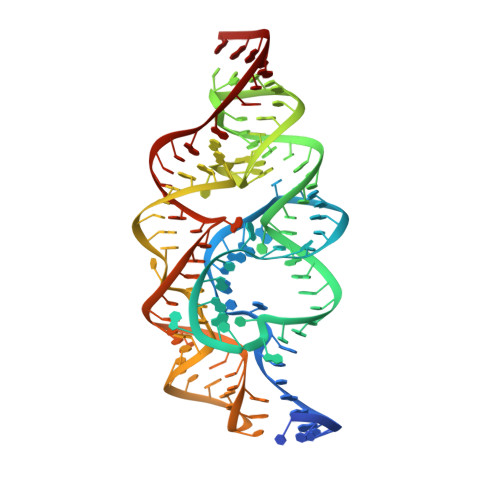
(121-MER) ribozyme126N/A
Sequence Annotations
Expand
Reference Sequence

Small Molecules

Ligands 1 Unique
IDChains Name / Formula / InChI Key2D Diagram3D Interactions
MG

Query on MG


Download:Ideal Coordinates CCD File
C [auth A]
D [auth B]
E [auth B]
F [auth B]
G [auth B]
C [auth A],
D [auth B],
E [auth B],
F [auth B],
G [auth B],
H [auth B],
I [auth B],
J [auth B],
K [auth B],
L [auth B],
M [auth B],
N [auth B],
O [auth B],
P [auth B],
Q [auth B],
R [auth B]
MAGNESIUM ION
Mg
JLVVSXFLKOJNIY-UHFFFAOYSA-N

Experimental Data & Validation

Experimental Data

  • Method: X-RAY DIFFRACTION
  • Resolution: 3.10 Å
  • R-Value Free:  0.252 (Depositor), 0.257 (DCC) 
  • R-Value Work:  0.197 (Depositor), 0.196 (DCC) 
  • R-Value Observed: 0.197 (Depositor) 
Space Group: P 21 21 2
Unit Cell:
Length ( Å )Angle ( ˚ )
a = 166.9α = 90
b = 40.4β = 90
c = 73.6γ = 90
Software Package:
Software NamePurpose
HKL-2000data collection
PHASERphasing
CNSrefinement
HKL-2000data reduction
HKL-2000data scaling

Structure Validation

View Full Validation Report


Entry History 

Deposition Data

Revision History  (Full details and data files)

  • Version 1.0: 2013-10-16
    Type: Initial release
  • Version 1.1: 2013-11-27
    Changes: Database references
  • Version 1.2: 2023-09-20
    Changes: Data collection, Database references, Derived calculations, Refinement description