4MAF | pdb_00004maf

Soybean ATP Sulfurylase


Experimental Data Snapshot

  • Method: X-RAY DIFFRACTION
  • Resolution: 2.48 Å
  • R-Value Free: 
    0.222 (Depositor), 0.234 (DCC) 
  • R-Value Work: 
    0.173 (Depositor), 0.188 (DCC) 
  • R-Value Observed: 
    0.175 (Depositor) 

Starting Model: experimental
View more details

wwPDB Validation 3D Report Full Report

Validation slider image for 4MAF

Ligand Structure Quality Assessment 


This is version 1.3 of the entry. See complete history

Literature

Structure and mechanism of soybean ATP sulfurylase and the committed step in plant sulfur assimilation.

Herrmann, J.Ravilious, G.E.McKinney, S.E.Westfall, C.S.Lee, S.G.Baraniecka, P.Giovannetti, M.Kopriva, S.Krishnan, H.B.Jez, J.M.

(2014) J Biological Chem 289: 10919-10929

  • DOI: https://doi.org/10.1074/jbc.M113.540401
  • Primary Citation Related Structures: 
    4MAF

  • PubMed Abstract: 

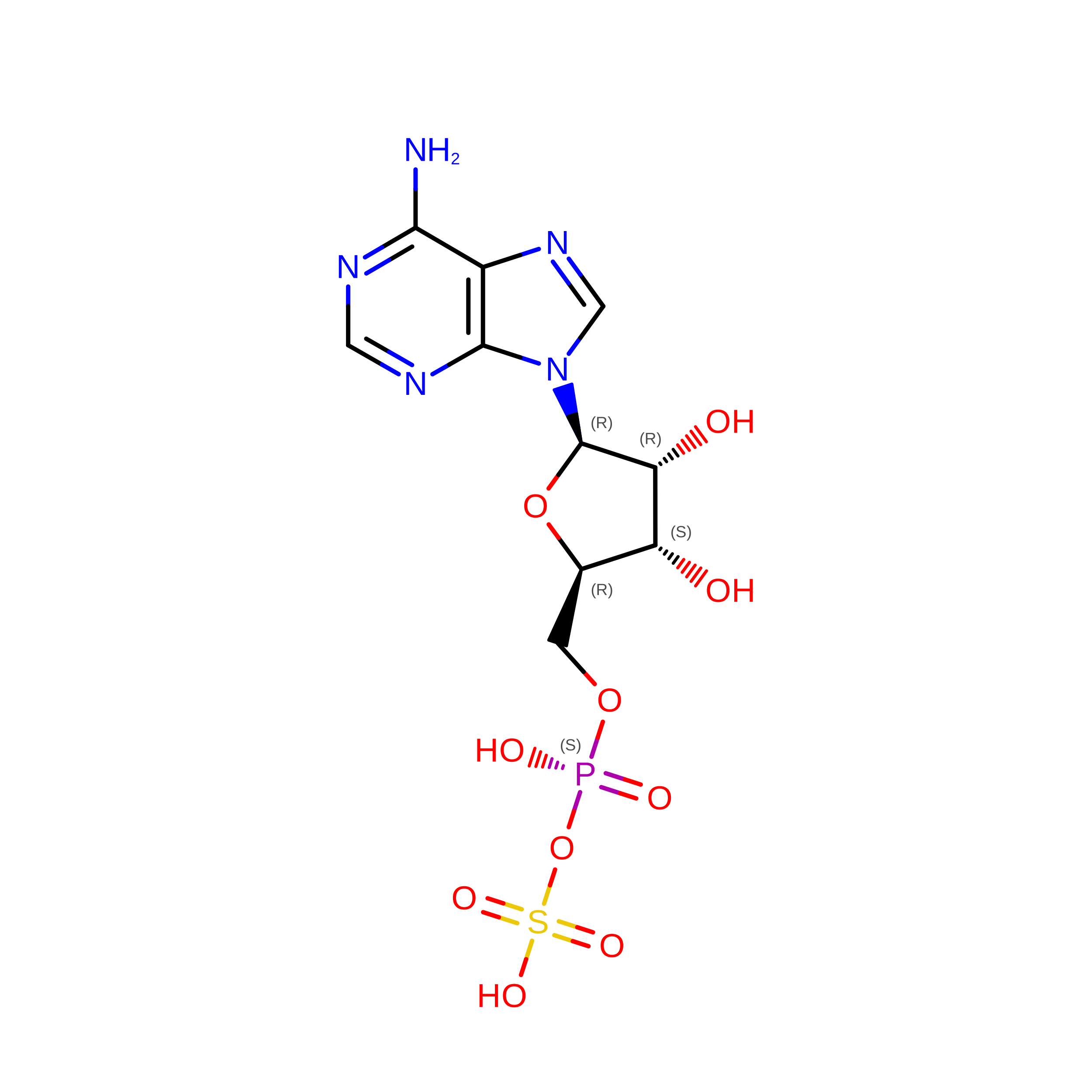
    Enzymes of the sulfur assimilation pathway are potential targets for improving nutrient content and environmental stress responses in plants. The committed step in this pathway is catalyzed by ATP sulfurylase, which synthesizes adenosine 5'-phosphosulfate (APS) from sulfate and ATP. To better understand the molecular basis of this energetically unfavorable reaction, the x-ray crystal structure of ATP sulfurylase isoform 1 from soybean (Glycine max ATP sulfurylase) in complex with APS was determined. This structure revealed several highly conserved substrate-binding motifs in the active site and a distinct dimerization interface compared with other ATP sulfurylases but was similar to mammalian 3'-phosphoadenosine 5'-phosphosulfate synthetase. Steady-state kinetic analysis of 20 G. max ATP sulfurylase point mutants suggests a reaction mechanism in which nucleophilic attack by sulfate on the α-phosphate of ATP involves transition state stabilization by Arg-248, Asn-249, His-255, and Arg-349. The structure and kinetic analysis suggest that ATP sulfurylase overcomes the energetic barrier of APS synthesis by distorting nucleotide structure and identifies critical residues for catalysis. Mutations that alter sulfate assimilation in Arabidopsis were mapped to the structure, which provides a molecular basis for understanding their effects on the sulfur assimilation pathway.


  • Organizational Affiliation
    • Department of Biology, Washington University, St. Louis, Missouri 63130.

Macromolecule Content 

  • Total Structure Weight: 368.16 kDa 
  • Atom Count: 26,495 
  • Modeled Residue Count: 3,199 
  • Deposited Residue Count: 3,232 
  • Unique protein chains: 1

Macromolecules

Find similar proteins by:|  3D Structure
Entity ID: 1
MoleculeChains  Sequence LengthOrganismDetailsImage
ATP sulfurylase
A, B, C, D, E
A, B, C, D, E, F, G, H
404Glycine maxMutation(s): 0 
EC: 2.7.7.4
UniProt
Find proteins for Q8SAG1 (Glycine max)
Explore Q8SAG1 
Go to UniProtKB:  Q8SAG1
Entity Groups
Sequence Clusters30% Identity50% Identity70% Identity90% Identity95% Identity100% Identity
UniProt GroupQ8SAG1
Sequence Annotations
Expand
Reference Sequence

Experimental Data & Validation

Experimental Data

  • Method: X-RAY DIFFRACTION
  • Resolution: 2.48 Å
  • R-Value Free:  0.222 (Depositor), 0.234 (DCC) 
  • R-Value Work:  0.173 (Depositor), 0.188 (DCC) 
  • R-Value Observed: 0.175 (Depositor) 
Space Group: C 2 2 2
Unit Cell:
Length ( Å )Angle ( ˚ )
a = 204.268α = 90
b = 230.751β = 90
c = 159.197γ = 90
Software Package:
Software NamePurpose
HKL-3000data collection
PHASERphasing
PHENIXrefinement
HKL-3000data reduction
HKL-3000data scaling

Structure Validation

View Full Validation Report


Ligand Structure Quality Assessment 


Entry History 

Deposition Data

Revision History  (Full details and data files)

  • Version 1.0: 2014-03-12
    Type: Initial release
  • Version 1.1: 2014-04-02
    Changes: Database references
  • Version 1.2: 2014-04-30
    Changes: Database references
  • Version 1.3: 2023-09-20
    Changes: Data collection, Database references, Derived calculations, Refinement description