Download Mendeley
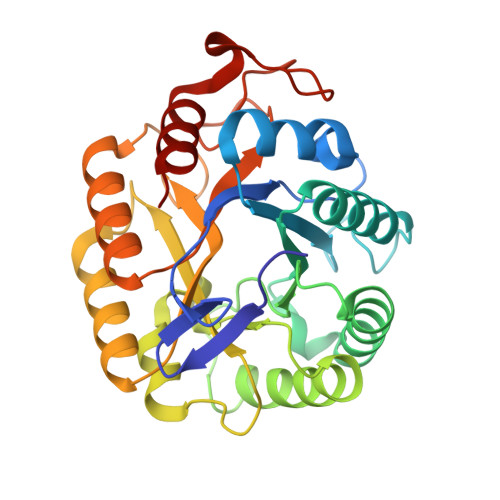
Structure and function of a novel cellulase 5 from sugarcane soil metagenome.
Alvarez, T.M., Paiva, J.H., Ruiz, D.M., Cairo, J.P., Pereira, I.O., Paixao, D.A., de Almeida, R.F., Tonoli, C.C., Ruller, R., Santos, C.R., Squina, F.M., Murakami, M.T.(2013) PLoS One 8: e83635-e83635
- PubMed: 24358302 Search on PubMedSearch on PubMed Central
- DOI: https://doi.org/10.1371/journal.pone.0083635
- Primary Citation Related Structures:
4M1R - PubMed Abstract:
Cellulases play a key role in enzymatic routes for degradation of plant cell-wall polysaccharides into simple and economically-relevant sugars. However, their low performance on complex substrates and reduced stability under industrial conditions remain the main obstacle for the large-scale production of cellulose-derived products and biofuels. Thus, in this study a novel cellulase with unusual catalytic properties from sugarcane soil metagenome (CelE1) was isolated and characterized. The polypeptide deduced from the celE1 gene encodes a unique glycoside hydrolase domain belonging to GH5 family. The recombinant enzyme was active on both carboxymethyl cellulose and β-glucan with an endo-acting mode according to capillary electrophoretic analysis of cleavage products. CelE1 showed optimum hydrolytic activity at pH 7.0 and 50 °C with remarkable activity at alkaline conditions that is attractive for industrial applications in which conventional acidic cellulases are not suitable. Moreover, its three-dimensional structure was determined at 1.8 Å resolution that allowed the identification of an insertion of eight residues in the β8-α8 loop of the catalytic domain of CelE1, which is not conserved in its psychrophilic orthologs. This 8-residue-long segment is a prominent and distinguishing feature of thermotolerant cellulases 5 suggesting that it might be involved with thermal stability. Based on its unconventional characteristics, CelE1 could be potentially employed in biotechnological processes that require thermotolerant and alkaline cellulases.
- Laboratório Nacional de Ciência e Tecnologia do Bioetanol (CTBE), Centro Nacional de Pesquisa em Energia e Materiais, Campinas, São Paulo, Brazil.
Organizational Affiliation: