4LXI | pdb_00004lxi

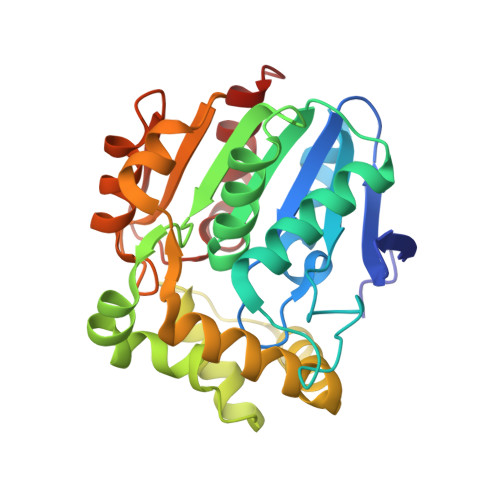
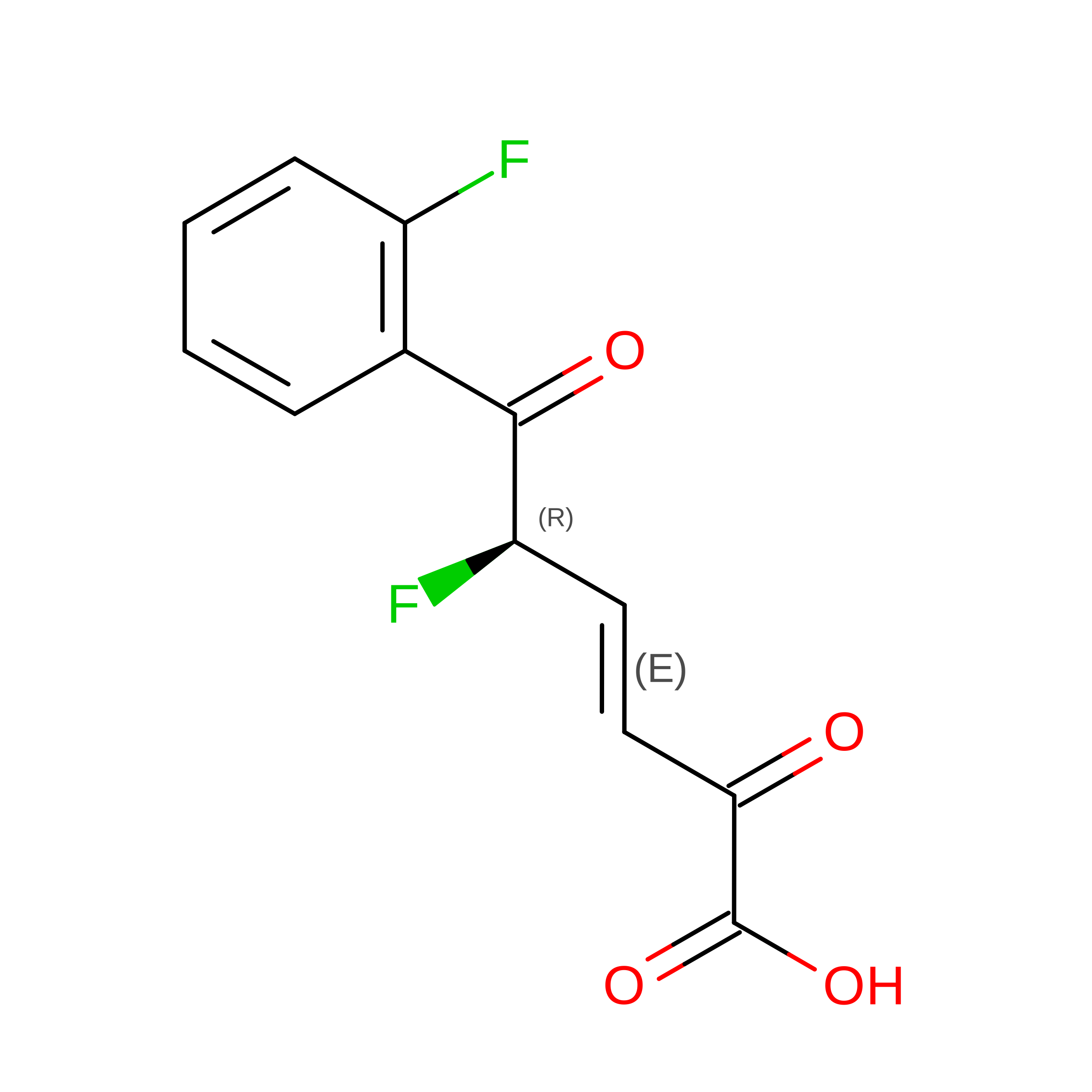
Crystal Structure of the S105A mutant of a carbon-carbon bond hydrolase, DxnB2 from Sphingomonas wittichii RW1, in complex with 5,8-diF HOPDA


Experimental Data Snapshot

  • Method: X-RAY DIFFRACTION
  • Resolution: 2.17 Å
  • R-Value Free: 
    0.258 (Depositor), 0.254 (DCC) 
  • R-Value Work: 
    0.204 (Depositor), 0.207 (DCC) 
  • R-Value Observed: 
    0.207 (Depositor) 

wwPDB Validation 3D Report Full Report

Validation slider image for 4LXI

Ligand Structure Quality Assessment 


This is version 1.3 of the entry. See complete history

Literature

A substrate-assisted mechanism of nucleophile activation in a ser-his-asp containing C-C bond hydrolase.

Ruzzini, A.C.Bhowmik, S.Ghosh, S.Yam, K.C.Bolin, J.T.Eltis, L.D.

(2013) Biochemistry 52: 7428-7438

  • DOI: https://doi.org/10.1021/bi401156a
  • Primary Citation Related Structures: 
    4LXI, 4LYE

  • PubMed Abstract: 

    The meta-cleavage product (MCP) hydrolases utilize a Ser-His-Asp triad to hydrolyze a carbon-carbon bond. Hydrolysis of the MCP substrate has been proposed to proceed via an enol-to-keto tautomerization followed by a nucleophilic mechanism of catalysis. Ketonization involves an intermediate, ES(red), which possesses a remarkable bathochromically shifted absorption spectrum. We investigated the catalytic mechanism of the MCP hydrolases using DxnB2 from Sphingomonas wittichii RW1. Pre-steady-state kinetic and LC ESI/MS evaluation of the DxnB2-mediated hydrolysis of 2-hydroxy-6-oxo-6-phenylhexa-2,4-dienoic acid to 2-hydroxy-2,4-pentadienoic acid and benzoate support a nucleophilic mechanism catalysis. In DxnB2, the rate of ES(red) decay and product formation showed a solvent kinetic isotope effect of 2.5, indicating that a proton transfer reaction, assigned here to substrate ketonization, limits the rate of acylation. For a series of substituted MCPs, this rate was linearly dependent on MCP pKa2 (βnuc ∼ 1). Structural characterization of DxnB2 S105A:MCP complexes revealed that the catalytic histidine is displaced upon substrate-binding. The results provide evidence for enzyme-catalyzed ketonization in which the catalytic His-Asp pair does not play an essential role. The data further suggest that ES(red) represents a dianionic intermediate that acts as a general base to activate the serine nucleophile. This substrate-assisted mechanism of nucleophilic catalysis distinguishes MCP hydrolases from other serine hydrolases.


  • Organizational Affiliation
    • Departments of †Biochemistry & Molecular Biology and ‡Microbiology & Immunology, The University of British Columbia , Vancouver, British Columbia V6T 1Z4, Canada.

Macromolecule Content 

  • Total Structure Weight: 30.49 kDa 
  • Atom Count: 2,197 
  • Modeled Residue Count: 276 
  • Deposited Residue Count: 277 
  • Unique protein chains: 1

Macromolecules

Find similar proteins by:|  3D Structure
Entity ID: 1
MoleculeChains  Sequence LengthOrganismDetailsImage
MCP Hydrolase277Rhizorhabdus wittichii RW1Mutation(s): 1 
Gene Names: dxnB2Swit_3055
EC: 3.7.1.8

Small Molecules

Ligands 2 Unique
IDChains Name / Formula / InChI Key2D Diagram3D Interactions
22J

Query on 22J


Download:Ideal Coordinates CCD File
B [auth A](3E,5R)-5-fluoro-6-(2-fluorophenyl)-2,6-dioxohex-3-enoic acid
C12 H8 F2 O4
YTBJKOAMJGQNPQ-VUHVRTRXSA-N
NA

Query on NA


Download:Ideal Coordinates CCD File
C [auth A]SODIUM ION
Na
FKNQFGJONOIPTF-UHFFFAOYSA-N

Experimental Data & Validation

Experimental Data

  • Method: X-RAY DIFFRACTION
  • Resolution: 2.17 Å
  • R-Value Free:  0.258 (Depositor), 0.254 (DCC) 
  • R-Value Work:  0.204 (Depositor), 0.207 (DCC) 
  • R-Value Observed: 0.207 (Depositor) 
Space Group: P 65 2 2
Unit Cell:
Length ( Å )Angle ( ˚ )
a = 66.155α = 90
b = 66.155β = 90
c = 342.18γ = 120
Software Package:
Software NamePurpose
REFMACrefinement
PDB_EXTRACTdata extraction
HKL-2000data reduction
HKL-2000data scaling
MOLREPphasing

Structure Validation

View Full Validation Report


Ligand Structure Quality Assessment 


Entry History 

Deposition Data

Revision History  (Full details and data files)

  • Version 1.0: 2013-10-09
    Type: Initial release
  • Version 1.1: 2013-11-06
    Changes: Database references
  • Version 1.2: 2017-11-15
    Changes: Refinement description
  • Version 1.3: 2024-02-28
    Changes: Data collection, Database references, Derived calculations