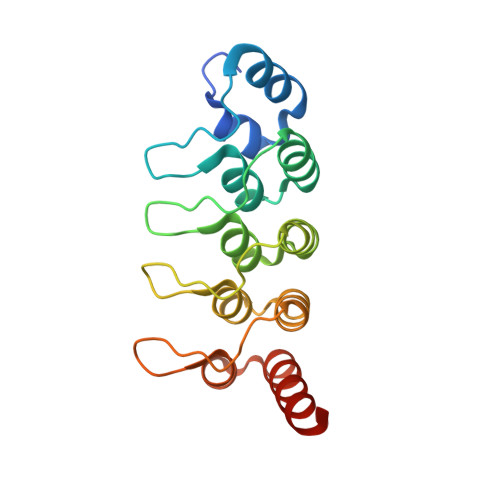
4LG6 | pdb_00004lg6

Crystal structure of ANKRA2-CCDC8 complex


Experimental Data Snapshot

  • Method: X-RAY DIFFRACTION
  • Resolution: 1.80 Å
  • R-Value Free: 
    0.208 (Depositor), 0.212 (DCC) 
  • R-Value Work: 
    0.196 (Depositor), 0.206 (DCC) 
  • R-Value Observed: 
    0.197 (Depositor) 

Starting Model: experimental
View more details

wwPDB Validation 3D Report Full Report

Validation slider image for 4LG6

This is version 1.3 of the entry. See complete history

Literature

Ankyrin Repeats of ANKRA2 Recognize a PxLPxL Motif on the 3M Syndrome Protein CCDC8.

Nie, J.Xu, C.Jin, J.Aka, J.A.Tempel, W.Nguyen, V.You, L.Weist, R.Min, J.Pawson, T.Yang, X.J.

(2015) Structure 23: 700-712

  • DOI: https://doi.org/10.1016/j.str.2015.02.001
  • Primary Citation Related Structures: 
    4LG6

  • PubMed Abstract: 

    Peptide motifs are often used for protein-protein interactions. We have recently demonstrated that ankyrin repeats of ANKRA2 and the paralogous bare lymphocyte syndrome transcription factor RFXANK recognize PxLPxL/I motifs shared by megalin, three histone deacetylases, and RFX5. We show here that that CCDC8 is a major partner of ANKRA2 but not RFXANK in cells. The CCDC8 gene is mutated in 3M syndrome, a short-stature disorder with additional facial and skeletal abnormalities. Two other genes mutated in this syndrome encode CUL7 and OBSL1. While CUL7 is a ubiquitin ligase and OBSL1 associates with the cytoskeleton, little is known about CCDC8. Binding and structural analyses reveal that the ankyrin repeats of ANKRA2 recognize a PxLPxL motif at the C-terminal region of CCDC8. The N-terminal part interacts with OBSL1 to form a CUL7 ligase complex. These results link ANKRA2 unexpectedly to 3M syndrome and suggest novel regulatory mechanisms for histone deacetylases and RFX7.


  • Organizational Affiliation
    • The Rosalind & Morris Goodman Cancer Research Center, Department of Medicine, McGill University, Montréal, QC H3A 1A3, Canada; Department of Breast Cancer, The Third Affiliated Hospital, Kunming Medical University, Yunnan 650118, China.

Macromolecule Content 

  • Total Structure Weight: 20.86 kDa 
  • Atom Count: 1,389 
  • Modeled Residue Count: 176 
  • Deposited Residue Count: 190 
  • Unique protein chains: 2

Macromolecules

Find similar proteins by:|  3D Structure
Entity ID: 1
MoleculeChains  Sequence LengthOrganismDetailsImage
Ankyrin repeat family A protein 2173Homo sapiensMutation(s): 0 
Gene Names: ANKRA2ANKRA
UniProt & NIH Common Fund Data Resources
Find proteins for Q9H9E1 (Homo sapiens)
Explore Q9H9E1 
Go to UniProtKB:  Q9H9E1
PHAROS:  Q9H9E1
GTEx:  ENSG00000164331 
Entity Groups
Sequence Clusters30% Identity50% Identity70% Identity90% Identity95% Identity100% Identity
UniProt GroupQ9H9E1
Sequence Annotations
Expand
Reference Sequence
Find similar proteins by:  Sequence   |   3D Structure  
Entity ID: 2
MoleculeChains  Sequence LengthOrganismDetailsImage
Coiled-coil domain-containing protein 817Homo sapiensMutation(s): 0 
UniProt & NIH Common Fund Data Resources
Find proteins for Q9H0W5 (Homo sapiens)
Explore Q9H0W5 
Go to UniProtKB:  Q9H0W5
PHAROS:  Q9H0W5
GTEx:  ENSG00000169515 
Entity Groups
Sequence Clusters30% Identity50% Identity70% Identity90% Identity95% Identity100% Identity
UniProt GroupQ9H0W5
Sequence Annotations
Expand
Reference Sequence

Experimental Data & Validation

Experimental Data

  • Method: X-RAY DIFFRACTION
  • Resolution: 1.80 Å
  • R-Value Free:  0.208 (Depositor), 0.212 (DCC) 
  • R-Value Work:  0.196 (Depositor), 0.206 (DCC) 
  • R-Value Observed: 0.197 (Depositor) 
Space Group: P 1 21 1
Unit Cell:
Length ( Å )Angle ( ˚ )
a = 38.726α = 90
b = 49.791β = 98.23
c = 41.243γ = 90
Software Package:
Software NamePurpose
SCALAdata scaling
PHASERphasing
REFMACrefinement
PDB_EXTRACTdata extraction
XDSdata reduction

Structure Validation

View Full Validation Report


Entry History 

Deposition Data

Revision History  (Full details and data files)

  • Version 1.0: 2013-09-25
    Type: Initial release
  • Version 1.1: 2015-03-18
    Changes: Database references
  • Version 1.2: 2015-04-29
    Changes: Database references
  • Version 1.3: 2023-09-20
    Changes: Data collection, Database references, Refinement description