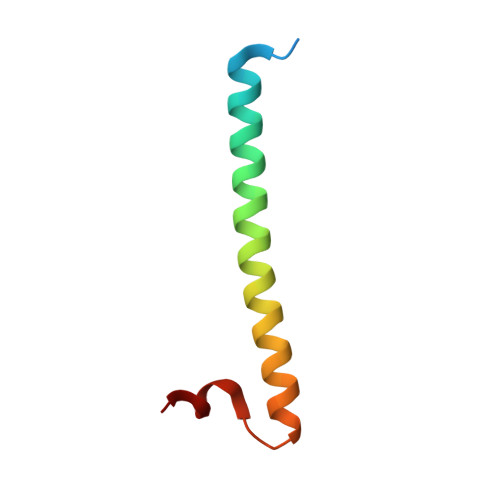
4L9U | pdb_00004l9u

Structure of C-terminal coiled coil of RasGRP1


Experimental Data Snapshot

  • Method: X-RAY DIFFRACTION
  • Resolution: 1.60 Å
  • R-Value Free: 
    0.235 (Depositor), 0.229 (DCC) 
  • R-Value Work: 
    0.201 (Depositor) 
  • R-Value Observed: 
    0.202 (Depositor) 

wwPDB Validation 3D Report Full Report

Validation slider image for 4L9U

This is version 1.1 of the entry. See complete history

Literature

Structural analysis of autoinhibition in the Ras-specific exchange factor RasGRP1.

Iwig, J.S.Vercoulen, Y.Das, R.Barros, T.Limnander, A.Che, Y.Pelton, J.G.Wemmer, D.E.Roose, J.P.Kuriyan, J.

(2013) Elife 2: e00813-e00813

  • DOI: https://doi.org/10.7554/eLife.00813
  • Primary Citation Related Structures: 
    2MA2, 4L9M, 4L9U

  • PubMed Abstract: 

    RasGRP1 and SOS are Ras-specific nucleotide exchange factors that have distinct roles in lymphocyte development. RasGRP1 is important in some cancers and autoimmune diseases but, in contrast to SOS, its regulatory mechanisms are poorly understood. Activating signals lead to the membrane recruitment of RasGRP1 and Ras engagement, but it is unclear how interactions between RasGRP1 and Ras are suppressed in the absence of such signals. We present a crystal structure of a fragment of RasGRP1 in which the Ras-binding site is blocked by an interdomain linker and the membrane-interaction surface of RasGRP1 is hidden within a dimerization interface that may be stabilized by the C-terminal oligomerization domain. NMR data demonstrate that calcium binding to the regulatory module generates substantial conformational changes that are incompatible with the inactive assembly. These features allow RasGRP1 to be maintained in an inactive state that is poised for activation by calcium and membrane-localization signals. DOI:http://dx.doi.org/10.7554/eLife.00813.001.


  • Organizational Affiliation
    • Department of Molecular and Cell Biology , University of California, Berkeley , Berkeley , United States ; California Institute for Quantitative Biosciences , University of California, Berkeley , Berkeley , United States.

Macromolecule Content 

  • Total Structure Weight: 13.63 kDa 
  • Atom Count: 879 
  • Modeled Residue Count: 91 
  • Deposited Residue Count: 112 
  • Unique protein chains: 1

Macromolecules

Find similar proteins by:|  3D Structure
Entity ID: 1
MoleculeChains  Sequence LengthOrganismDetailsImage
RAS guanyl-releasing protein 1
A, B
56Homo sapiensMutation(s): 0 
Gene Names: RASGRP1RASGRP
UniProt & NIH Common Fund Data Resources
Find proteins for O95267 (Homo sapiens)
Explore O95267 
Go to UniProtKB:  O95267
PHAROS:  O95267
GTEx:  ENSG00000172575 
Entity Groups
Sequence Clusters30% Identity50% Identity70% Identity90% Identity95% Identity100% Identity
UniProt GroupO95267
Sequence Annotations
Expand
Reference Sequence

Experimental Data & Validation

Experimental Data

  • Method: X-RAY DIFFRACTION
  • Resolution: 1.60 Å
  • R-Value Free:  0.235 (Depositor), 0.229 (DCC) 
  • R-Value Work:  0.201 (Depositor) 
  • R-Value Observed: 0.202 (Depositor) 
Space Group: P 21 21 2
Unit Cell:
Length ( Å )Angle ( ˚ )
a = 24.878α = 90
b = 165.047β = 90
c = 28.319γ = 90
Software Package:
Software NamePurpose
ADSCdata collection
PHASERphasing
PHENIXrefinement
XDSdata reduction
SCALAdata scaling

Structure Validation

View Full Validation Report


Entry History 

Deposition Data

Revision History  (Full details and data files)

  • Version 1.0: 2013-08-21
    Type: Initial release
  • Version 1.1: 2024-02-28
    Changes: Data collection, Database references, Derived calculations