4L8H | pdb_00004l8h

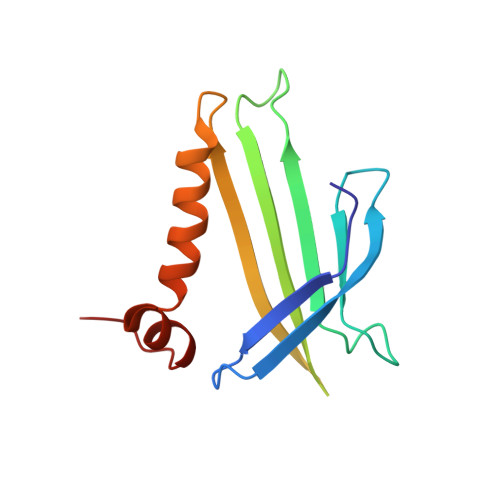
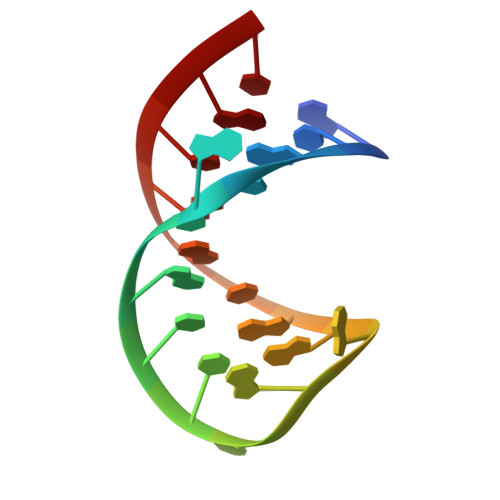
Bacteriophage Qbeta coat protein in complex with RNA operator hairpin


Experimental Data Snapshot

  • Method: X-RAY DIFFRACTION
  • Resolution: 2.40 Å
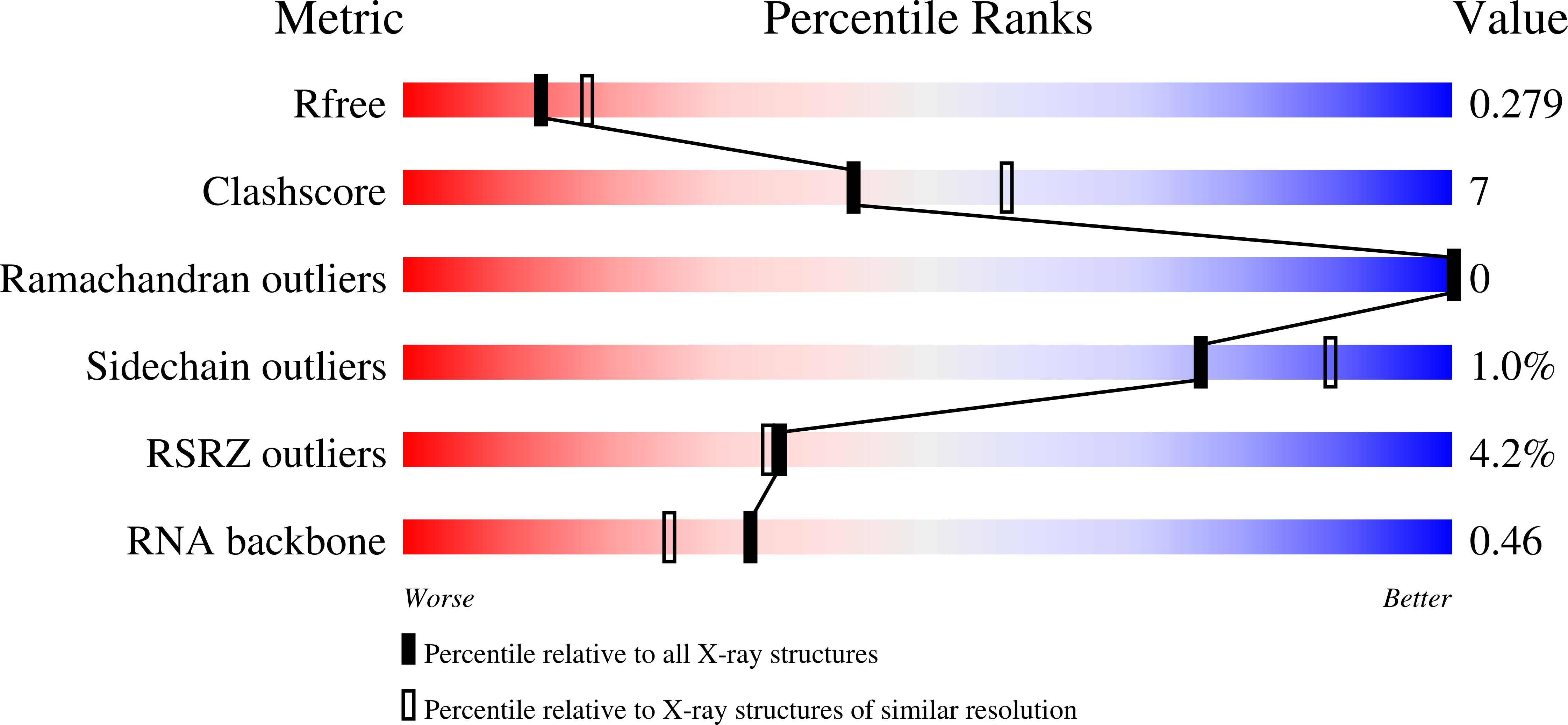
  • R-Value Free: 
    0.288 (Depositor), 0.279 (DCC) 
  • R-Value Work: 
    0.253 (Depositor), 0.247 (DCC) 
  • R-Value Observed: 
    0.255 (Depositor) 

Starting Model: experimental
View more details

wwPDB Validation 3D Report Full Report

Validation slider image for 4L8H

This is version 1.3 of the entry. See complete history

Literature

Crystal structure of the bacteriophage q beta coat protein in complex with the RNA operator of the replicase gene.

Rumnieks, J.Tars, K.

(2014) J Mol Biology 426: 1039-1049

  • DOI: https://doi.org/10.1016/j.jmb.2013.08.025
  • Primary Citation Related Structures: 
    4L8H

  • PubMed Abstract: 

    The coat proteins of single-stranded RNA bacteriophages specifically recognize and bind to a hairpin structure in their genome at the beginning of the replicase gene. The interaction serves to repress the synthesis of the replicase enzyme late in infection and contributes to the specific encapsidation of phage RNA. While this mechanism is conserved throughout the Leviviridae family, the coat protein and operator sequences from different phages show remarkable variation, serving as prime examples for the co-evolution of protein and RNA structure. To better understand the protein-RNA interactions in this virus family, we have determined the three-dimensional structure of the coat protein from bacteriophage Qβ bound to its cognate translational operator. The RNA binding mode of Qβ coat protein shares several features with that of the widely studied phage MS2, but only one nucleotide base in the hairpin loop makes sequence-specific contacts with the protein. Unlike in other RNA phages, the Qβ coat protein does not utilize an adenine-recognition pocket for binding a bulged adenine base in the hairpin stem but instead uses a stacking interaction with a tyrosine side chain to accommodate the base. The extended loop between β strands E and F of Qβ coat protein makes contacts with the lower part of the RNA stem, explaining the greater length dependence of the RNA helix for optimal binding to the protein. Consequently, the complex structure allows the proposal of a mechanism by which the Qβ coat protein recognizes and discriminates in favor of its cognate RNA.


  • Organizational Affiliation
    • Biomedical Research and Study Center, Ratsupites 1, Riga LV1067, Latvia.

Macromolecule Content 

  • Total Structure Weight: 35.08 kDa 
  • Atom Count: 2,374 
  • Modeled Residue Count: 264 
  • Deposited Residue Count: 284 
  • Unique protein chains: 1
  • Unique nucleic acid chains: 1

Macromolecules


Find similar proteins by:|  3D Structure
Entity ID: 1
MoleculeChains  Sequence LengthOrganismDetailsImage
Coat protein
A, B
132Qubevirus durumMutation(s): 4 
Gene Names: coat
UniProt
Find proteins for P03615 (Escherichia virus Qbeta)
Explore P03615 
Go to UniProtKB:  P03615
Entity Groups
Sequence Clusters30% Identity50% Identity70% Identity90% Identity95% Identity100% Identity
UniProt GroupP03615
Sequence Annotations
Expand
Reference Sequence
Find similar nucleic acids by:  Sequence
Entity ID: 2
MoleculeChains LengthOrganismImage
RNA operator hairpinC [auth R]20N/A
Sequence Annotations
Expand
Reference Sequence

Experimental Data & Validation

Experimental Data

  • Method: X-RAY DIFFRACTION
  • Resolution: 2.40 Å
  • R-Value Free:  0.288 (Depositor), 0.279 (DCC) 
  • R-Value Work:  0.253 (Depositor), 0.247 (DCC) 
  • R-Value Observed: 0.255 (Depositor) 
Space Group: P 65 2 2
Unit Cell:
Length ( Å )Angle ( ˚ )
a = 75.84α = 90
b = 75.84β = 90
c = 303.49γ = 120
Software Package:
Software NamePurpose
MAR345data collection
MOLREPphasing
REFMACrefinement
MOSFLMdata reduction
SCALAdata scaling

Structure Validation

View Full Validation Report


Entry History 

Deposition Data

Revision History  (Full details and data files)

  • Version 1.0: 2013-10-02
    Type: Initial release
  • Version 1.1: 2014-03-05
    Changes: Database references
  • Version 1.2: 2017-11-15
    Changes: Data collection, Refinement description
  • Version 1.3: 2023-09-20
    Changes: Data collection, Database references, Derived calculations, Refinement description