4L58 | pdb_00004l58

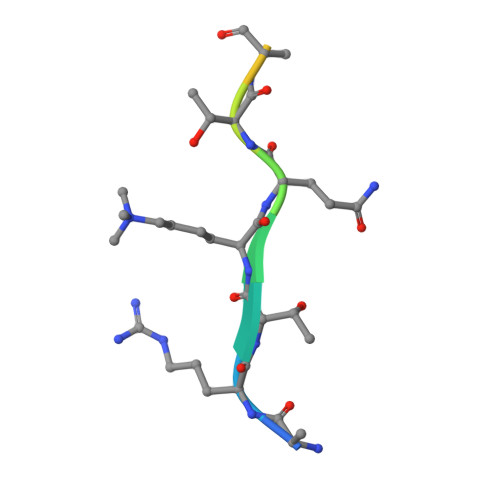
Crystal structure of the MLL5 PHD finger in complex with H3K4me3


Experimental Data Snapshot

  • Method: X-RAY DIFFRACTION
  • Resolution: 1.48 Å
  • R-Value Free: 
    0.140 (Depositor), 0.141 (DCC) 
  • R-Value Work: 
    0.125 (Depositor), 0.126 (DCC) 
  • R-Value Observed: 
    0.126 (Depositor) 

wwPDB Validation 3D Report Full Report

Validation slider image for 4L58

This is version 1.3 of the entry. See complete history

Literature

Molecular basis for chromatin binding and regulation of MLL5.

Ali, M.Rincon-Arano, H.Zhao, W.Rothbart, S.B.Tong, Q.Parkhurst, S.M.Strahl, B.D.Deng, L.W.Groudine, M.Kutateladze, T.G.

(2013) Proc Natl Acad Sci U S A 110: 11296-11301

  • DOI: https://doi.org/10.1073/pnas.1310156110
  • Primary Citation Related Structures: 
    4L58

  • PubMed Abstract: 

    The human mixed-lineage leukemia 5 (MLL5) protein mediates hematopoietic cell homeostasis, cell cycle, and survival; however, the molecular basis underlying MLL5 activities remains unknown. Here, we show that MLL5 is recruited to gene-rich euchromatic regions via the interaction of its plant homeodomain finger with the histone mark H3K4me3. The 1.48-Å resolution crystal structure of MLL5 plant homeodomain in complex with the H3K4me3 peptide reveals a noncanonical binding mechanism, whereby K4me3 is recognized through a single aromatic residue and an aspartate. The binding induces a unique His-Asp swapping rearrangement mediated by a C-terminal α-helix. Phosphorylation of H3T3 and H3T6 abrogates the association with H3K4me3 in vitro and in vivo, releasing MLL5 from chromatin in mitosis. This regulatory switch is conserved in the Drosophila ortholog of MLL5, UpSET, and suggests the developmental control for targeting of H3K4me3. Together, our findings provide first insights into the molecular basis for the recruitment, exclusion, and regulation of MLL5 at chromatin.


  • Organizational Affiliation
    • Department of Pharmacology, University of Colorado School of Medicine, Aurora, CO 80045, USA.

Macromolecule Content 

  • Total Structure Weight: 9.67 kDa 
  • Atom Count: 718 
  • Modeled Residue Count: 72 
  • Deposited Residue Count: 81 
  • Unique protein chains: 2

Macromolecules

Find similar proteins by:|  3D Structure
Entity ID: 1
MoleculeChains  Sequence LengthOrganismDetailsImage
Histone-lysine N-methyltransferase MLL569Homo sapiensMutation(s): 0 
Gene Names: MLL5KMT2E
EC: 2.1.1.43
UniProt & NIH Common Fund Data Resources
Find proteins for Q8IZD2 (Homo sapiens)
Explore Q8IZD2 
Go to UniProtKB:  Q8IZD2
PHAROS:  Q8IZD2
GTEx:  ENSG00000005483 
Entity Groups
Sequence Clusters30% Identity50% Identity70% Identity90% Identity95% Identity100% Identity
UniProt GroupQ8IZD2
Sequence Annotations
Expand
Reference Sequence
Find similar proteins by:  Sequence   |   3D Structure  
Entity ID: 2
MoleculeChains  Sequence LengthOrganismDetailsImage
Histone H3 peptide12Homo sapiensMutation(s): 0 
UniProt & NIH Common Fund Data Resources
Find proteins for P84243 (Homo sapiens)
Explore P84243 
Go to UniProtKB:  P84243
Entity Groups
Sequence Clusters30% Identity50% Identity70% Identity90% Identity95% Identity100% Identity
UniProt GroupP84243
Sequence Annotations
Expand
Reference Sequence

Small Molecules

Modified Residues  1 Unique
IDChains TypeFormula2D DiagramParent
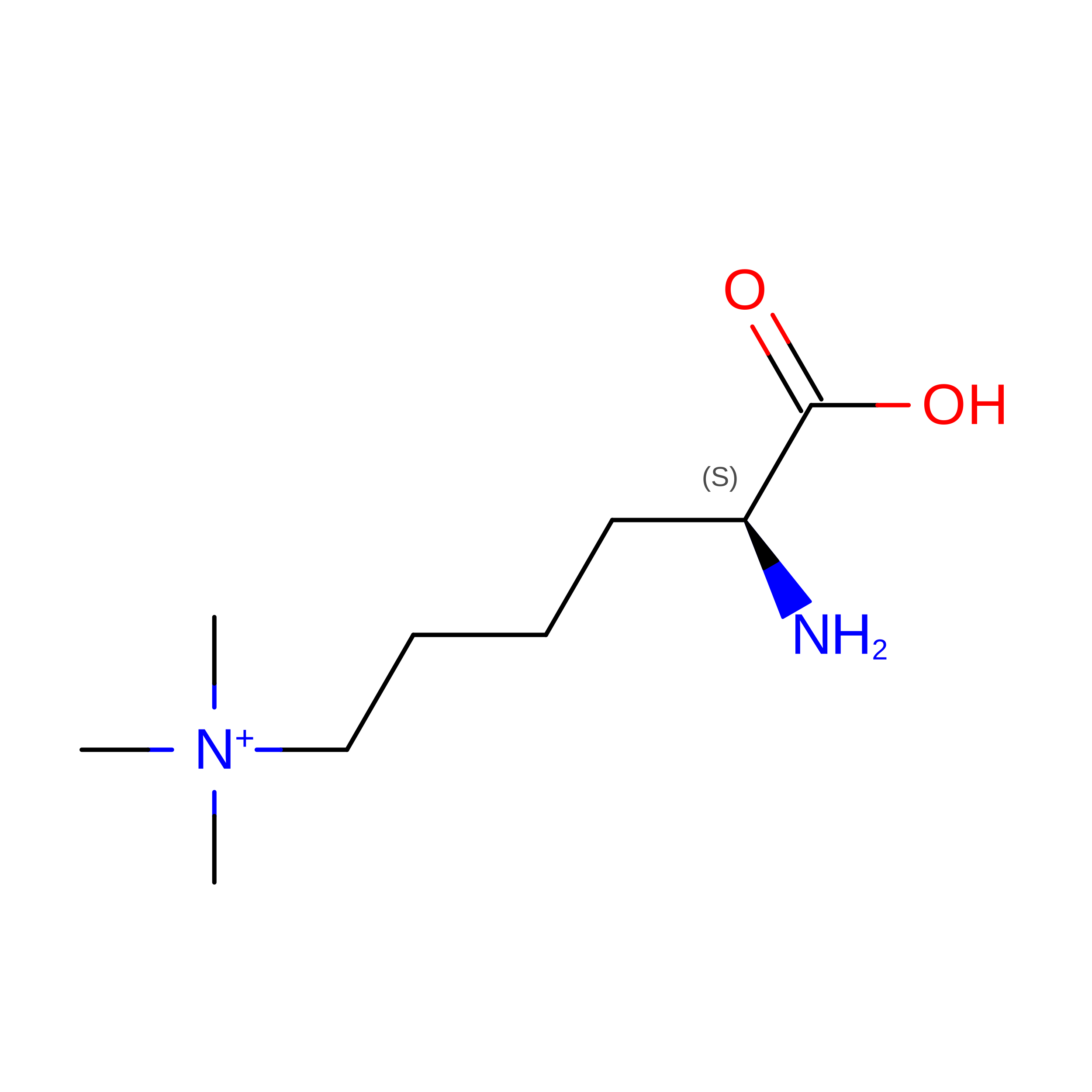
M3L
Query on M3L
B
L-PEPTIDE LINKINGC9 H21 N2 O2LYS

Experimental Data & Validation

Experimental Data

  • Method: X-RAY DIFFRACTION
  • Resolution: 1.48 Å
  • R-Value Free:  0.140 (Depositor), 0.141 (DCC) 
  • R-Value Work:  0.125 (Depositor), 0.126 (DCC) 
  • R-Value Observed: 0.126 (Depositor) 
Space Group: P 21 21 21
Unit Cell:
Length ( Å )Angle ( ˚ )
a = 31.286α = 90
b = 43.638β = 90
c = 52.856γ = 90
Software Package:
Software NamePurpose
ADSCdata collection
PHENIXmodel building
PHENIXrefinement
HKL-2000data reduction
HKL-2000data scaling
PHENIXphasing

Structure Validation

View Full Validation Report


Entry History 

Deposition Data

Revision History  (Full details and data files)

  • Version 1.0: 2013-06-26
    Type: Initial release
  • Version 1.1: 2013-07-17
    Changes: Database references
  • Version 1.2: 2013-07-24
    Changes: Database references
  • Version 1.3: 2025-03-26
    Changes: Data collection, Database references, Derived calculations, Structure summary