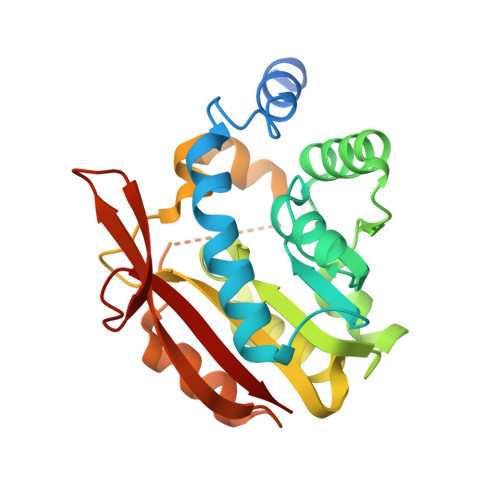
4KDC | pdb_00004kdc

Crystal Structure of UBIG


Experimental Data Snapshot

  • Method: X-RAY DIFFRACTION
  • Resolution: 2.09 Å
  • R-Value Free: 
    0.225 (Depositor), 0.226 (DCC) 
  • R-Value Work: 
    0.183 (Depositor), 0.189 (DCC) 
  • R-Value Observed: 
    0.185 (Depositor) 

wwPDB Validation 3D Report Full Report

Validation slider image for 4KDC

This is version 1.2 of the entry. See complete history

Literature

Structural and biochemical studies reveal UbiG/Coq3 as a class of novel membrane-binding proteins.

Zhu, Y.Wu, B.Zhang, X.Fan, X.Niu, L.Li, X.Wang, J.Teng, M.

(2015) Biochem J 470: 105-114

  • DOI: https://doi.org/10.1042/BJ20150329
  • Primary Citation Related Structures: 
    4KDC

  • PubMed Abstract: 

    UbiG and Coq3 (orthologue in eukaryotes) are SAM-MTases (S-adenosylmethionine-dependent methyltransferases) that catalyse both O-methylation steps in CoQ biosynthesis from prokaryotes to eukaryotes. However, the detailed molecular mechanism by which they function remains elusive. In the present paper, we report that UbiG/Coq3 defines a novel class of membrane-binding proteins. Escherichia coli UbiG binds specifically to liposomes containing PG (phosphatidylglycerol) or CL (cardiolipin, or diphosphatidylglycerol), two major lipid components of the E. coli plasma membrane, whereas human and yeast Coq3 display a strong preference for liposomes enriched with CL, a signature lipid of the mitochondrial membrane. The crystal structure of UbiG from E. coli was determined at 2.1 Å (1 Å = 0.1 nm) resolution. The structure exhibits a typical Class I SAM-MTase fold with several variations, including a unique insertion between strand β5 and helix α10. This insertion is highly conserved and is required for membrane binding. Mutation of the key residues renders UbiG unable to efficiently bind liposome in vitro and the mutant fails to rescue the phenotype of ΔubiG strain in vivo. Taken together, our results shed light on a novel biochemical function of the UbiG/Coq3 protein.


  • Organizational Affiliation
    • Hefei National Laboratory for Physical Sciences at Microscale and School of Life Sciences, University of Science and Technology of China, Hefei, Anhui 230026, People's Republic of China.

Macromolecule Content 

  • Total Structure Weight: 27.42 kDa 
  • Atom Count: 1,718 
  • Modeled Residue Count: 217 
  • Deposited Residue Count: 246 
  • Unique protein chains: 1

Macromolecules

Find similar proteins by:|  3D Structure
Entity ID: 1
MoleculeChains  Sequence LengthOrganismDetailsImage
3-demethylubiquinone-9 3-methyltransferase246Escherichia coli K-12Mutation(s): 0 
Gene Names: ubiGpufXyfaBb2232JW2226
EC: 2.1.1.64 (PDB Primary Data), 2.1.1.222 (PDB Primary Data)
UniProt
Find proteins for P17993 (Escherichia coli (strain K12))
Explore P17993 
Go to UniProtKB:  P17993
Entity Groups
Sequence Clusters30% Identity50% Identity70% Identity90% Identity95% Identity100% Identity
UniProt GroupP17993
Sequence Annotations
Expand
Reference Sequence

Experimental Data & Validation

Experimental Data

  • Method: X-RAY DIFFRACTION
  • Resolution: 2.09 Å
  • R-Value Free:  0.225 (Depositor), 0.226 (DCC) 
  • R-Value Work:  0.183 (Depositor), 0.189 (DCC) 
  • R-Value Observed: 0.185 (Depositor) 
Space Group: C 1 2 1
Unit Cell:
Length ( Å )Angle ( ˚ )
a = 119.848α = 90
b = 58.584β = 105.26
c = 40.168γ = 90
Software Package:
Software NamePurpose
HKL-2000data collection
MOLREPphasing
REFMACrefinement
HKL-2000data reduction
SCALAdata scaling

Structure Validation

View Full Validation Report


Entry History 

Deposition Data

Revision History  (Full details and data files)

  • Version 1.0: 2014-04-30
    Type: Initial release
  • Version 1.1: 2018-01-24
    Changes: Database references
  • Version 1.2: 2024-02-28
    Changes: Data collection, Database references