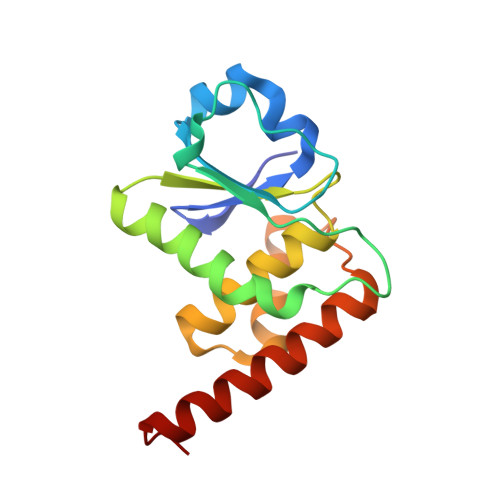
4JMK | pdb_00004jmk

Structure of dusp8


Experimental Data Snapshot

  • Method: X-RAY DIFFRACTION
  • Resolution: 1.90 Å
  • R-Value Free: 
    0.207 (Depositor), 0.216 (DCC) 
  • R-Value Work: 
    0.176 (Depositor), 0.190 (DCC) 
  • R-Value Observed: 
    0.178 (Depositor) 

Starting Model: experimental
View more details

wwPDB Validation 3D Report Full Report

Validation slider image for 4JMK

This is version 1.2 of the entry. See complete history

Literature

The family-wide structure and function of human dual-specificity protein phosphatases.

Jeong, D.G.Wei, C.H.Ku, B.Jeon, T.J.Chien, P.N.Kim, J.K.Park, S.Y.Hwang, H.S.Ryu, S.Y.Park, H.Kim, D.S.Kim, S.J.Ryu, S.E.

(2014) Acta Crystallogr D Biol Crystallogr 70: 421-435

  • DOI: https://doi.org/10.1107/S1399004713029866
  • Primary Citation Related Structures: 
    4JMJ, 4JMK, 4JNB, 4KI9

  • PubMed Abstract: 

    Dual-specificity protein phosphatases (DUSPs), which dephosphorylate both phosphoserine/threonine and phosphotyrosine, play vital roles in immune activation, brain function and cell-growth signalling. A family-wide structural library of human DUSPs was constructed based on experimental structure determination supplemented with homology modelling. The catalytic domain of each individual DUSP has characteristic features in the active site and in surface-charge distribution, indicating substrate-interaction specificity. The active-site loop-to-strand switch occurs in a subtype-specific manner, indicating that the switch process is necessary for characteristic substrate interactions in the corresponding DUSPs. A comprehensive analysis of the activity-inhibition profile and active-site geometry of DUSPs revealed a novel role of the active-pocket structure in the substrate specificity of DUSPs. A structure-based analysis of redox responses indicated that the additional cysteine residues are important for the protection of enzyme activity. The family-wide structures of DUSPs form a basis for the understanding of phosphorylation-mediated signal transduction and the development of therapeutics.


  • Organizational Affiliation
    • Medical Proteomics Research Center, KRIBB, Daejeon, Republic of Korea.

Macromolecule Content 

  • Total Structure Weight: 34.7 kDa 
  • Atom Count: 2,522 
  • Modeled Residue Count: 296 
  • Deposited Residue Count: 304 
  • Unique protein chains: 1

Macromolecules

Find similar proteins by:|  3D Structure
Entity ID: 1
MoleculeChains  Sequence LengthOrganismDetailsImage
Dual specificity protein phosphatase 8
A, B
152Homo sapiensMutation(s): 1 
Gene Names: DUSP8C11orf81VH5
EC: 3.1.3.16 (PDB Primary Data), 3.1.3.48 (PDB Primary Data)
UniProt & NIH Common Fund Data Resources
Find proteins for Q13202 (Homo sapiens)
Explore Q13202 
Go to UniProtKB:  Q13202
PHAROS:  Q13202
GTEx:  ENSG00000184545 
Entity Groups
Sequence Clusters30% Identity50% Identity70% Identity90% Identity95% Identity100% Identity
UniProt GroupQ13202
Sequence Annotations
Expand
Reference Sequence

Experimental Data & Validation

Experimental Data

  • Method: X-RAY DIFFRACTION
  • Resolution: 1.90 Å
  • R-Value Free:  0.207 (Depositor), 0.216 (DCC) 
  • R-Value Work:  0.176 (Depositor), 0.190 (DCC) 
  • R-Value Observed: 0.178 (Depositor) 
Space Group: P 41 21 2
Unit Cell:
Length ( Å )Angle ( ˚ )
a = 65.85α = 90
b = 65.85β = 90
c = 124.5γ = 90
Software Package:
Software NamePurpose
ADSCdata collection
AMoREphasing
CNSrefinement
MOSFLMdata reduction
SCALAdata scaling
PHENIXrefinement

Structure Validation

View Full Validation Report


Entry History 

Deposition Data

Revision History  (Full details and data files)

  • Version 1.0: 2014-02-26
    Type: Initial release
  • Version 1.1: 2019-12-25
    Changes: Database references
  • Version 1.2: 2023-11-08
    Changes: Data collection, Database references, Derived calculations, Refinement description