4JL4 | pdb_00004jl4

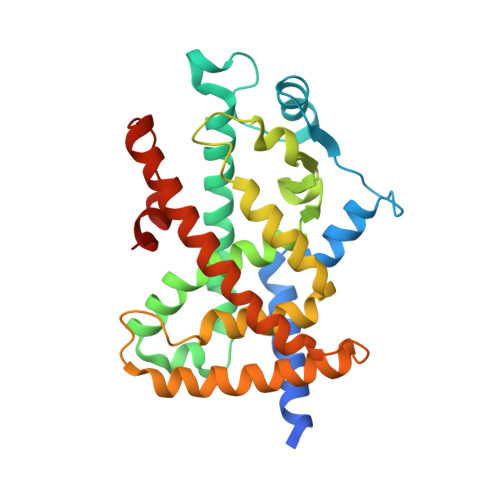
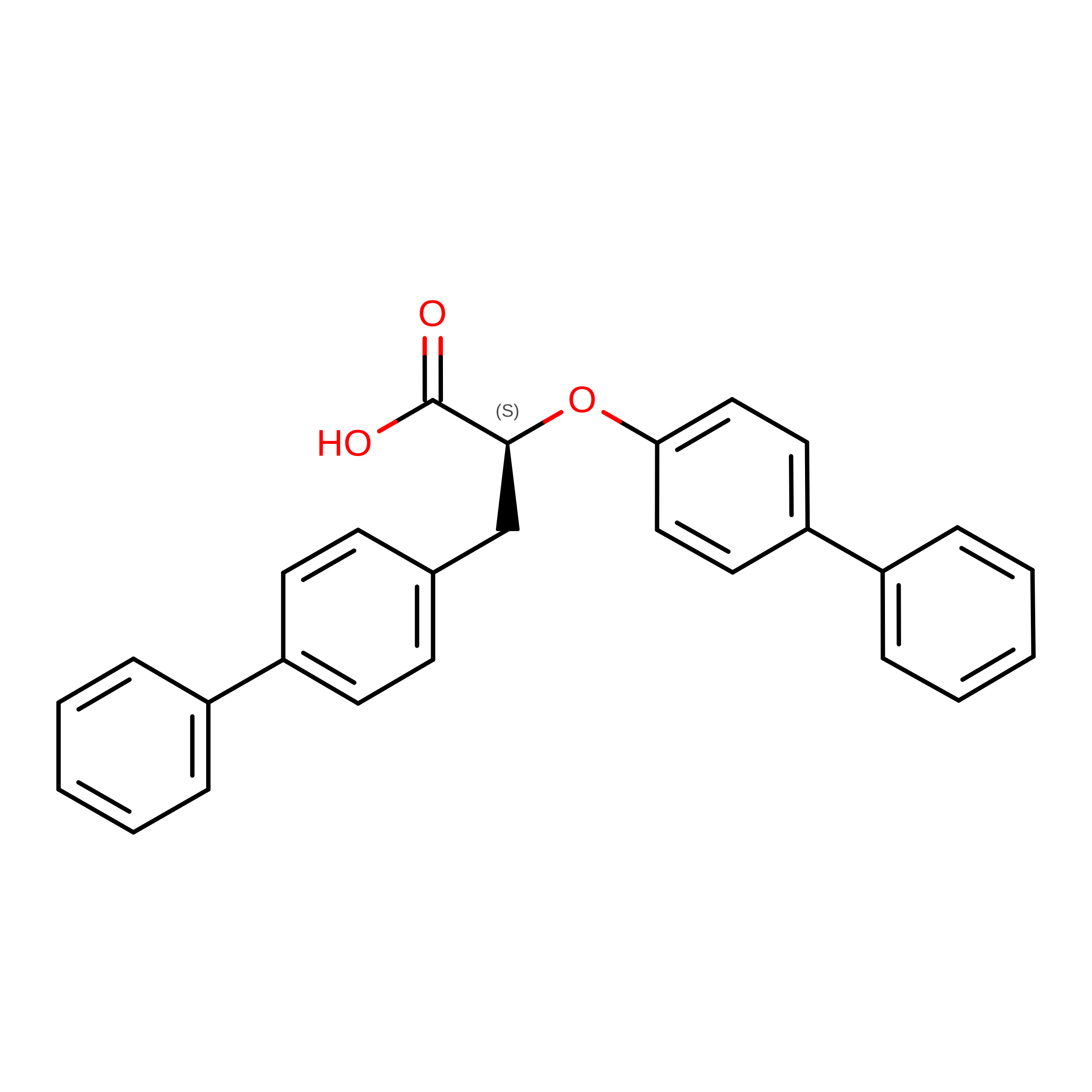
Crystal structure of the complex between PPARgamma LBD and the ligand LJ570 [(2S)-3-(biphenyl-4-yl)-2-(biphenyl-4-yloxy)propanoic acid]


Experimental Data Snapshot

  • Method: X-RAY DIFFRACTION
  • Resolution: 2.50 Å
  • R-Value Free: 
    0.287 (Depositor), 0.281 (DCC) 
  • R-Value Work: 
    0.241 (Depositor), 0.269 (DCC) 
  • R-Value Observed: 
    0.243 (Depositor) 

wwPDB Validation 3D Report Full Report

Validation slider image for 4JL4

Ligand Structure Quality Assessment 


This is version 1.2 of the entry. See complete history

Literature

Identification of the First PPAR alpha / gamma Dual Agonist Able To Bind to Canonical and Alternative Sites of PPAR gamma and To Inhibit Its Cdk5-Mediated Phosphorylation.

Laghezza, A.Piemontese, L.Cerchia, C.Montanari, R.Capelli, D.Giudici, M.Crestani, M.Tortorella, P.Peiretti, F.Pochetti, G.Lavecchia, A.Loiodice, F.

(2018) J Med Chem 61: 8282-8298

  • DOI: https://doi.org/10.1021/acs.jmedchem.8b00835
  • Primary Citation Related Structures: 
    4JL4, 6F2L

  • PubMed Abstract: 

    A new series of derivatives of the PPARα/γ dual agonist 1 allowed us to identify the ligand ( S)-6 as a potent partial agonist of both PPARα and γ subtypes. X-ray studies in PPARγ revealed two different binding modes of ( S)-6 to the canonical site. However, ( S)-6 was also able to bind an alternative site as demonstrated by transactivation assay in the presence of a canonical PPARγ antagonist and supported from docking experiments. This compound did not activate the PPARγ-dependent program of adipocyte differentiation inducing a very less severe lipid accumulation compared to rosiglitazone but increased the insulin-stimulated glucose uptake in 3T3-L1 adipocytes. Finally, ( S)-6 inhibited the Cdk5-mediated phosphorylation of PPARγ at serine 273 that is currently considered the mechanism by which some PPARγ partial agonists exert antidiabetic effects similar to thiazolidinediones, without showing their typical side effects. This is the first PPARα/γ dual agonist reported to show this inhibitory effect representing the potential lead of a new class of drugs for treatment of dyslipidemic type 2 diabetes.


  • Organizational Affiliation
    • Dipartimento Farmacia-Scienze del Farmaco , Università degli Studi di Bari "Aldo Moro" , Via Orabona 4 , 70125 Bari , Italy.

Macromolecule Content 

  • Total Structure Weight: 65.78 kDa 
  • Atom Count: 4,505 
  • Modeled Residue Count: 535 
  • Deposited Residue Count: 574 
  • Unique protein chains: 1

Macromolecules

Find similar proteins by:|  3D Structure
Entity ID: 1
MoleculeChains  Sequence LengthOrganismDetailsImage
Peroxisome proliferator-activated receptor gamma
A, B
287Homo sapiensMutation(s): 0 
Gene Names: PPARGNR1C3
UniProt & NIH Common Fund Data Resources
Find proteins for P37231 (Homo sapiens)
Explore P37231 
Go to UniProtKB:  P37231
PHAROS:  P37231
GTEx:  ENSG00000132170 
Entity Groups
Sequence Clusters30% Identity50% Identity70% Identity90% Identity95% Identity100% Identity
UniProt GroupP37231
Sequence Annotations
Expand
Reference Sequence

Small Molecules

Ligands 1 Unique
IDChains Name / Formula / InChI Key2D Diagram3D Interactions
AXY

Query on AXY


Download:Ideal Coordinates CCD File
C [auth A](2S)-3-(biphenyl-4-yl)-2-(biphenyl-4-yloxy)propanoic acid
C27 H22 O3
DGMLYRGMJHVKNC-SANMLTNESA-N

Experimental Data & Validation

Experimental Data

  • Method: X-RAY DIFFRACTION
  • Resolution: 2.50 Å
  • R-Value Free:  0.287 (Depositor), 0.281 (DCC) 
  • R-Value Work:  0.241 (Depositor), 0.269 (DCC) 
  • R-Value Observed: 0.243 (Depositor) 
Space Group: C 1 2 1
Unit Cell:
Length ( Å )Angle ( ˚ )
a = 93.04α = 90
b = 62.53β = 102.31
c = 119.05γ = 90
Software Package:
Software NamePurpose
HKL-2000data collection
AMoREphasing
CNSrefinement
MOSFLMdata reduction
SCALAdata scaling

Structure Validation

View Full Validation Report


Ligand Structure Quality Assessment 


Entry History 

Deposition Data

Revision History  (Full details and data files)

  • Version 1.0: 2014-03-12
    Type: Initial release
  • Version 1.1: 2023-08-02
    Changes: Database references, Derived calculations
  • Version 1.2: 2024-05-22
    Changes: Data collection