4J9V | pdb_00004j9v

Crystal Structure of the TrkA Gating ring bound to ATP-gamma-S


Experimental Data Snapshot

  • Method: X-RAY DIFFRACTION
  • Resolution: 3.05 Å
  • R-Value Free: 
    0.272 (Depositor), 0.276 (DCC) 
  • R-Value Work: 
    0.211 (Depositor), 0.213 (DCC) 
  • R-Value Observed: 
    0.214 (Depositor) 

wwPDB Validation 3D Report Full Report

Validation slider image for 4J9V

Ligand Structure Quality Assessment 


This is version 1.3 of the entry. See complete history

Literature

Gating of the TrkH ion channel by its associated RCK protein TrkA.

Cao, Y.Pan, Y.Huang, H.Jin, X.Levin, E.J.Kloss, B.Zhou, M.

(2013) Nature 496: 317-322

  • DOI: https://doi.org/10.1038/nature12056
  • Primary Citation Related Structures: 
    4J9U, 4J9V

  • PubMed Abstract: 

    TrkH belongs to a superfamily of K(+) transport proteins required for growth of bacteria in low external K(+) concentrations. The crystal structure of TrkH from Vibrio parahaemolyticus showed that TrkH resembles a K(+) channel and may have a gating mechanism substantially different from K(+) channels. TrkH assembles with TrkA, a cytosolic protein comprising two RCK (regulate the conductance of K(+)) domains, which are found in certain K(+) channels and control their gating. However, fundamental questions on whether TrkH is an ion channel and how it is regulated by TrkA remain unresolved. Here we show single-channel activity of TrkH that is upregulated by ATP via TrkA. We report two structures of the tetrameric TrkA ring, one in complex with TrkH and one in isolation, in which the ring assumes two markedly different conformations. These results suggest a mechanism for how ATP increases TrkH activity by inducing conformational changes in TrkA.


  • Organizational Affiliation
    • Department of Physiology & Cellular Biophysics, College of Physicians and Surgeons, Columbia University, 630 West 168th Street, New York, New York 10032, USA.

Macromolecule Content 

  • Total Structure Weight: 102.62 kDa 
  • Atom Count: 7,132 
  • Modeled Residue Count: 910 
  • Deposited Residue Count: 916 
  • Unique protein chains: 1

Macromolecules

Find similar proteins by:|  3D Structure
Entity ID: 1
MoleculeChains  Sequence LengthOrganismDetailsImage
Potassium uptake protein TrkA
A, B
458Vibrio parahaemolyticus RIMD 2210633Mutation(s): 0 
Gene Names: VP3045
Membrane Entity: Yes 
UniProt
Find proteins for Q87KD2 (Vibrio parahaemolyticus serotype O3:K6 (strain RIMD 2210633))
Explore Q87KD2 
Go to UniProtKB:  Q87KD2
Entity Groups
Sequence Clusters30% Identity50% Identity70% Identity90% Identity95% Identity100% Identity
UniProt GroupQ87KD2
Sequence Annotations
Expand
Reference Sequence

Small Molecules

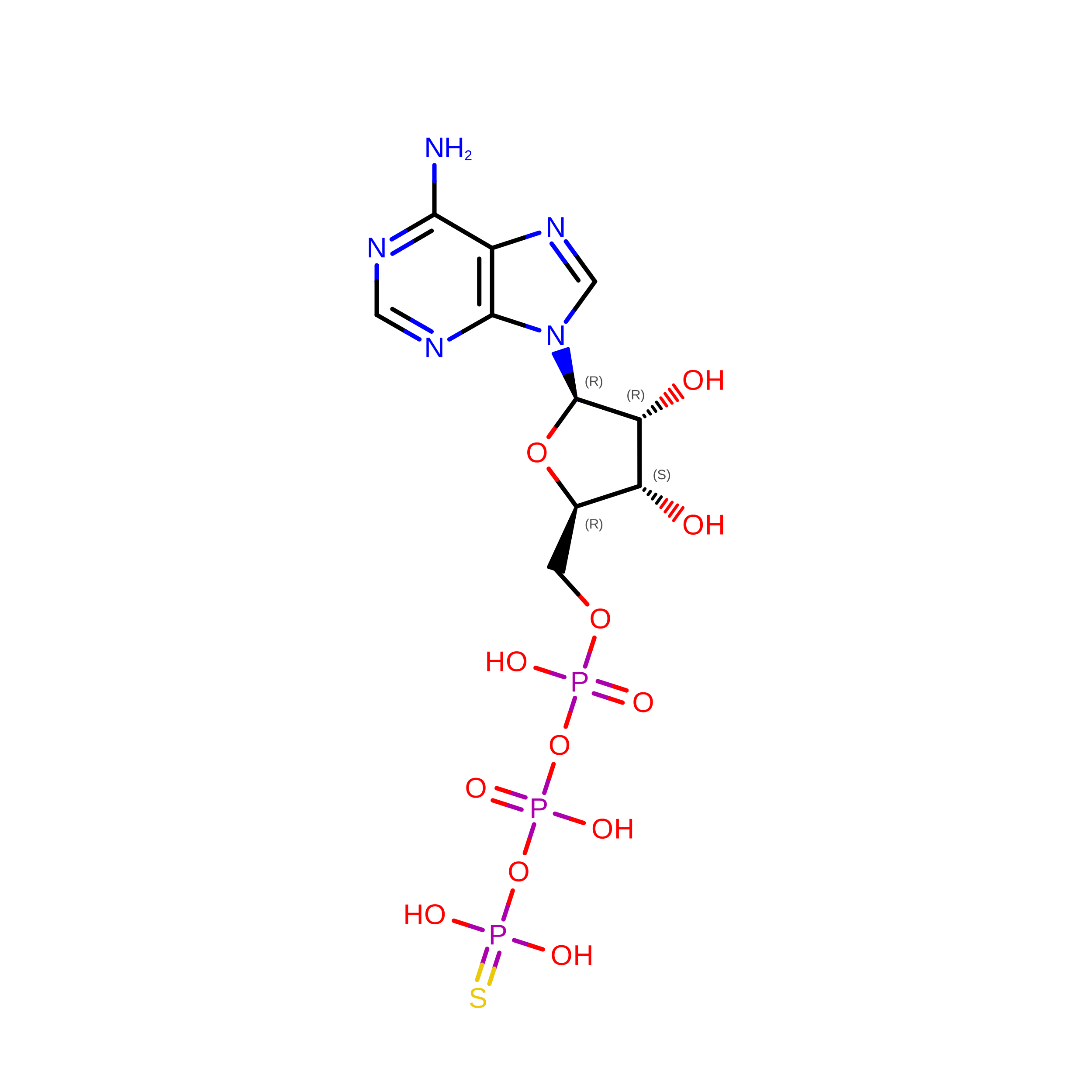
Ligands 3 Unique
IDChains Name / Formula / InChI Key2D Diagram3D Interactions
AGS

Query on AGS


Download:Ideal Coordinates CCD File
C [auth A],
D [auth A],
F [auth B],
G [auth B]
PHOSPHOTHIOPHOSPHORIC ACID-ADENYLATE ESTER
C10 H16 N5 O12 P3 S
NLTUCYMLOPLUHL-KQYNXXCUSA-N
SO4

Query on SO4


Download:Ideal Coordinates CCD File
H [auth B]SULFATE ION
O4 S
QAOWNCQODCNURD-UHFFFAOYSA-L
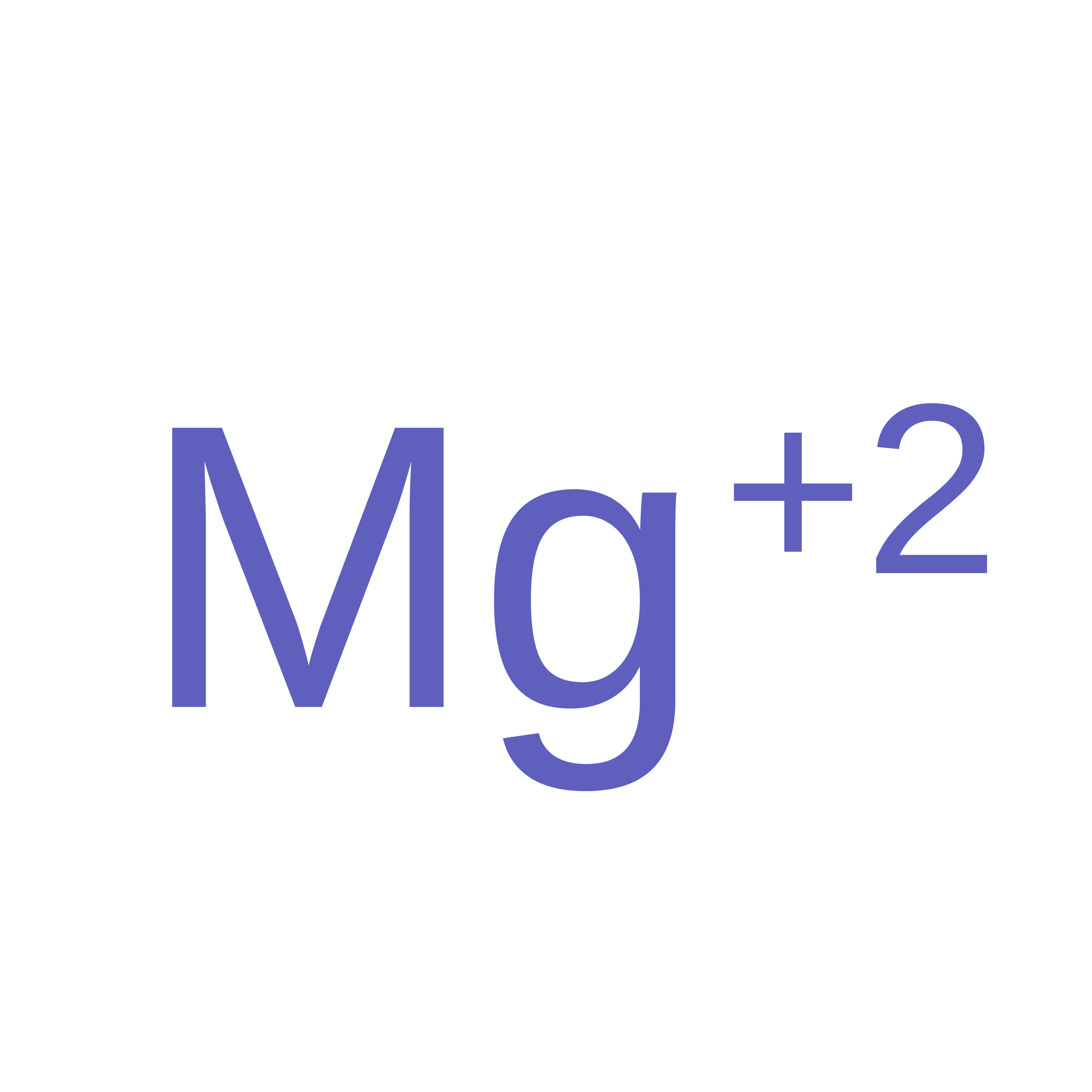
MG

Query on MG


Download:Ideal Coordinates CCD File
E [auth B],
I [auth B]
MAGNESIUM ION
Mg
JLVVSXFLKOJNIY-UHFFFAOYSA-N

Experimental Data & Validation

Experimental Data

  • Method: X-RAY DIFFRACTION
  • Resolution: 3.05 Å
  • R-Value Free:  0.272 (Depositor), 0.276 (DCC) 
  • R-Value Work:  0.211 (Depositor), 0.213 (DCC) 
  • R-Value Observed: 0.214 (Depositor) 
Space Group: P 61 2 2
Unit Cell:
Length ( Å )Angle ( ˚ )
a = 109.324α = 90
b = 109.324β = 90
c = 337.656γ = 120
Software Package:
Software NamePurpose
DENZOdata reduction
SCALEPACKdata scaling
PHASERphasing
PHENIXrefinement
PDB_EXTRACTdata extraction

Structure Validation

View Full Validation Report


Ligand Structure Quality Assessment 


Entry History 

Deposition Data

Revision History  (Full details and data files)

  • Version 1.0: 2013-04-10
    Type: Initial release
  • Version 1.1: 2013-05-01
    Changes: Database references
  • Version 1.2: 2018-01-24
    Changes: Structure summary
  • Version 1.3: 2024-02-28
    Changes: Data collection, Database references, Derived calculations