4J95 | pdb_00004j95

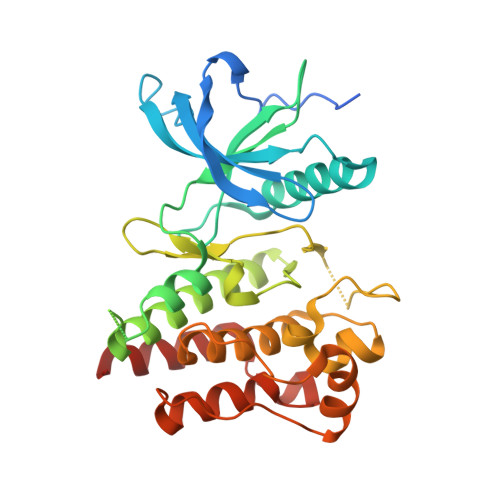
Crystal Structure of FGF Receptor 2 (FGFR2) Kinase Domain Harboring the Pathogenic K659N Mutation Responsible for an Unclassified Craniosynostosis Syndrome in Space Group C2.


Experimental Data Snapshot

  • Method: X-RAY DIFFRACTION
  • Resolution: 2.38 Å
  • R-Value Free: 
    0.255 (Depositor), 0.255 (DCC) 
  • R-Value Work: 
    0.212 (Depositor), 0.213 (DCC) 
  • R-Value Observed: 
    0.214 (Depositor) 

Starting Model: experimental
View more details

wwPDB Validation 3D Report Full Report

Validation slider image for 4J95

Ligand Structure Quality Assessment 


This is version 1.3 of the entry. See complete history

Literature

Cracking the Molecular Origin of Intrinsic Tyrosine Kinase Activity through Analysis of Pathogenic Gain-of-Function Mutations.

Chen, H.Huang, Z.Dutta, K.Blais, S.Neubert, T.A.Li, X.Cowburn, D.Traaseth, N.J.Mohammadi, M.

(2013) Cell Rep 4: 376-384

  • DOI: https://doi.org/10.1016/j.celrep.2013.06.025
  • Primary Citation Related Structures: 
    4J95, 4J96, 4J97, 4J98, 4J99

  • PubMed Abstract: 

    The basal (ligand-independent) kinase activity of receptor tyrosine kinases (RTKs) promotes trans-phosphorylation on activation loop tyrosines upon ligand-induced receptor dimerization, thus upregulating intrinsic kinase activity and triggering intracellular signaling. To understand the molecular determinants of intrinsic kinase activity, we used X-ray crystallography and NMR spectroscopy to analyze pathogenic FGF receptor mutants with gradations in gain-of-function activity. These structural analyses revealed a "two-state" dynamic equilibrium model whereby the kinase toggles between an "inhibited," structurally rigid ground state and a more dynamic and heterogeneous active state. The pathogenic mutations have different abilities to shift this equilibrium toward the active state. The increase in the fractional population of FGF receptors in the active state correlates with the degree of gain-of-function activity and clinical severity. Our data demonstrate that the fractional population of RTKs in the active state determines intrinsic kinase activity and underscore how a slight increase in the active population of kinases can have grave consequences for human health.


  • Organizational Affiliation
    • Department of Biochemistry and Molecular Pharmacology, New York University School of Medicine, New York, NY 10016, USA.

Macromolecule Content 

  • Total Structure Weight: 151.08 kDa 
  • Atom Count: 9,059 
  • Modeled Residue Count: 1,113 
  • Deposited Residue Count: 1,296 
  • Unique protein chains: 1

Macromolecules

Find similar proteins by:|  3D Structure
Entity ID: 1
MoleculeChains  Sequence LengthOrganismDetailsImage
Fibroblast growth factor receptor 2
A, B, C, D
324Homo sapiensMutation(s): 2 
Gene Names: BEKFGFR2KGFRKSAM
EC: 2.7.10.1
UniProt & NIH Common Fund Data Resources
Find proteins for P21802 (Homo sapiens)
Explore P21802 
Go to UniProtKB:  P21802
PHAROS:  P21802
GTEx:  ENSG00000066468 
Entity Groups
Sequence Clusters30% Identity50% Identity70% Identity90% Identity95% Identity100% Identity
UniProt GroupP21802
Sequence Annotations
Expand
Reference Sequence

Small Molecules

Ligands 2 Unique
IDChains Name / Formula / InChI Key2D Diagram3D Interactions
ACP

Query on ACP


Download:Ideal Coordinates CCD File
E [auth A],
H [auth B],
J [auth C],
N [auth D]
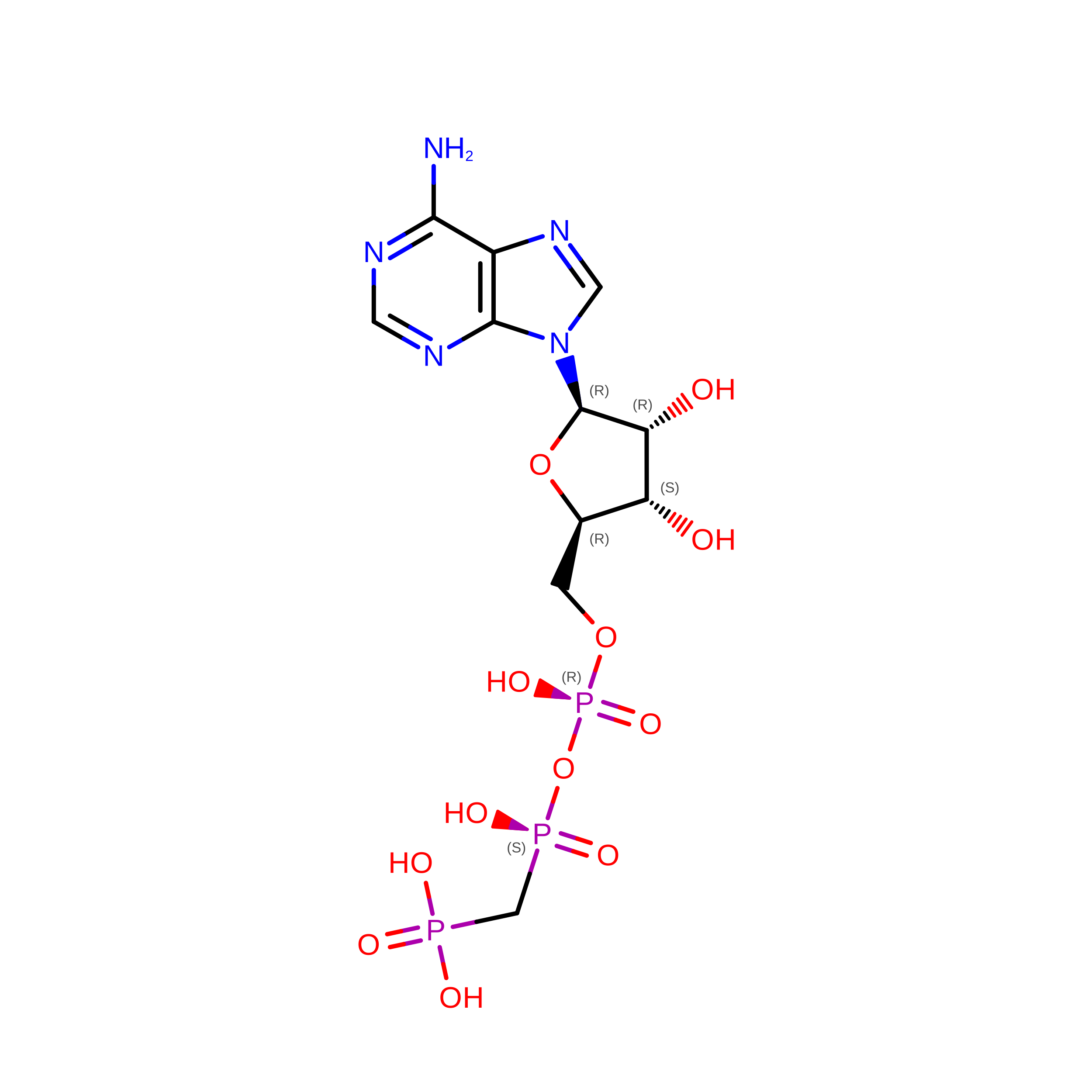
PHOSPHOMETHYLPHOSPHONIC ACID ADENYLATE ESTER
C11 H18 N5 O12 P3
UFZTZBNSLXELAL-IOSLPCCCSA-N
SO4

Query on SO4


Download:Ideal Coordinates CCD File
F [auth A]
G [auth A]
I [auth B]
K [auth C]
L [auth C]
F [auth A],
G [auth A],
I [auth B],
K [auth C],
L [auth C],
M [auth C],
O [auth D]
SULFATE ION
O4 S
QAOWNCQODCNURD-UHFFFAOYSA-L

Experimental Data & Validation

Experimental Data

  • Method: X-RAY DIFFRACTION
  • Resolution: 2.38 Å
  • R-Value Free:  0.255 (Depositor), 0.255 (DCC) 
  • R-Value Work:  0.212 (Depositor), 0.213 (DCC) 
  • R-Value Observed: 0.214 (Depositor) 
Space Group: C 1 2 1
Unit Cell:
Length ( Å )Angle ( ˚ )
a = 278.634α = 90
b = 78.122β = 101.9
c = 72.791γ = 90
Software Package:
Software NamePurpose
HKL-2000data collection
AMoREphasing
PHENIXrefinement
HKL-2000data reduction
HKL-2000data scaling

Structure Validation

View Full Validation Report


Ligand Structure Quality Assessment 


Entry History 

Deposition Data

Revision History  (Full details and data files)

  • Version 1.0: 2013-08-07
    Type: Initial release
  • Version 1.1: 2013-08-21
    Changes: Database references
  • Version 1.2: 2016-12-28
    Changes: Structure summary
  • Version 1.3: 2023-09-20
    Changes: Data collection, Database references, Derived calculations, Refinement description