4J0M | pdb_00004j0m

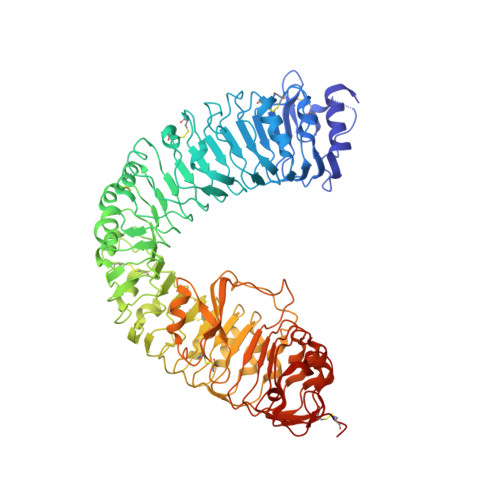
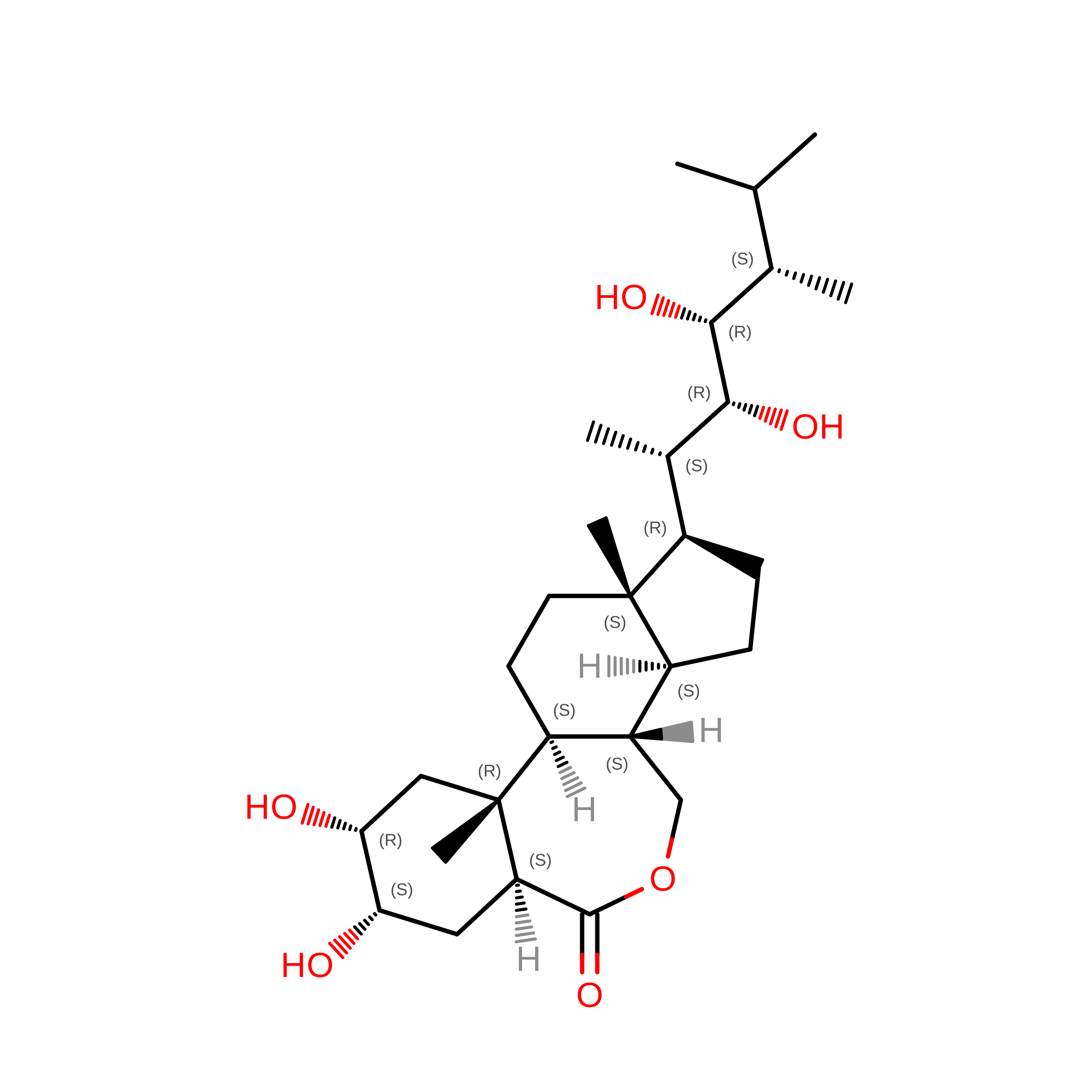
Crystal structure of BRL1 (LRR) in complex with brassinolide


Experimental Data Snapshot

  • Method: X-RAY DIFFRACTION
  • Resolution: 2.50 Å
  • R-Value Free: 
    0.239 (Depositor), 0.239 (DCC) 
  • R-Value Work: 
    0.187 (Depositor), 0.188 (DCC) 
  • R-Value Observed: 
    0.190 (Depositor) 

Starting Model: experimental
View more details

wwPDB Validation 3D Report Full Report

Validation slider image for 4J0M

Ligand Structure Quality Assessment 


This is version 2.2 of the entry. See complete history

Literature

Structural basis for differential recognition of brassinolide by its receptors

She, J.Han, Z.Zhou, B.Chai, J.

(2013) Protein Cell 4: 475-482

  • DOI: https://doi.org/10.1007/s13238-013-3027-8
  • Primary Citation Related Structures: 
    4J0M

  • PubMed Abstract: 

    Brassinosteroids, a group of plant steroid hormones, regulate many aspects of plant growth and development. We and other have previously solved the crystal structures of BRI1(LRR) in complex with brassinolide, the most active brassinosteroid identified thus far. Although these studies provide a structural basis for the recognition of brassinolide by its receptor BRI1, it still remains poorly understood how the hormone differentiates among its conserved receptors. Here we present the crystal structure of the BRI1 homolog BRL1 in complex with brassinolide. The structure shows that subtle differences around the brassinolide binding site can generate a striking effect on its recognition by the BRI1 family of receptors. Structural comparison of BRL1 and BRI1 in their brassinolide-bound forms reveals the molecular basis for differential binding of brassinolide to its different receptors, which can be used for more efficient design of plant growth regulators for agricultural practice. On the basis of our structural studies and others' data, we also suggest possible mechanisms for the activation of BRI1 family receptors.


  • Organizational Affiliation
    • School of Life Sciences, Peking University, Beijing, 100871, China.

Macromolecule Content 

  • Total Structure Weight: 166.23 kDa 
  • Atom Count: 11,785 
  • Modeled Residue Count: 1,448 
  • Deposited Residue Count: 1,480 
  • Unique protein chains: 1

Macromolecules

Find similar proteins by:|  3D Structure
Entity ID: 1
MoleculeChains  Sequence LengthOrganismDetailsImage
Serine/threonine-protein kinase BRI1-like 1
A, B
740Arabidopsis thalianaMutation(s): 0 
Gene Names: BRL1At1g55610F20N2.4
EC: 2.7.11.1
UniProt
Find proteins for Q9ZWC8 (Arabidopsis thaliana)
Explore Q9ZWC8 
Go to UniProtKB:  Q9ZWC8
Entity Groups
Sequence Clusters30% Identity50% Identity70% Identity90% Identity95% Identity100% Identity
UniProt GroupQ9ZWC8
Glycosylation
Glycosylation Sites: 7
Sequence Annotations
Expand
Reference Sequence

Oligosaccharides

Help  
Entity ID: 2
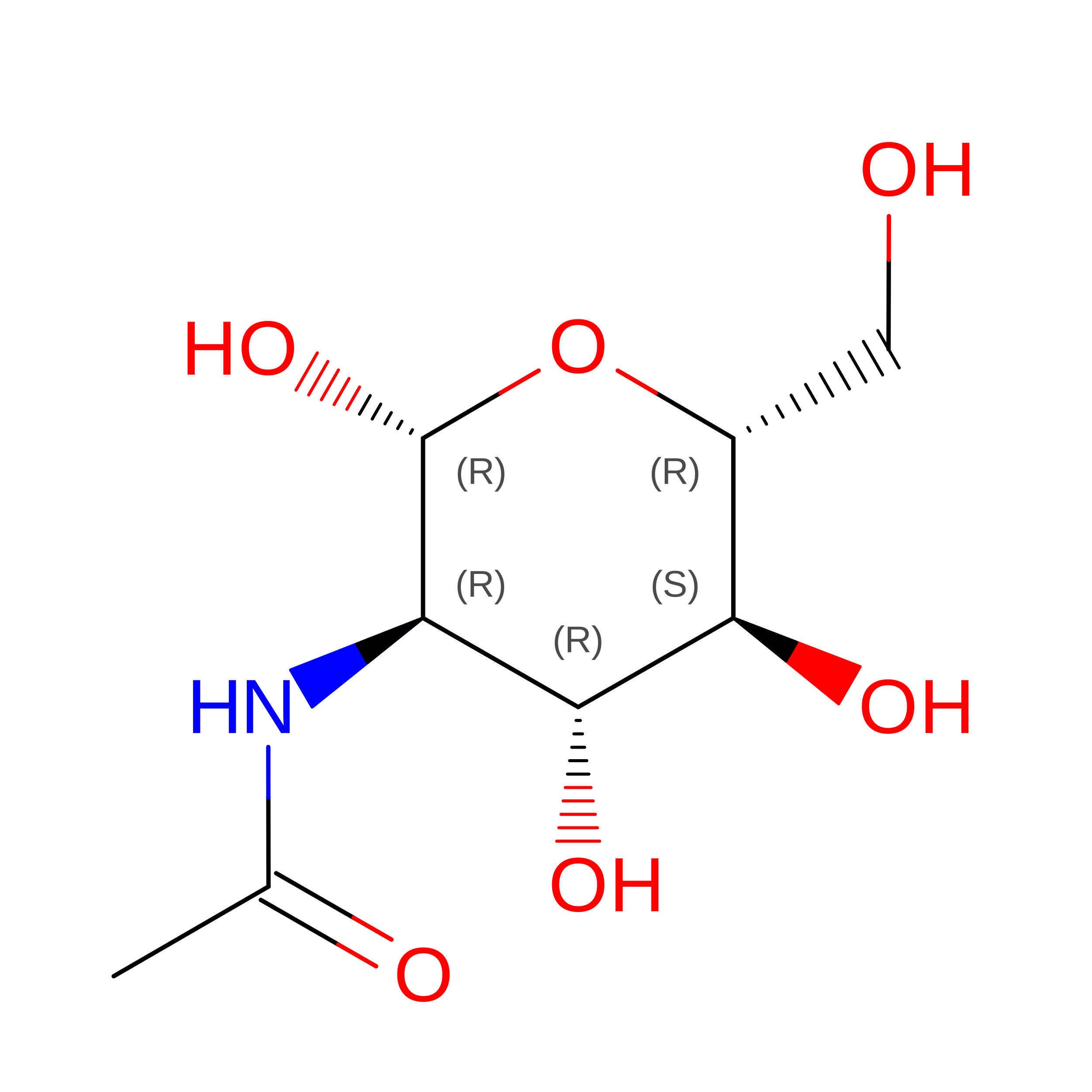
MoleculeChains Length2D Diagram GlycosylationD Interactions
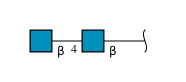
2-acetamido-2-deoxy-beta-D-glucopyranose-(1-4)-2-acetamido-2-deoxy-beta-D-glucopyranose
C, E, F, G, H
C, E, F, G, H, J, K
2N-Glycosylation
Glycosylation Resources
GlyTouCan: G42666HT
GlyCosmos: G42666HT
GlyGen: G42666HT
Entity ID: 3
MoleculeChains Length2D Diagram GlycosylationD Interactions
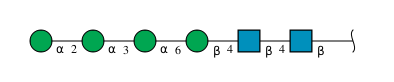
alpha-D-mannopyranose-(1-2)-alpha-D-mannopyranose-(1-3)-alpha-D-mannopyranose-(1-6)-beta-D-mannopyranose-(1-4)-2-acetamido-2-deoxy-beta-D-glucopyranose-(1-4)-2-acetamido-2-deoxy-beta-D-glucopyranose
D, I
6N-Glycosylation
Glycosylation Resources
GlyTouCan: G47410OF
GlyCosmos: G47410OF
GlyGen: G47410OF

Experimental Data & Validation

Experimental Data

  • Method: X-RAY DIFFRACTION
  • Resolution: 2.50 Å
  • R-Value Free:  0.239 (Depositor), 0.239 (DCC) 
  • R-Value Work:  0.187 (Depositor), 0.188 (DCC) 
  • R-Value Observed: 0.190 (Depositor) 
Space Group: C 1 2 1
Unit Cell:
Length ( Å )Angle ( ˚ )
a = 105.864α = 90
b = 83.4β = 97.24
c = 264.064γ = 90
Software Package:
Software NamePurpose
HKL-2000data collection
PHASERphasing
PHENIXrefinement
HKL-2000data reduction
HKL-2000data scaling

Structure Validation

View Full Validation Report


Ligand Structure Quality Assessment 


Entry History 

Deposition Data

Revision History  (Full details and data files)

  • Version 1.0: 2013-07-24
    Type: Initial release
  • Version 2.0: 2020-07-29
    Type: Remediation
    Reason: Carbohydrate remediation
    Changes: Advisory, Atomic model, Data collection, Database references, Derived calculations, Structure summary
  • Version 2.1: 2023-11-08
    Changes: Data collection, Database references, Refinement description, Structure summary
  • Version 2.2: 2024-10-30
    Changes: Structure summary