4IBR | pdb_00004ibr

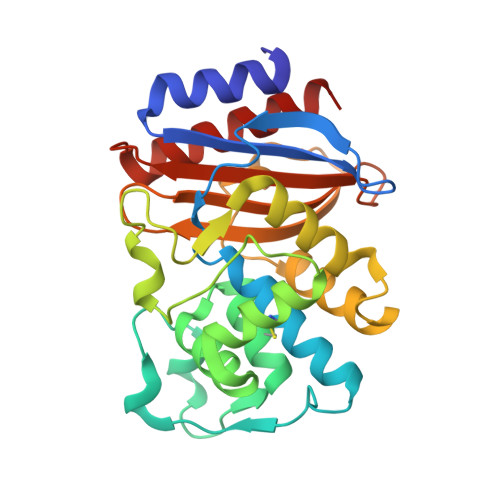
Crystal structure of stabilized TEM-1 beta-lactamase variant v.13 carrying G238S/E104K mutations


Experimental Data Snapshot

  • Method: X-RAY DIFFRACTION
  • Resolution: 2.20 Å
  • R-Value Free: 
    0.247 (Depositor), 0.249 (DCC) 
  • R-Value Work: 
    0.195 (Depositor), 0.196 (DCC) 
  • R-Value Observed: 
    0.198 (Depositor) 

Starting Model: experimental
View more details

wwPDB Validation 3D Report Full Report

Validation slider image for 4IBR

This is version 1.5 of the entry. See complete history

Literature

What Makes a Protein Fold Amenable to Functional Innovation? Fold Polarity and Stability Trade-offs.

Dellus-Gur, E.Toth-Petroczy, A.Elias, M.Tawfik, D.S.

(2013) J Mol Biology 425: 2609-2621

  • DOI: https://doi.org/10.1016/j.jmb.2013.03.033
  • Primary Citation Related Structures: 
    4IBR, 4IBX

  • PubMed Abstract: 

    Protein evolvability includes two elements--robustness (or neutrality, mutations having no effect) and innovability (mutations readily inducing new functions). How are these two conflicting demands bridged? Does the ability to bridge them relate to the observation that certain folds, such as TIM barrels, accommodate numerous functions, whereas other folds support only one? Here, we hypothesize that the key to innovability is polarity--an active site composed of flexible, loosely packed loops alongside a well-separated, highly ordered scaffold. We show that highly stabilized variants of TEM-1 β-lactamase exhibit selective rigidification of the enzyme's scaffold while the active-site loops maintained their conformational plasticity. Polarity therefore results in stabilizing, compensatory mutations not trading off, but instead promoting the acquisition of new activities. Indeed, computational analysis indicates that in folds that accommodate only one function throughout evolution, for example, dihydrofolate reductase, ≥ 60% of the active-site residues belong to the scaffold. In contrast, folds associated with multiple functions such as the TIM barrel show high scaffold-active-site polarity (~20% of the active site comprises scaffold residues) and >2-fold higher rates of sequence divergence at active-site positions. Our work suggests structural measures of fold polarity that appear to be correlated with innovability, thereby providing new insights regarding protein evolution, design, and engineering.


  • Organizational Affiliation
    • Department of Biological Chemistry, Weizmann Institute of Science, Rehovot 76100, Israel.

Macromolecule Content 

  • Total Structure Weight: 29.04 kDa 
  • Atom Count: 2,100 
  • Modeled Residue Count: 263 
  • Deposited Residue Count: 263 
  • Unique protein chains: 1

Macromolecules

Find similar proteins by:|  3D Structure
Entity ID: 1
MoleculeChains  Sequence LengthOrganismDetailsImage
TEM-94 ES-beta-lactamase263Escherichia coliMutation(s): 8 
Gene Names: bla-TEM-94
EC: 3.5.2.6
UniProt
Find proteins for P62593 (Escherichia coli)
Explore P62593 
Go to UniProtKB:  P62593
Entity Groups
Sequence Clusters30% Identity50% Identity70% Identity90% Identity95% Identity100% Identity
UniProt GroupP62593
Sequence Annotations
Expand
Reference Sequence

Small Molecules

Experimental Data & Validation

Experimental Data

  • Method: X-RAY DIFFRACTION
  • Resolution: 2.20 Å
  • R-Value Free:  0.247 (Depositor), 0.249 (DCC) 
  • R-Value Work:  0.195 (Depositor), 0.196 (DCC) 
  • R-Value Observed: 0.198 (Depositor) 
Space Group: C 1 2 1
Unit Cell:
Length ( Å )Angle ( ˚ )
a = 136.24α = 90
b = 46.6β = 93.87
c = 39γ = 90
Software Package:
Software NamePurpose
MOLREPphasing
REFMACrefinement
XDSdata reduction
XSCALEdata scaling

Structure Validation

View Full Validation Report


Entry History 

Deposition Data

Revision History  (Full details and data files)

  • Version 1.0: 2013-04-03
    Type: Initial release
  • Version 1.1: 2013-04-17
    Changes: Database references
  • Version 1.2: 2013-07-17
    Changes: Database references
  • Version 1.3: 2017-11-15
    Changes: Refinement description
  • Version 1.4: 2023-09-20
    Changes: Data collection, Database references, Derived calculations, Refinement description
  • Version 1.5: 2024-11-06
    Changes: Structure summary