4I0K | pdb_00004i0k

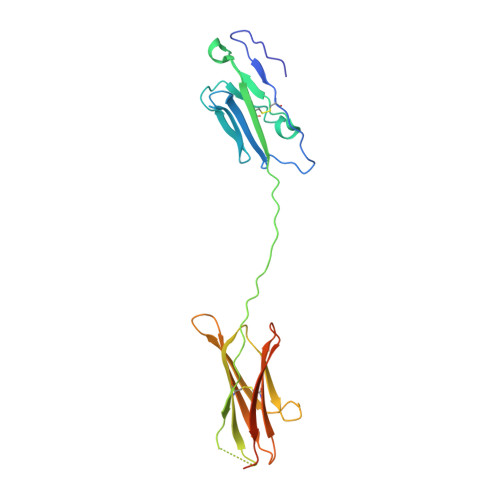
Crystal structure of murine B7-H3 extracellular domain


Experimental Data Snapshot

  • Method: X-RAY DIFFRACTION
  • Resolution: 2.97 Å
  • R-Value Free: 
    0.250 (Depositor), 0.251 (DCC) 
  • R-Value Work: 
    0.215 (Depositor), 0.217 (DCC) 
  • R-Value Observed: 
    0.217 (Depositor) 

Starting Model: experimental
View more details

wwPDB Validation 3D Report Full Report

Validation slider image for 4I0K

Ligand Structure Quality Assessment 


This is version 2.2 of the entry. See complete history

Literature

Structure and T cell inhibition properties of B7 family member, B7-H3.

Vigdorovich, V.Ramagopal, U.A.Lazar-Molnar, E.Sylvestre, E.Lee, J.S.Hofmeyer, K.A.Zang, X.Nathenson, S.G.Almo, S.C.

(2013) Structure 21: 707-717

  • DOI: https://doi.org/10.1016/j.str.2013.03.003
  • Primary Citation Related Structures: 
    4I0K

  • PubMed Abstract: 

    T cell activity is controlled by a combination of antigen-dependent signaling through the T cell receptor and a set of auxiliary signals delivered through antigen-independent interactions, including the recognition of the B7 family of ligands. B7-H3 is a recently identified B7 family member that is strongly overexpressed in a range of cancers and correlates with poor prognosis. We report the crystal structure of murine B7-H3 at a 3 Å resolution, which provides a model for the organization of the IgV and IgC domains within the ectodomain. We demonstrate that B7-H3 inhibits T cell proliferation and show that the FG loop of the IgV domain plays a critical role in this function. B7-H3 crystallized as an unusual dimer arising from the exchange of the G strands in the IgV domains of partner molecules. This arrangement, in combination with previous reports, highlights the dynamic nature and plasticity of the immunoglobulin fold.


  • Organizational Affiliation
    • Department of Microbiology and Immunology, Albert Einstein College of Medicine, Bronx, NY 10461, USA. vladimir.vigdorovich@gmail.com

Macromolecule Content 

  • Total Structure Weight: 25.43 kDa 
  • Atom Count: 1,605 
  • Modeled Residue Count: 200 
  • Deposited Residue Count: 222 
  • Unique protein chains: 1

Macromolecules

Find similar proteins by:|  3D Structure
Entity ID: 1
MoleculeChains  Sequence LengthOrganismDetailsImage
CD276 antigen222Mus musculusMutation(s): 0 
Gene Names: B7-H3B7h3Cd276
UniProt & NIH Common Fund Data Resources
Find proteins for Q8VE98 (Mus musculus)
Explore Q8VE98 
Go to UniProtKB:  Q8VE98
IMPC:  MGI:2183926
Entity Groups
Sequence Clusters30% Identity50% Identity70% Identity90% Identity95% Identity100% Identity
UniProt GroupQ8VE98
Glycosylation
Glycosylation Sites: 2Go to GlyGen: Q8VE98-1
Sequence Annotations
Expand
Reference Sequence

Oligosaccharides

Help  
Entity ID: 2
MoleculeChains Length2D Diagram GlycosylationD Interactions
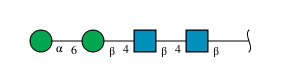
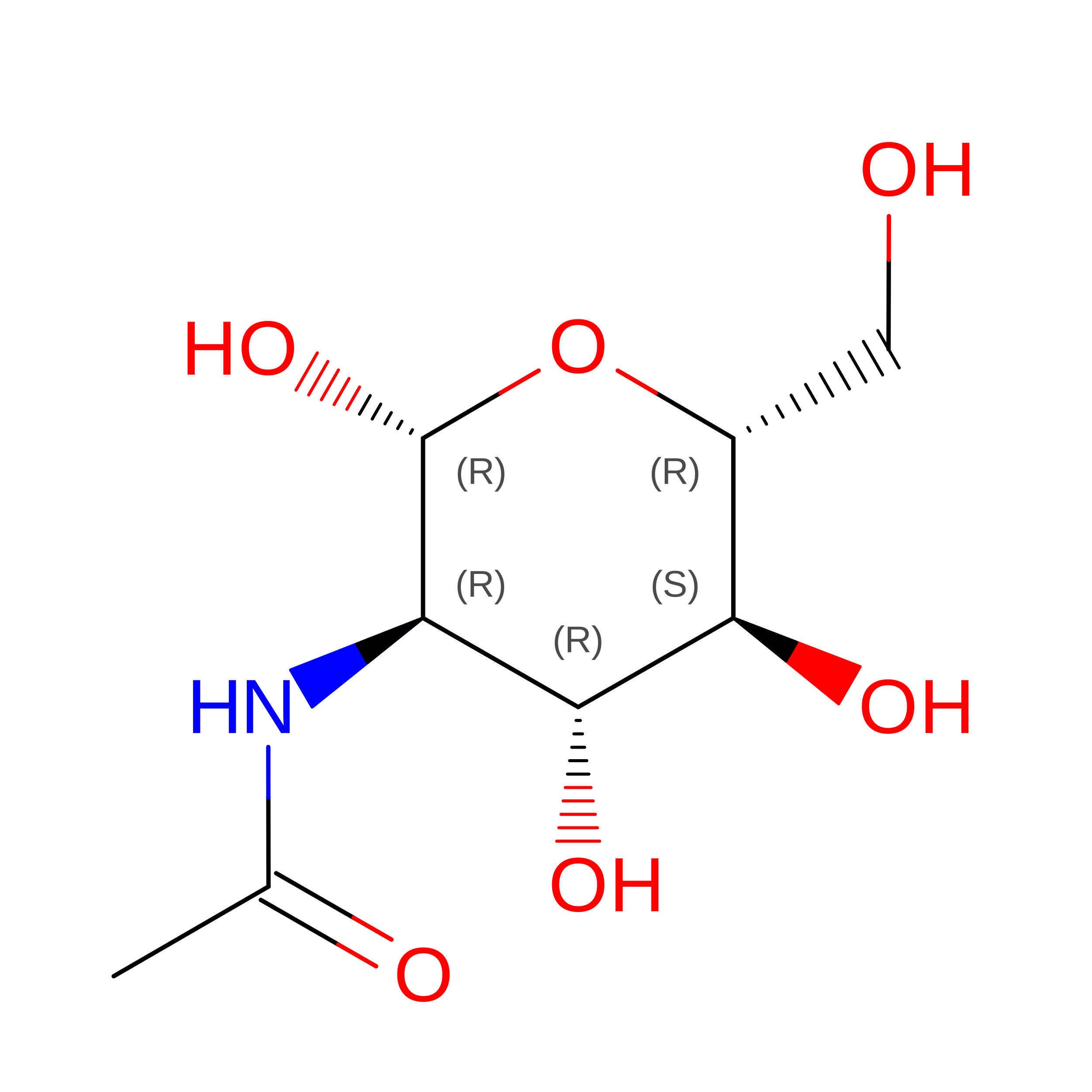
alpha-D-mannopyranose-(1-6)-beta-D-mannopyranose-(1-4)-2-acetamido-2-deoxy-beta-D-glucopyranose-(1-4)-2-acetamido-2-deoxy-beta-D-glucopyranose
B
4N-Glycosylation
Glycosylation Resources
GlyTouCan: G22573RC
GlyCosmos: G22573RC
GlyGen: G22573RC

Experimental Data & Validation

Experimental Data

  • Method: X-RAY DIFFRACTION
  • Resolution: 2.97 Å
  • R-Value Free:  0.250 (Depositor), 0.251 (DCC) 
  • R-Value Work:  0.215 (Depositor), 0.217 (DCC) 
  • R-Value Observed: 0.217 (Depositor) 
Space Group: P 61 2 2
Unit Cell:
Length ( Å )Angle ( ˚ )
a = 100.92α = 90
b = 100.92β = 90
c = 188.18γ = 120
Software Package:
Software NamePurpose
SCALAdata scaling
REFMACrefinement
PDB_EXTRACTdata extraction
CBASSdata collection
MOSFLMdata reduction
BALBESphasing

Structure Validation

View Full Validation Report


Ligand Structure Quality Assessment 


Entry History 

Revision History  (Full details and data files)

  • Version 1.0: 2012-12-05
    Type: Initial release
  • Version 1.1: 2016-11-16
    Changes: Database references
  • Version 2.0: 2020-07-29
    Type: Remediation
    Reason: Carbohydrate remediation
    Changes: Advisory, Atomic model, Data collection, Database references, Derived calculations, Structure summary
  • Version 2.1: 2023-09-20
    Changes: Data collection, Database references, Refinement description, Structure summary
  • Version 2.2: 2024-10-16
    Changes: Structure summary