4HDU | pdb_00004hdu

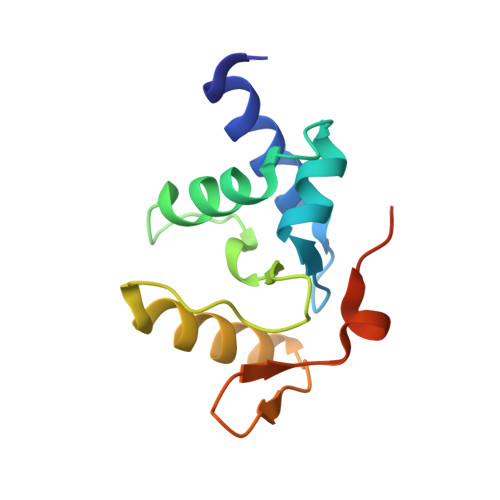
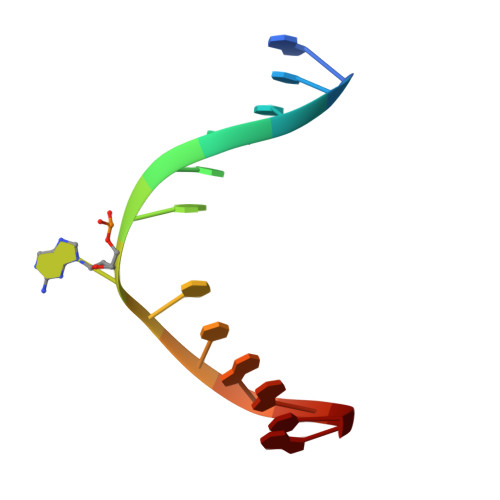
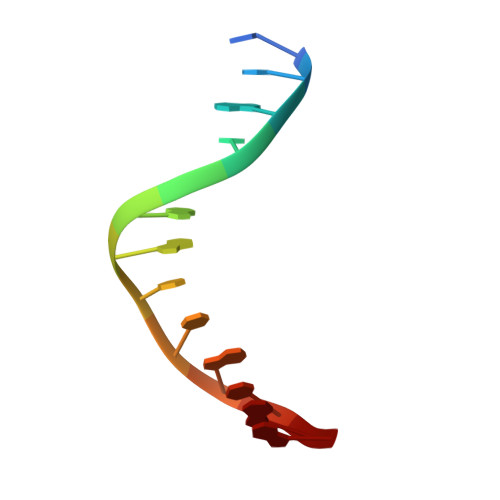
Crystal structure of S. pombe ATL1 in complex with damaged DNA containing 2-aminopurine


Experimental Data Snapshot

  • Method: X-RAY DIFFRACTION
  • Resolution: 2.85 Å
  • R-Value Free: 
    0.267 (Depositor), 0.264 (DCC) 
  • R-Value Work: 
    0.213 (Depositor), 0.220 (DCC) 
  • R-Value Observed: 
    0.219 (Depositor) 

Starting Model: experimental
View more details

wwPDB Validation 3D Report Full Report

Validation slider image for 4HDU

This is version 1.1 of the entry. See complete history

Literature

Alkyltransferase-like protein (Atl1) distinguishes alkylated guanines for DNA repair using cation-{pi} interactions.

Wilkinson, O.J.Latypov, V.Tubbs, J.L.Millington, C.L.Morita, R.Blackburn, H.Marriott, A.McGown, G.Thorncroft, M.Watson, A.J.Connolly, B.A.Grasby, J.A.Masui, R.Hunter, C.A.Tainer, J.A.Margison, G.P.Williams, D.M.

(2012) Proc Natl Acad Sci U S A 109: 18755-18760

  • DOI: https://doi.org/10.1073/pnas.1209451109
  • Primary Citation Related Structures: 
    4HDU, 4HDV

  • PubMed Abstract: 

    Alkyltransferase-like (ATL) proteins in Schizosaccharomyces pombe (Atl1) and Thermus thermophilus (TTHA1564) protect against the adverse effects of DNA alkylation damage by flagging O(6)-alkylguanine lesions for nucleotide excision repair (NER). We show that both ATL proteins bind with high affinity to oligodeoxyribonucleotides containing O(6)-alkylguanines differing in size, polarity, and charge of the alkyl group. However, Atl1 shows a greater ability than TTHA1564 to distinguish between O(6)-alkylguanine and guanine and in an unprecedented mechanism uses Arg69 to probe the electrostatic potential surface of O(6)-alkylguanine, as determined using molecular mechanics calculations. An unexpected consequence of this feature is the recognition of 2,6-diaminopurine and 2-aminopurine, as confirmed in crystal structures of respective Atl1-DNA complexes. O(6)-Alkylguanine and guanine discrimination is diminished for Atl1 R69A and R69F mutants, and S. pombe R69A and R69F mutants are more sensitive toward alkylating agent toxicity, revealing the key role of Arg69 in identifying O(6)-alkylguanines critical for NER recognition.


  • Organizational Affiliation
    • Centre for Chemical Biology, Department of Chemistry, Krebs Institute, University of Sheffield, Sheffield S3 7HF, United Kingdom.

Macromolecule Content 

  • Total Structure Weight: 21.59 kDa 
  • Atom Count: 1,426 
  • Modeled Residue Count: 134 
  • Deposited Residue Count: 142 
  • Unique protein chains: 1
  • Unique nucleic acid chains: 2

Macromolecules


Find similar proteins by:|  3D Structure
Entity ID: 1
MoleculeChains  Sequence LengthOrganismDetailsImage
Alkyltransferase-like protein 1116Schizosaccharomyces pombeMutation(s): 0 
Gene Names: atl1SPAC1250.04c
UniProt
Find proteins for Q9UTN9 (Schizosaccharomyces pombe (strain 972 / ATCC 24843))
Explore Q9UTN9 
Go to UniProtKB:  Q9UTN9
Entity Groups
Sequence Clusters30% Identity50% Identity70% Identity90% Identity95% Identity100% Identity
UniProt GroupQ9UTN9
Sequence Annotations
Expand
Reference Sequence
Find similar nucleic acids by:  Sequence
Entity ID: 2
MoleculeChains LengthOrganismImage
5'-D(*GP*CP*CP*AP*TP*GP*(2PR)P*CP*TP*AP*GP*TP*A)-3'13N/A
Sequence Annotations
Expand
Reference Sequence
Find similar nucleic acids by:  Sequence
Entity ID: 3
MoleculeChains LengthOrganismImage
5'-D(*CP*TP*AP*CP*TP*AP*GP*CP*CP*AP*TP*GP*G)-3'13N/A
Sequence Annotations
Expand
Reference Sequence

Experimental Data & Validation

Experimental Data

  • Method: X-RAY DIFFRACTION
  • Resolution: 2.85 Å
  • R-Value Free:  0.267 (Depositor), 0.264 (DCC) 
  • R-Value Work:  0.213 (Depositor), 0.220 (DCC) 
  • R-Value Observed: 0.219 (Depositor) 
Space Group: P 61 2 2
Unit Cell:
Length ( Å )Angle ( ˚ )
a = 59.978α = 90
b = 59.978β = 90
c = 235.488γ = 120
Software Package:
Software NamePurpose
HKL-2000data collection
PHASERphasing
PHENIXrefinement
HKL-2000data reduction
HKL-2000data scaling

Structure Validation

View Full Validation Report


Entry History 

Deposition Data

Revision History  (Full details and data files)

  • Version 1.0: 2012-12-26
    Type: Initial release
  • Version 1.1: 2023-09-20
    Changes: Data collection, Database references, Derived calculations, Refinement description