4H4K | pdb_00004h4k

Structure of the Cmr2-Cmr3 subcomplex of the Cmr RNA-silencing complex


Experimental Data Snapshot

  • Method: X-RAY DIFFRACTION
  • Resolution: 2.80 Å
  • R-Value Free: 
    0.284 (Depositor), 0.272 (DCC) 
  • R-Value Work: 
    0.214 (Depositor), 0.234 (DCC) 
  • R-Value Observed: 
    0.218 (Depositor) 

wwPDB Validation 3D Report Full Report

Validation slider image for 4H4K

Ligand Structure Quality Assessment 


This is version 1.3 of the entry. See complete history

Literature

Structure of the cmr2-cmr3 subcomplex of the cmr RNA silencing complex.

Shao, Y.Cocozaki, A.I.Ramia, N.F.Terns, R.M.Terns, M.P.Li, H.

(2013) Structure 21: 376-384

  • DOI: https://doi.org/10.1016/j.str.2013.01.002
  • Primary Citation Related Structures: 
    4H4K

  • PubMed Abstract: 

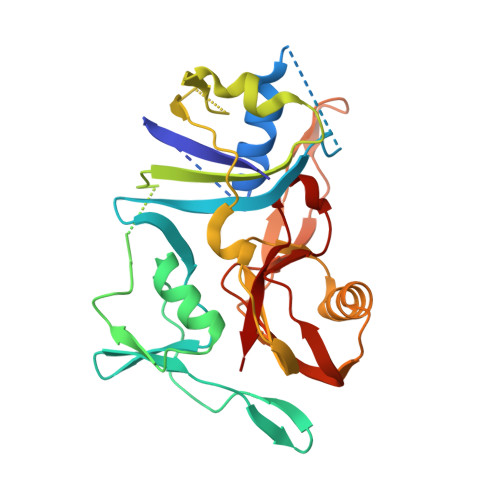
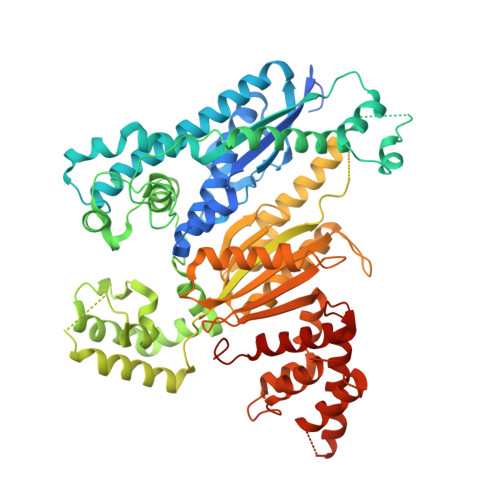
    The Cmr complex is an RNA-guided effector complex that cleaves invader RNA in the prokaryotic immune response mediated by the CRISPR (Clustered Regularly Interspaced Short Palindromic Repeat)-Cas system. Here, we report the crystal structure of a Cmr subcomplex containing Cmr2 (Cas10) and Cmr3 subunits at 2.8 Å resolution. The structure revealed a dual ferredoxin fold and glycine-rich loops characteristic of previously known repeat-associated mysterious proteins and two unique insertion elements in Cmr3 that mediate its interaction with Cmr2. Surprisingly, while mutation of both insertion elements significantly weakened Cmr3-Cmr2 interaction, they exhibit differential effects on Cmr-mediated RNA cleavage by the Cmr complex, suggesting stabilization of Cmr2-Cmr3 interactions by other subunits. Further mutational analysis of the two conserved (but non-Cmr2-binding) glycine-rich loops of Cmr3 identified a region that is likely involved in assembly or the RNA cleavage function of the Cmr complex.


  • Organizational Affiliation
    • Institute of Molecular Biophysics, Florida State University, Tallahassee, FL 32306, USA.

Macromolecule Content 

  • Total Structure Weight: 117.45 kDa 
  • Atom Count: 7,014 
  • Modeled Residue Count: 863 
  • Deposited Residue Count: 1,018 
  • Unique protein chains: 2

Macromolecules

Find similar proteins by:|  3D Structure
Entity ID: 1
MoleculeChains  Sequence LengthOrganismDetailsImage
CRISPR system Cmr subunit Cmr3322Pyrococcus furiosus DSM 3638Mutation(s): 0 
Gene Names: cmr3PF1128
UniProt
Find proteins for Q8U1S7 (Pyrococcus furiosus (strain ATCC 43587 / DSM 3638 / JCM 8422 / Vc1))
Explore Q8U1S7 
Go to UniProtKB:  Q8U1S7
Entity Groups
Sequence Clusters30% Identity50% Identity70% Identity90% Identity95% Identity100% Identity
UniProt GroupQ8U1S7
Sequence Annotations
Expand
Reference Sequence
Find similar proteins by:|  3D Structure
Entity ID: 2
MoleculeChains  Sequence LengthOrganismDetailsImage
CRISPR system Cmr subunit Cmr2B [auth C]696Pyrococcus furiosus DSM 3638Mutation(s): 0 
Gene Names: cmr2PF1129
UniProt
Find proteins for Q8U1S6 (Pyrococcus furiosus (strain ATCC 43587 / DSM 3638 / JCM 8422 / Vc1))
Explore Q8U1S6 
Go to UniProtKB:  Q8U1S6
Entity Groups
Sequence Clusters30% Identity50% Identity70% Identity90% Identity95% Identity100% Identity
UniProt GroupQ8U1S6
Sequence Annotations
Expand
Reference Sequence

Experimental Data & Validation

Experimental Data

  • Method: X-RAY DIFFRACTION
  • Resolution: 2.80 Å
  • R-Value Free:  0.284 (Depositor), 0.272 (DCC) 
  • R-Value Work:  0.214 (Depositor), 0.234 (DCC) 
  • R-Value Observed: 0.218 (Depositor) 
Space Group: I 2 2 2
Unit Cell:
Length ( Å )Angle ( ˚ )
a = 102.523α = 90
b = 135.958β = 90
c = 189.655γ = 90
Software Package:
Software NamePurpose
HKL-2000data collection
PHENIXmodel building
PHENIXrefinement
HKL-2000data reduction
HKL-2000data scaling
PHENIXphasing

Structure Validation

View Full Validation Report


Ligand Structure Quality Assessment 


Entry History 

Deposition Data

Revision History  (Full details and data files)

  • Version 1.0: 2013-03-06
    Type: Initial release
  • Version 1.1: 2013-03-27
    Changes: Database references
  • Version 1.2: 2016-03-30
    Changes: Other
  • Version 1.3: 2024-02-28
    Changes: Data collection, Database references, Derived calculations