4H14 | pdb_00004h14

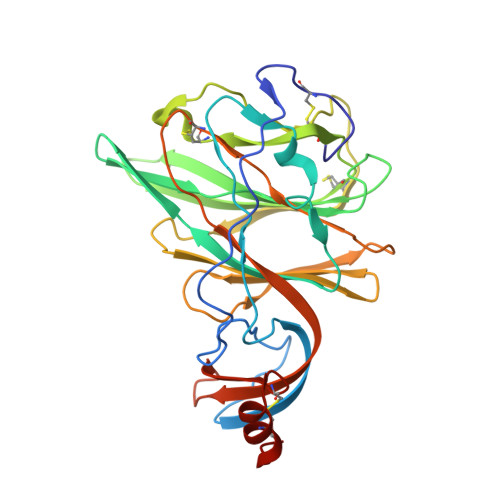
Crystal Structure of Bovine Coronavirus Spike Protein Lectin Domain


Experimental Data Snapshot

  • Method: X-RAY DIFFRACTION
  • Resolution: 1.55 Å
  • R-Value Free: 
    0.177 (Depositor), 0.177 (DCC) 
  • R-Value Work: 
    0.163 (Depositor), 0.162 (DCC) 
  • R-Value Observed: 
    0.163 (Depositor) 

wwPDB Validation   3D Report Full Report


Ligand Structure Quality Assessment 


This is version 2.1 of the entry. See complete history


Literature

Crystal structure of bovine coronavirus spike protein lectin domain.

Peng, G.Xu, L.Lin, Y.L.Chen, L.Pasquarella, J.R.Holmes, K.V.Li, F.

(2012) J Biological Chem 287: 41931-41938

  • DOI: https://doi.org/10.1074/jbc.M112.418210
  • Primary Citation of Related Structures:  
    4H14

  • PubMed Abstract: 

    The spike protein N-terminal domains (NTDs) of bovine coronavirus (BCoV) and mouse hepatitis coronavirus (MHV) recognize sugar and protein receptors, respectively, despite their significant sequence homology. We recently determined the crystal structure of MHV NTD complexed with its protein receptor murine carcinoembryonic antigen-related cell adhesion molecule 1 (CEACAM1), which surprisingly revealed a human galectin (galactose-binding lectin) fold in MHV NTD. Here, we have determined at 1.55 Å resolution the crystal structure of BCoV NTD, which also has the human galectin fold. Using mutagenesis, we have located the sugar-binding site in BCoV NTD, which overlaps with the galactose-binding site in human galectins. Using a glycan array screen, we have identified 5-N-acetyl-9-O-acetylneuraminic acid as the preferred sugar substrate for BCoV NTD. Subtle structural differences between BCoV and MHV NTDs, primarily involving different conformations of receptor-binding loops, explain why BCoV NTD does not bind CEACAM1 and why MHV NTD does not bind sugar. These results suggest a successful viral evolution strategy in which coronaviruses stole a galectin from hosts, incorporated it into their spike protein, and evolved it into viral receptor-binding domains with altered sugar specificity in contemporary BCoV or novel protein specificity in contemporary MHV.


  • Organizational Affiliation
    • Department of Pharmacology, University of Minnesota Medical School, Minneapolis, Minnesota 55455, USA.

Macromolecules
Find similar proteins by:  (by identity cutoff)  |  3D Structure
Entity ID: 1
MoleculeChains Sequence LengthOrganismDetailsImage
Spike glycoprotein290Bovine coronavirusMutation(s): 0 
UniProt
Find proteins for Q1HLC5 (Bovine coronavirus)
Explore Q1HLC5 
Go to UniProtKB:  Q1HLC5
Entity Groups  
Sequence Clusters30% Identity50% Identity70% Identity90% Identity95% Identity100% Identity
UniProt GroupQ1HLC5
Glycosylation
Glycosylation Sites: 2
Sequence Annotations
Expand
  • Reference Sequence
Oligosaccharides

Help

Entity ID: 2
MoleculeChains Length2D Diagram Glycosylation3D Interactions
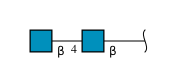
2-acetamido-2-deoxy-beta-D-glucopyranose-(1-4)-2-acetamido-2-deoxy-beta-D-glucopyranose
B, C
2N-Glycosylation
Glycosylation Resources
GlyTouCan:  G42666HT
GlyCosmos:  G42666HT
GlyGen:  G42666HT
Experimental Data & Validation

Experimental Data

  • Method: X-RAY DIFFRACTION
  • Resolution: 1.55 Å
  • R-Value Free:  0.177 (Depositor), 0.177 (DCC) 
  • R-Value Work:  0.163 (Depositor), 0.162 (DCC) 
  • R-Value Observed: 0.163 (Depositor) 
Space Group: P 31 2 1
Unit Cell:
Length ( Å )Angle ( ˚ )
a = 86.563α = 90
b = 86.563β = 90
c = 78.068γ = 120
Software Package:
Software NamePurpose
REFMACrefinement

Structure Validation

View Full Validation Report


Ligand Structure Quality Assessment 


Entry History 

Deposition Data

  • Released Date: 2012-10-31 
  • Deposition Author(s): Li, F.

Revision History  (Full details and data files)

  • Version 1.0: 2012-10-31
    Type: Initial release
  • Version 1.1: 2013-05-22
    Changes: Database references
  • Version 2.0: 2020-07-29
    Type: Remediation
    Reason: Carbohydrate remediation
    Changes: Advisory, Atomic model, Data collection, Database references, Derived calculations, Structure summary
  • Version 2.1: 2024-10-16
    Changes: Data collection, Database references, Structure summary