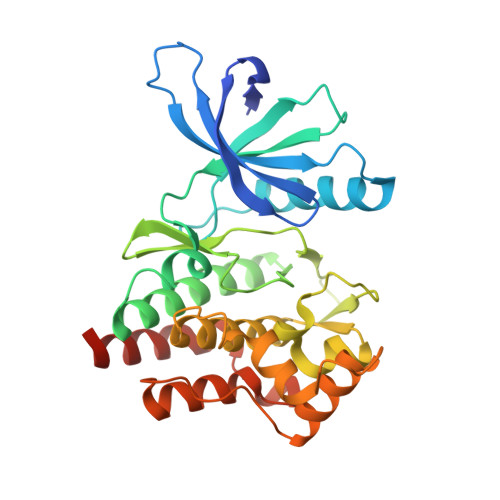
4GJ3 | pdb_00004gj3

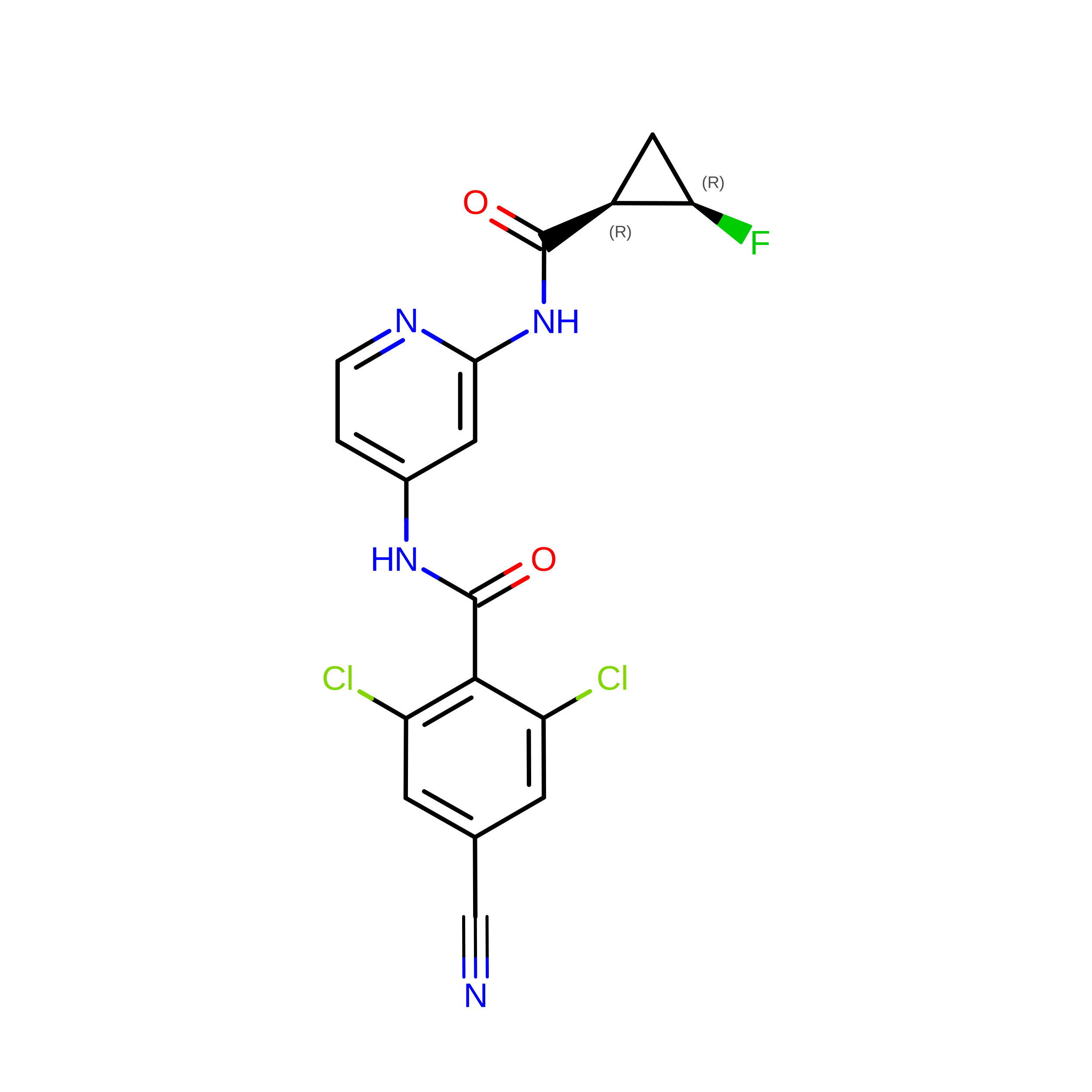
Tyk2 (JH1) in complex with 2,6-dichloro-4-cyano-N-[2-({[(1R,2R)-2-fluorocyclopropyl]carbonyl}amino)pyridin-4-yl]benzamide


Experimental Data Snapshot

  • Method: X-RAY DIFFRACTION
  • Resolution: 2.50 Å
  • R-Value Free: 
    0.260 (Depositor), 0.229 (DCC) 
  • R-Value Work: 
    0.207 (Depositor), 0.218 (DCC) 
  • R-Value Observed: 
    0.212 (Depositor) 

Starting Model: experimental
View more details

wwPDB Validation 3D Report Full Report

Validation slider image for 4GJ3

Ligand Structure Quality Assessment 


This is version 1.2 of the entry. See complete history

Literature

Lead Optimization of a 4-Aminopyridine Benzamide Scaffold To Identify Potent, Selective, and Orally Bioavailable TYK2 Inhibitors.

Liang, J.van Abbema, A.Balazs, M.Barrett, K.Berezhkovsky, L.Blair, W.Chang, C.Delarosa, D.Devoss, J.Driscoll, J.Eigenbrot, C.Ghilardi, N.Gibbons, P.Halladay, J.Johnson, A.Kohli, P.B.Lai, Y.Liu, Y.Lyssikatos, J.Mantik, P.Menghrajani, K.Murray, J.Peng, I.Sambrone, A.Shia, S.Shin, Y.Smith, J.Sohn, S.Tsui, V.Ultsch, M.Wu, L.C.Xiao, Y.Yang, W.Young, J.Zhang, B.Zhu, B.Y.Magnuson, S.

(2013) J Med Chem 56: 4521-4536

  • DOI: https://doi.org/10.1021/jm400266t
  • Primary Citation Related Structures: 
    4GII, 4GJ2, 4GJ3

  • PubMed Abstract: 

    Herein we report our lead optimization effort to identify potent, selective, and orally bioavailable TYK2 inhibitors, starting with lead molecule 3. We used structure-based design to discover 2,6-dichloro-4-cyanophenyl and (1R,2R)-2-fluorocyclopropylamide modifications, each of which exhibited improved TYK2 potency and JAK1 and JAK2 selectivity relative to 3. Further optimization eventually led to compound 37 that showed good TYK2 enzyme and interleukin-12 (IL-12) cell potency, as well as acceptable cellular JAK1 and JAK2 selectivity and excellent oral exposure in mice. When tested in a mouse IL-12 PK/PD model, compound 37 showed statistically significant knockdown of cytokine interferon-γ (IFNγ), suggesting that selective inhibition of TYK2 kinase activity might be sufficient to block the IL-12 pathway in vivo.


  • Organizational Affiliation
    • Department of Discovery Chemistry, Genentech, Inc., 1 DNA Way, South San Francisco, California 94080, USA. liang.jun@gene.com

Macromolecule Content 

  • Total Structure Weight: 35.14 kDa 
  • Atom Count: 2,427 
  • Modeled Residue Count: 288 
  • Deposited Residue Count: 302 
  • Unique protein chains: 1

Macromolecules

Find similar proteins by:|  3D Structure
Entity ID: 1
MoleculeChains  Sequence LengthOrganismDetailsImage
Non-receptor tyrosine-protein kinase TYK2302Homo sapiensMutation(s): 6 
Gene Names: Tyk2
EC: 2.7.10.2
UniProt & NIH Common Fund Data Resources
Find proteins for P29597 (Homo sapiens)
Explore P29597 
Go to UniProtKB:  P29597
PHAROS:  P29597
GTEx:  ENSG00000105397 
Entity Groups
Sequence Clusters30% Identity50% Identity70% Identity90% Identity95% Identity100% Identity
UniProt GroupP29597
Sequence Annotations
Expand
Reference Sequence

Small Molecules

Ligands 1 Unique
IDChains Name / Formula / InChI Key2D Diagram3D Interactions
0XP

Query on 0XP


Download:Ideal Coordinates CCD File
B [auth A]2,6-dichloro-4-cyano-N-[2-({[(1R,2R)-2-fluorocyclopropyl]carbonyl}amino)pyridin-4-yl]benzamide
C17 H11 Cl2 F N4 O2
TZBYGJGLZFYXII-GXFFZTMASA-N

Experimental Data & Validation

Experimental Data

  • Method: X-RAY DIFFRACTION
  • Resolution: 2.50 Å
  • R-Value Free:  0.260 (Depositor), 0.229 (DCC) 
  • R-Value Work:  0.207 (Depositor), 0.218 (DCC) 
  • R-Value Observed: 0.212 (Depositor) 
Space Group: P 21 21 21
Unit Cell:
Length ( Å )Angle ( ˚ )
a = 36.229α = 90
b = 74.203β = 90
c = 105.891γ = 90
Software Package:
Software NamePurpose
HKL-2000data collection
PHASERphasing
BUSTERrefinement
XDSdata reduction
SCALAdata scaling

Structure Validation

View Full Validation Report


Ligand Structure Quality Assessment 


Entry History 

Deposition Data

  • Released Date: 2013-05-29 
  • Deposition Author(s): Ultsch, M.H.

Revision History  (Full details and data files)

  • Version 1.0: 2013-05-29
    Type: Initial release
  • Version 1.1: 2013-06-26
    Changes: Database references
  • Version 1.2: 2023-09-13
    Changes: Data collection, Database references, Derived calculations, Refinement description