4GI4 | pdb_00004gi4

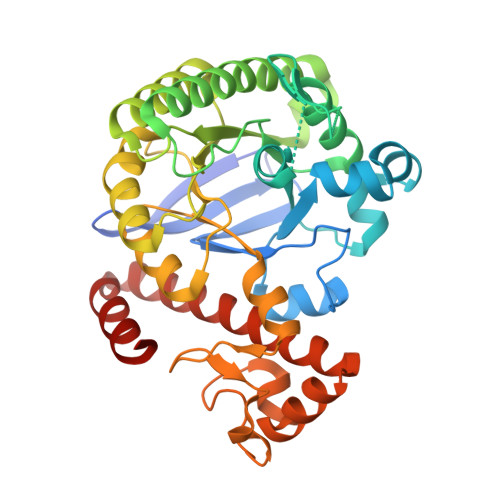
tRNA Guanine Transglycosylase in complex with disubstituted lin-benzoguanine inhibitor


Experimental Data Snapshot

  • Method: X-RAY DIFFRACTION
  • Resolution: 1.97 Å
  • R-Value Free: 
    0.248 (Depositor), 0.200 (DCC) 
  • R-Value Work: 
    0.188 (Depositor), 0.190 (DCC) 
  • R-Value Observed: 
    0.190 (Depositor) 

Starting Model: experimental
View more details

wwPDB Validation   3D Report Full Report


Ligand Structure Quality Assessment 


This is version 1.3 of the entry. See complete history


Literature

High-affinity inhibitors of Zymomonas mobilis tRNA-guanine transglycosylase through convergent optimization.

Barandun, L.J.Immekus, F.Kohler, P.C.Ritschel, T.Heine, A.Orlando, P.Klebe, G.Diederich, F.

(2013) Acta Crystallogr D Biol Crystallogr 69: 1798-1807

  • DOI: https://doi.org/10.1107/S0907444913014509
  • Primary Citation of Related Structures:  
    4GG9, 4GH1, 4GH3, 4GI4, 4GIY, 4GKT

  • PubMed Abstract: 

    The tRNA-modifying enzyme tRNA-guanine transglycosylase (TGT) has been recognized as a drug target for the treatment of the foodborne illness shigellosis. The active site of TGT consists of three pockets: the central guanine/preQ1 recognition site and the ribose-33 and ribose-34 pockets. In previous work, lin-benzoguanines and lin-benzohypoxanthines, which differ by the presence of an exocyclic NH2 group in the former and its absence in the latter, were used as central scaffolds that bind to the guanine/preQ1 recognition site and allow suitable functionalization along exit vectors targeting the two ribose pockets. The substituents for both of these two pockets have been optimized individually. Here, a series of bifunctionalized inhibitors that occupy both ribose pockets are reported for the first time. Dissociation constants Kd down to the picomolar range were measured for the bifunctionalized lin-benzoguanine-based ligands and Kd values in the nanomolar range were measured for the corresponding lin-benzohypoxanthine-based ligands. The binding mode of all inhibitors was elucidated by X-ray crystal structure analysis. A remarkable influence of the crystallization protocol on the solvation pattern in the solid state and the residual mobility of the bound ligands was observed.


  • Organizational Affiliation
    • Laboratorium für Organische Chemie, ETH Zürich, Hönggerberg, HCI, 8093 Zurich, Switzerland.

Macromolecules
Find similar proteins by:  (by identity cutoff)  |  3D Structure
Entity ID: 1
MoleculeChains Sequence LengthOrganismDetailsImage
Queuine tRNA-ribosyltransferase386Zymomonas mobilis subsp. mobilis ZM4 = ATCC 31821Mutation(s): 1 
Gene Names: tgtZMO0363
EC: 2.4.2.29
UniProt
Find proteins for P28720 (Zymomonas mobilis subsp. mobilis (strain ATCC 31821 / ZM4 / CP4))
Explore P28720 
Go to UniProtKB:  P28720
Entity Groups  
Sequence Clusters30% Identity50% Identity70% Identity90% Identity95% Identity100% Identity
UniProt GroupP28720
Sequence Annotations
Expand
  • Reference Sequence
Small Molecules
Ligands 2 Unique
IDChains Name / Formula / InChI Key2D Diagram3D Interactions
0EX
Query on 0EX

Download Ideal Coordinates CCD File 
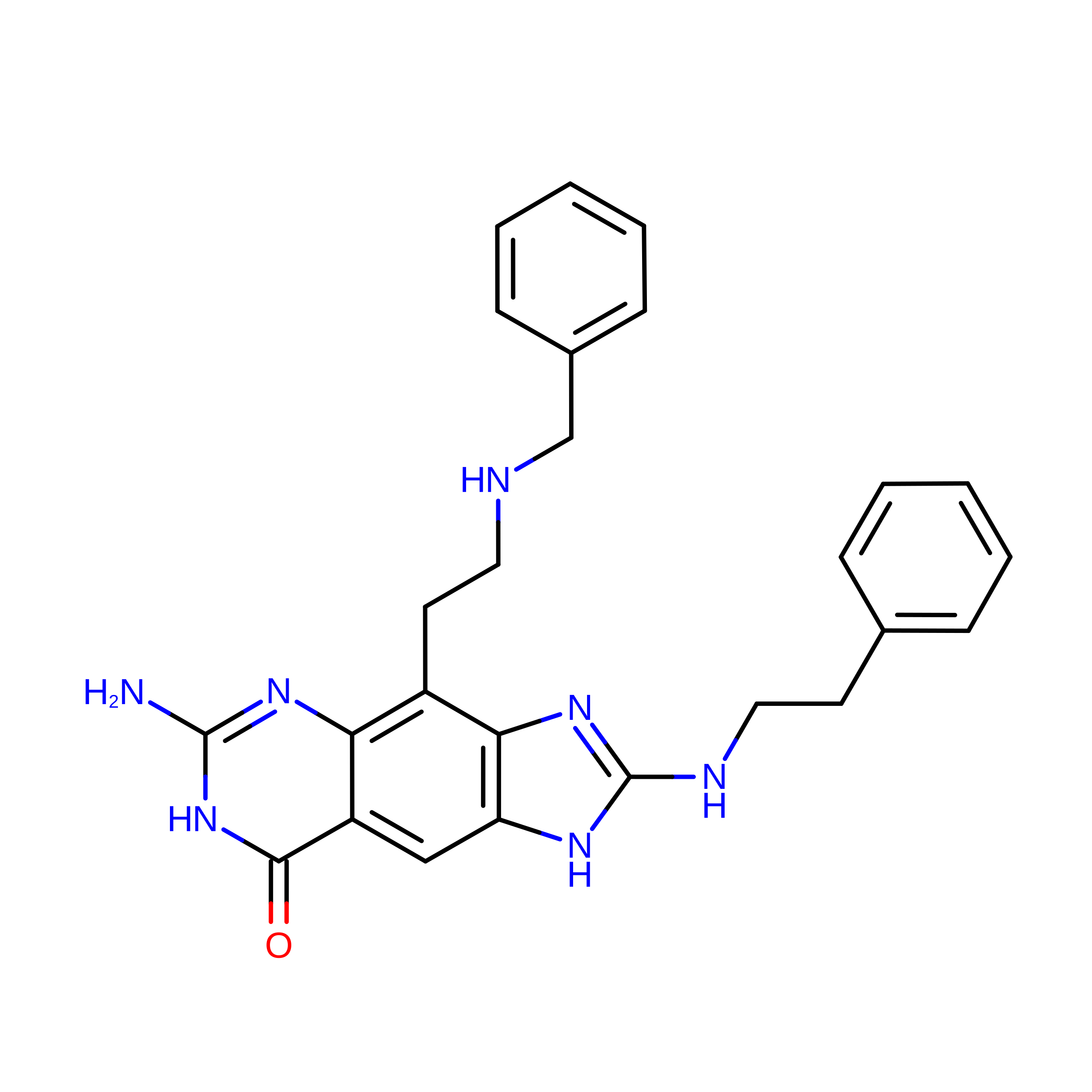
B [auth A]6-amino-4-[2-(benzylamino)ethyl]-2-[(2-phenylethyl)amino]-1,7-dihydro-8H-imidazo[4,5-g]quinazolin-8-one
C26 H27 N7 O
YCQZLEKKVPSANH-UHFFFAOYSA-N
ZN
Query on ZN

Download Ideal Coordinates CCD File 
C [auth A]ZINC ION
Zn
PTFCDOFLOPIGGS-UHFFFAOYSA-N
Experimental Data & Validation

Experimental Data

  • Method: X-RAY DIFFRACTION
  • Resolution: 1.97 Å
  • R-Value Free:  0.248 (Depositor), 0.200 (DCC) 
  • R-Value Work:  0.188 (Depositor), 0.190 (DCC) 
  • R-Value Observed: 0.190 (Depositor) 
Space Group: C 1 2 1
Unit Cell:
Length ( Å )Angle ( ˚ )
a = 89.85α = 90
b = 64.728β = 96.05
c = 70.65γ = 90
Software Package:
Software NamePurpose
SHELXL-97refinement
CNSrefinement
MAR345dtbdata collection
HKL-2000data reduction
HKL-2000data scaling
CNSphasing

Structure Validation

View Full Validation Report


Ligand Structure Quality Assessment 


Entry History 

Deposition Data

Revision History  (Full details and data files)

  • Version 1.0: 2013-09-04
    Type: Initial release
  • Version 1.1: 2019-07-17
    Changes: Data collection, Refinement description
  • Version 1.2: 2023-09-13
    Changes: Data collection, Database references, Derived calculations, Refinement description
  • Version 1.3: 2025-11-12
    Changes: Database references, Structure summary