4GB1 | pdb_00004gb1

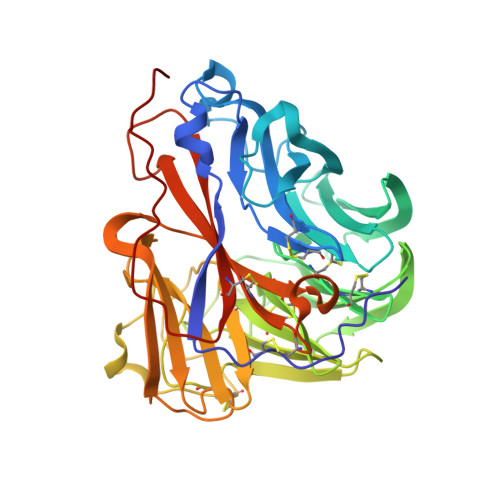
Synthesis and Evaluation of Novel 3-C-alkylated-Neu5Ac2en Derivatives as Probes of Influenza Virus Sialidase 150-loop flexibility


Experimental Data Snapshot

  • Method: X-RAY DIFFRACTION
  • Resolution: 2.62 Å
  • R-Value Free: 
    0.280 (Depositor), 0.270 (DCC) 
  • R-Value Work: 
    0.204 (Depositor), 0.199 (DCC) 
  • R-Value Observed: 
    0.208 (Depositor) 

Starting Model: experimental
View more details

wwPDB Validation 3D Report Full Report

Validation slider image for 4GB1

Ligand Structure Quality Assessment 


This is version 2.3 of the entry. See complete history

Literature

Synthesis and evaluation of novel 3-C-alkylated-Neu5Ac2en derivatives as probes of influenza virus sialidase 150-loop flexibility.

Rudrawar, S.Kerry, P.S.Rameix-Welti, M.A.Maggioni, A.Dyason, J.C.Rose, F.J.van der Werf, S.Thomson, R.J.Naffakh, N.Russell, R.J.von Itzstein, M.

(2012) Org Biomol Chem 10: 8628-8639

  • DOI: https://doi.org/10.1039/c2ob25627d
  • Primary Citation Related Structures: 
    4GB1

  • PubMed Abstract: 

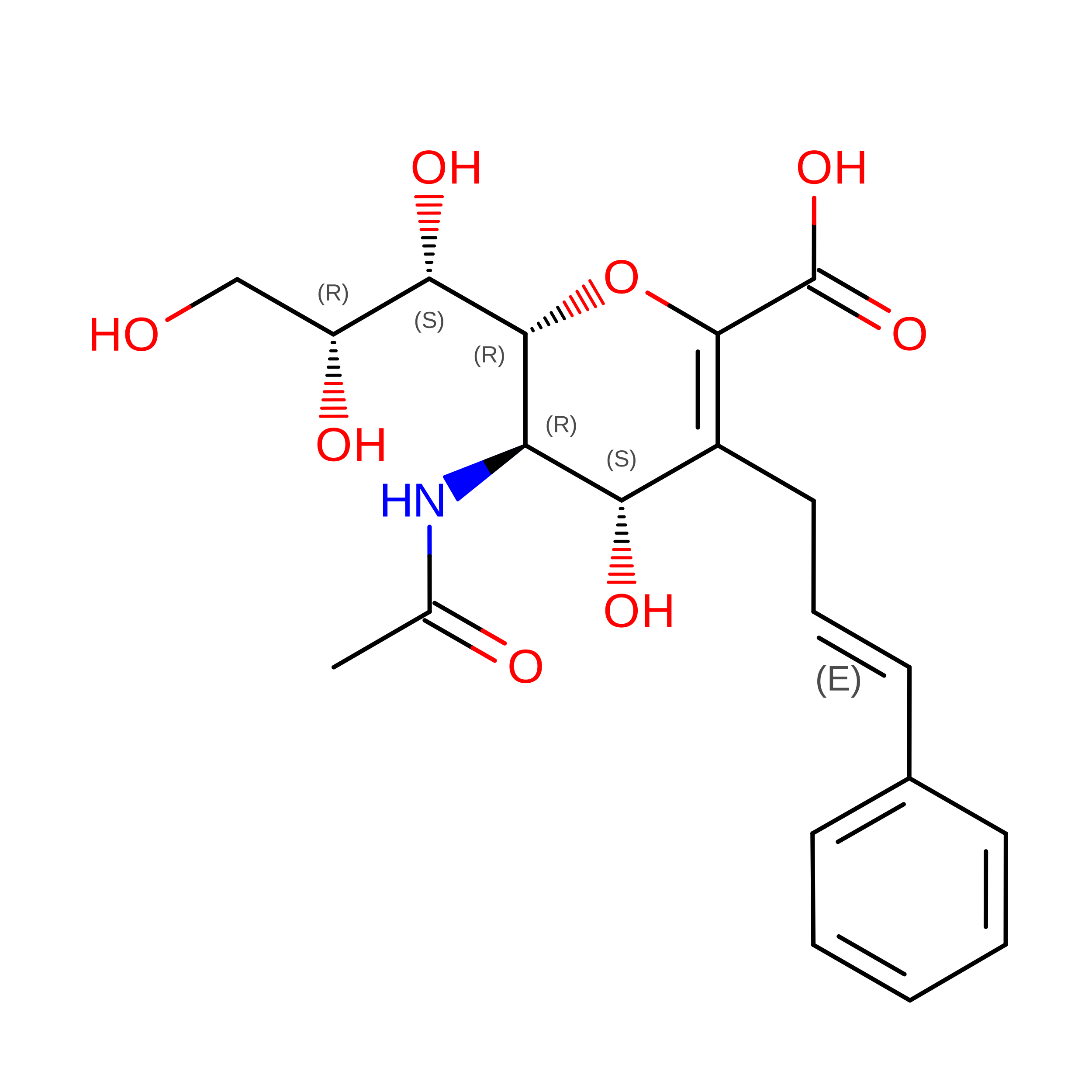
    Novel 3-C-alkylated-Neu5Ac2en derivatives have been designed to target the expanded active site cavity of influenza virus sialidases with an open 150-loop, currently seen in X-ray crystal structures of influenza A virus group-1 (N1, N4, N5, N8), but not group-2 (N2, N9), sialidases. The compounds show selectivity for inhibition of H5N1 and pdm09 H1N1 sialidases over an N2 sialidase, providing evidence of the relative 150-loop flexibility of these sialidases. In a complex with N8 sialidase, the C3 substituent of 3-phenylally-Neu5Ac2en occupies the 150-cavity while the central ring and the remaining substituents bind the active site as seen for the unsubstituted template. This new class of inhibitors, which can 'trap' the open 150-loop form of the sialidase, should prove useful as probes of 150-loop flexibility.


  • Organizational Affiliation
    • Institute for Glycomics, Gold Coast Campus, Griffith University, Queensland 4222, Australia.

Macromolecule Content 

  • Total Structure Weight: 43.66 kDa 
  • Atom Count: 3,150 
  • Modeled Residue Count: 387 
  • Deposited Residue Count: 390 
  • Unique protein chains: 1

Macromolecules

Find similar proteins by:|  3D Structure
Entity ID: 1
MoleculeChains  Sequence LengthOrganismDetailsImage
Neuraminidase390Influenza A virus (A/duck/Ukraine/1/1963(H3N8))Mutation(s): 0 
EC: 3.2.1.18
UniProt
Find proteins for Q07599 (Influenza A virus (strain A/Duck/Ukraine/1/1963 H3N8))
Explore Q07599 
Go to UniProtKB:  Q07599
Entity Groups
Sequence Clusters30% Identity50% Identity70% Identity90% Identity95% Identity100% Identity
UniProt GroupQ07599
Sequence Annotations
Expand
Reference Sequence

Small Molecules

Ligands 2 Unique
IDChains Name / Formula / InChI Key2D Diagram3D Interactions
0LP

Query on 0LP


Download:Ideal Coordinates CCD File
B [auth A]5-acetamido-2,6-anhydro-3,5-dideoxy-3-[(2E)-3-phenylprop-2-en-1-yl]-D-glycero-L-altro-non-2-enonic acid
C20 H25 N O8
LRXKGKMIXXSWGY-KXNCHKOWSA-N
CA

Query on CA


Download:Ideal Coordinates CCD File
C [auth A]CALCIUM ION
Ca
BHPQYMZQTOCNFJ-UHFFFAOYSA-N

Experimental Data & Validation

Experimental Data

  • Method: X-RAY DIFFRACTION
  • Resolution: 2.62 Å
  • R-Value Free:  0.280 (Depositor), 0.270 (DCC) 
  • R-Value Work:  0.204 (Depositor), 0.199 (DCC) 
  • R-Value Observed: 0.208 (Depositor) 
Space Group: I 4
Unit Cell:
Length ( Å )Angle ( ˚ )
a = 90.501α = 90
b = 90.501β = 90
c = 108.731γ = 90
Software Package:
Software NamePurpose
StructureStudiodata collection
PHENIXrefinement
HKL-2000data reduction
HKL-2000data scaling

Structure Validation

View Full Validation Report


Ligand Structure Quality Assessment 


Entry History 

Revision History  (Full details and data files)

  • Version 1.0: 2012-09-26
    Type: Initial release
  • Version 1.1: 2012-10-31
    Changes: Database references
  • Version 1.2: 2018-01-24
    Changes: Structure summary
  • Version 2.0: 2020-04-22
    Changes: Atomic model, Data collection, Database references, Structure summary
  • Version 2.1: 2020-07-29
    Type: Remediation
    Reason: Carbohydrate remediation
    Changes: Derived calculations, Structure summary
  • Version 2.2: 2023-09-13
    Changes: Data collection, Database references, Refinement description, Structure summary
  • Version 2.3: 2024-10-30
    Changes: Structure summary