4FHI | pdb_00004fhi

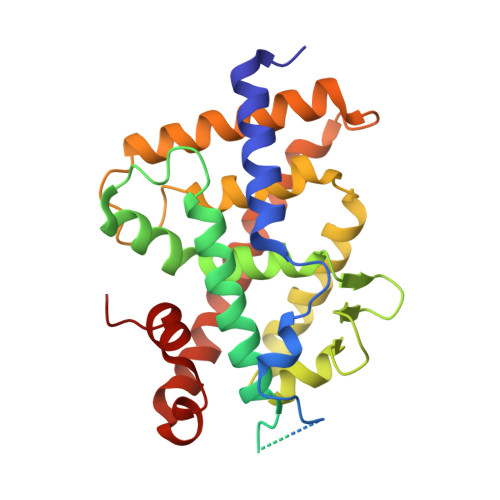
Development of synthetically accessible non-secosteroidal hybrid molecules combining vitamin D receptor agonism and histone deacetylase inhibition


Experimental Data Snapshot

  • Method: X-RAY DIFFRACTION
  • Resolution: 2.40 Å
  • R-Value Free: 
    0.253 (Depositor), 0.261 (DCC) 
  • R-Value Work: 
    0.214 (Depositor), 0.222 (DCC) 
  • R-Value Observed: 
    0.214 (Depositor) 

wwPDB Validation 3D Report Full Report

Validation slider image for 4FHI

Ligand Structure Quality Assessment 


This is version 1.2 of the entry. See complete history

Literature

Synthetically accessible non-secosteroidal hybrid molecules combining vitamin d receptor agonism and histone deacetylase inhibition.

Fischer, J.Wang, T.T.Kaldre, D.Rochel, N.Moras, D.White, J.H.Gleason, J.L.

(2012) Chem Biol 19: 963-971

  • DOI: https://doi.org/10.1016/j.chembiol.2012.05.024
  • Primary Citation Related Structures: 
    4FHH, 4FHI

  • PubMed Abstract: 

    1,25-Dihydroxyvitamin D(3) (1,25D), the hormonal form of vitamin D, and several analogs have failed as monotherapies for cancer because of poor efficacy or acquired resistance. However, 1,25D analogs are amenable to bifunctionalization. Preclinical studies have revealed combinatorial effects of 1,25D analogs and histone deacetylase inhibitors (HDACi). Secosteroidal hybrid molecules combining vitamin D receptor (VDR) agonism with HDACi displayed enhanced efficacy but are laborious to synthesize. Here, we have developed easily assembled, fully integrated, non-secosteroidal VDR agonist/HDACi hybrids. The most promising are full VDR agonists with ~10-fold lower potency than 1,25D. Structure/function studies revealed that antiproliferative activity against 1,25D-resistant squamous carcinoma cells required VDR agonism and HDACi. Remarkably, modeling and X-ray crystallography reveal non-secosteroidal hybrids bind in the VDR ligand binding domain in the opposite orientation of their secosteroidal counterparts.


  • Organizational Affiliation
    • Department of Chemistry, McGill University, Montreal, Quebec H3A 0G4, Canada.

Macromolecule Content 

  • Total Structure Weight: 35.95 kDa 
  • Atom Count: 2,105 
  • Modeled Residue Count: 248 
  • Deposited Residue Count: 313 
  • Unique protein chains: 2

Macromolecules

Find similar proteins by:|  3D Structure
Entity ID: 1
MoleculeChains  Sequence LengthOrganismDetailsImage
Vitamin Nuclear Receptor300Danio rerioMutation(s): 0 
UniProt
Find proteins for Q9PTN2 (Danio rerio)
Explore Q9PTN2 
Go to UniProtKB:  Q9PTN2
Entity Groups
Sequence Clusters30% Identity50% Identity70% Identity90% Identity95% Identity100% Identity
UniProt GroupQ9PTN2
Sequence Annotations
Expand
Reference Sequence
Find similar proteins by:  Sequence   |   3D Structure  
Entity ID: 2
MoleculeChains  Sequence LengthOrganismDetailsImage
SRC-113Homo sapiensMutation(s): 0 
UniProt & NIH Common Fund Data Resources
Find proteins for Q15596 (Homo sapiens)
Explore Q15596 
Go to UniProtKB:  Q15596
PHAROS:  Q15596
GTEx:  ENSG00000140396 
Entity Groups
Sequence Clusters30% Identity50% Identity70% Identity90% Identity95% Identity100% Identity
UniProt GroupQ15596
Sequence Annotations
Expand
Reference Sequence

Small Molecules

Ligands 1 Unique
IDChains Name / Formula / InChI Key2D Diagram3D Interactions
0S4

Query on 0S4


Download:Ideal Coordinates CCD File
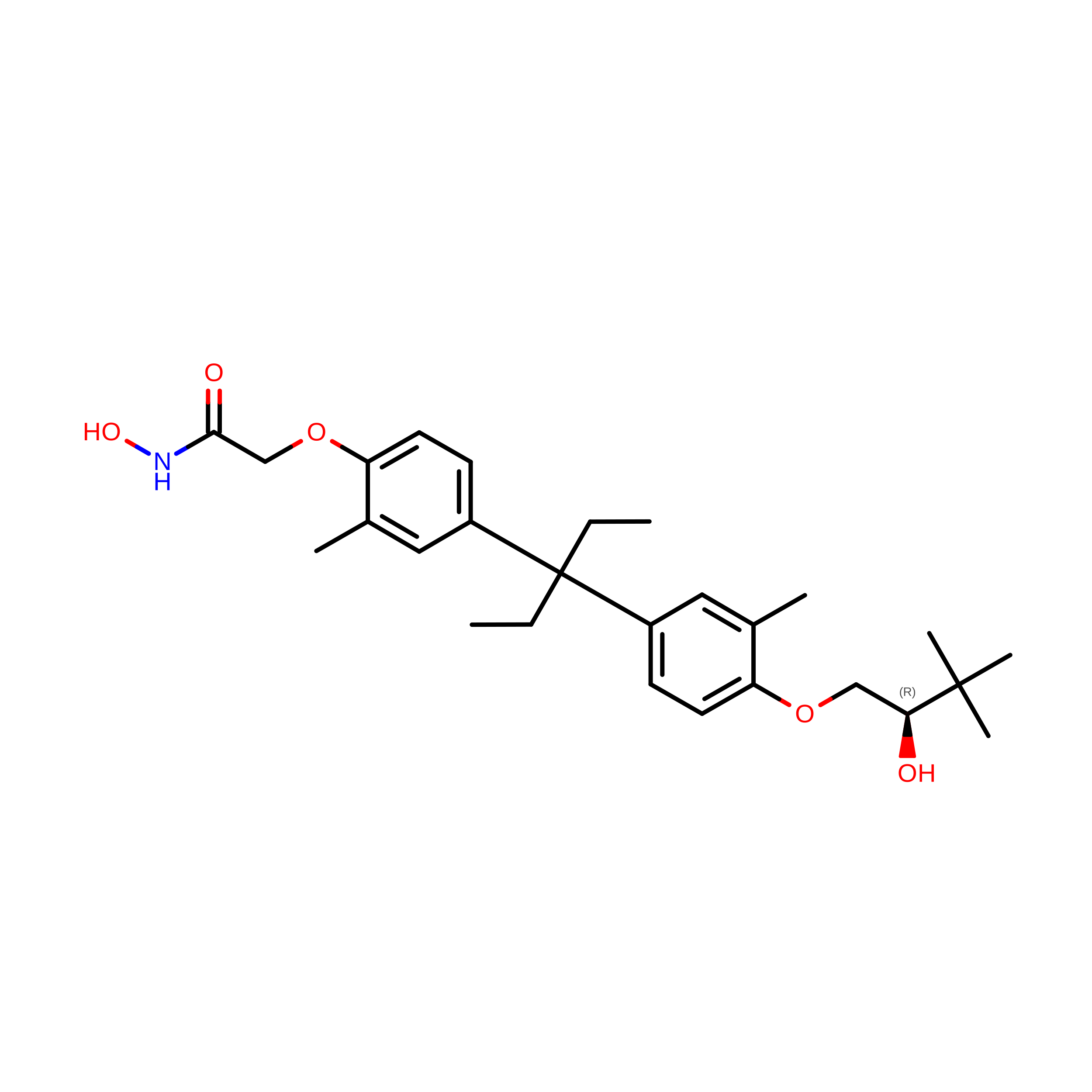
C [auth A]N-hydroxy-2-{4-[3-(4-{[(2R)-2-hydroxy-3,3-dimethylbutyl]oxy}-3-methylphenyl)pentan-3-yl]-2-methylphenoxy}acetamide
C27 H39 N O5
HLEDBIQBAUIWNJ-DEOSSOPVSA-N

Experimental Data & Validation

Experimental Data

  • Method: X-RAY DIFFRACTION
  • Resolution: 2.40 Å
  • R-Value Free:  0.253 (Depositor), 0.261 (DCC) 
  • R-Value Work:  0.214 (Depositor), 0.222 (DCC) 
  • R-Value Observed: 0.214 (Depositor) 
Space Group: P 65 2 2
Unit Cell:
Length ( Å )Angle ( ˚ )
a = 66.3α = 90
b = 66.3β = 90
c = 264.509γ = 120
Software Package:
Software NamePurpose
HKL-2000data collection
CNSrefinement
HKL-2000data reduction
HKL-2000data scaling
CNSphasing

Structure Validation

View Full Validation Report


Ligand Structure Quality Assessment 


Entry History 

Deposition Data

Revision History  (Full details and data files)

  • Version 1.0: 2012-09-19
    Type: Initial release
  • Version 1.1: 2021-03-10
    Changes: Derived calculations
  • Version 1.2: 2024-02-28
    Changes: Data collection, Database references