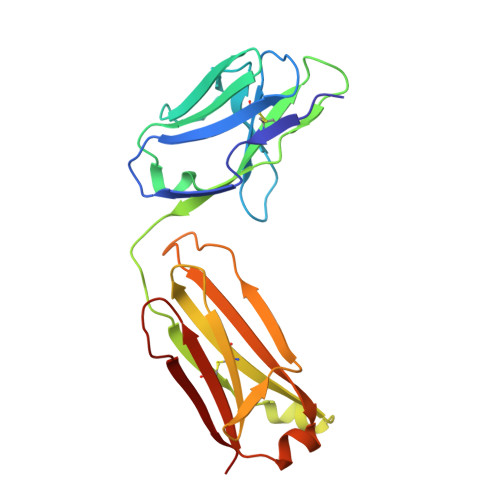
4FG6 | pdb_00004fg6

Structure of EcCLC E148A mutant in Glutamate


Experimental Data Snapshot

  • Method: X-RAY DIFFRACTION
  • Resolution: 3.02 Å
  • R-Value Free: 
    0.274 (Depositor), 0.271 (DCC) 
  • R-Value Work: 
    0.237 (Depositor), 0.233 (DCC) 
  • R-Value Observed: 
    0.239 (Depositor) 

Starting Model: experimental
View more details

wwPDB Validation 3D Report Full Report

Validation slider image for 4FG6

This is version 1.6 of the entry. See complete history

Literature

Molecular mechanism of proton transport in CLC Cl-/H+ exchange transporters.

Feng, L.Campbell, E.B.MacKinnon, R.

(2012) Proc Natl Acad Sci U S A 109: 11699-11704

  • DOI: https://doi.org/10.1073/pnas.1205764109
  • Primary Citation Related Structures: 
    4FG6

  • PubMed Abstract: 

    CLC proteins underlie muscle, kidney, bone, and other organ system function by catalyzing the transport of Cl(-) ions across cell and organellar membranes. Some CLC proteins are ion channels while others are pumps that exchange Cl(-) for H(+). The pathway through which Cl(-) ions cross the membrane has been characterized, but the transport of H(+) and the principle by which their movement is coupled to Cl(-) movement is not well understood. Here we show that H(+) transport depends not only on the presence of a specific glutamate residue but also the presence of Cl(-) ions. H(+) transport, however, can be isolated and analyzed in the absence of Cl(-) by mutating the glutamate to alanine and adding carboxylate-containing molecules to solution, consistent with the notion that H(+) transfer is mediated through the entry of a carboxylate group into the anion pathway. Cl(-) ions and carboxylate interact with each other strongly. These data support a mechanism in which the glutamate carboxylate functions as a surrogate Cl(-) ion, but it can accept a H(+) and transfer it between the external solution and the central Cl(-) binding site, coupled to the movement of 2 Cl(-) ions.


  • Organizational Affiliation
    • Laboratory of Molecular Neurobiology and Biophysics, Rockefeller University, Howard Hughes Medical Institute, 1230 York Avenue, New York, NY 10065, USA.

Macromolecule Content 

  • Total Structure Weight: 193.02 kDa 
  • Atom Count: 13,158 
  • Modeled Residue Count: 1,749 
  • Deposited Residue Count: 1,796 
  • Unique protein chains: 3

Macromolecules

Find similar proteins by:|  3D Structure
Entity ID: 1
MoleculeChains  Sequence LengthOrganismDetailsImage
H(+)/Cl(-) exchange transporter ClcA
A, B
465Escherichia coli K-12Mutation(s): 0 
Gene Names: b0155clcAeriCJW5012SSON_0167yadQ
Membrane Entity: Yes 
UniProt
Find proteins for P37019 (Escherichia coli (strain K12))
Explore P37019 
Go to UniProtKB:  P37019
Entity Groups
Sequence Clusters30% Identity50% Identity70% Identity90% Identity95% Identity100% Identity
UniProt GroupP37019
Sequence Annotations
Expand
Reference Sequence
Find similar proteins by:|  3D Structure
Entity ID: 2
MoleculeChains  Sequence LengthOrganismDetailsImage
Fab fragment (Heavy chain)
C, E
222Mus musculusMutation(s): 0 
Find similar proteins by:|  3D Structure
Entity ID: 3
MoleculeChains  Sequence LengthOrganismDetailsImage
Fab fragment (Light chain)
D, F
211Mus musculusMutation(s): 0 

Experimental Data & Validation

Experimental Data

  • Method: X-RAY DIFFRACTION
  • Resolution: 3.02 Å
  • R-Value Free:  0.274 (Depositor), 0.271 (DCC) 
  • R-Value Work:  0.237 (Depositor), 0.233 (DCC) 
  • R-Value Observed: 0.239 (Depositor) 
Space Group: C 1 2 1
Unit Cell:
Length ( Å )Angle ( ˚ )
a = 221.455α = 90
b = 121.284β = 128.08
c = 151.698γ = 90
Software Package:
Software NamePurpose
DENZOdata reduction
SCALEPACKdata scaling
PHENIXrefinement
PDB_EXTRACTdata extraction

Structure Validation

View Full Validation Report


Entry History 

Deposition Data

Revision History  (Full details and data files)

  • Version 1.0: 2012-07-04
    Type: Initial release
  • Version 1.1: 2012-07-25
    Changes: Database references
  • Version 1.2: 2013-01-02
    Changes: Database references
  • Version 1.3: 2016-11-09
    Changes: Structure summary
  • Version 1.4: 2017-11-08
    Changes: Refinement description, Source and taxonomy
  • Version 1.5: 2023-09-13
    Changes: Data collection, Database references, Refinement description
  • Version 1.6: 2024-11-27
    Changes: Structure summary