4FEA | pdb_00004fea

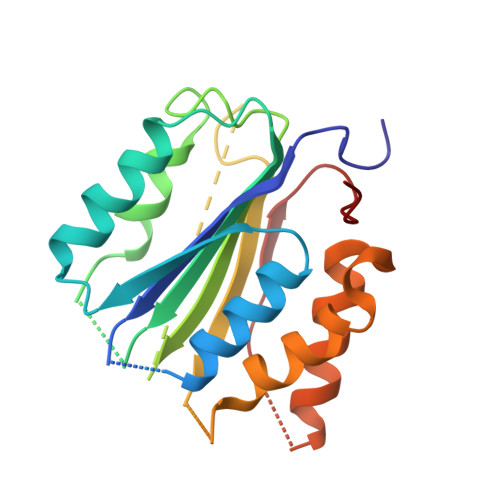
Crystal structure of CASPASE-7 in Complex with allosteric inhibitor


Experimental Data Snapshot

  • Method: X-RAY DIFFRACTION
  • Resolution: 3.79 Å
  • R-Value Free: 
    0.286 (Depositor), 0.280 (DCC) 
  • R-Value Work: 
    0.236 (Depositor), 0.242 (DCC) 
  • R-Value Observed: 
    0.242 (Depositor) 

Starting Model: experimental
View more details

wwPDB Validation 3D Report Full Report

Validation slider image for 4FEA

Ligand Structure Quality Assessment 


This is version 1.2 of the entry. See complete history

Literature

A class of allosteric caspase inhibitors identified by high-throughput screening.

Feldman, T.Kabaleeswaran, V.Jang, S.B.Antczak, C.Djaballah, H.Wu, H.Jiang, X.

(2012) Mol Cell 47: 585-595

  • DOI: https://doi.org/10.1016/j.molcel.2012.06.007
  • Primary Citation Related Structures: 
    4FDL, 4FEA

  • PubMed Abstract: 

    Caspase inhibition is a promising approach for treating multiple diseases. Using a reconstituted assay and high-throughput screening, we identified a group of nonpeptide caspase inhibitors. These inhibitors share common chemical scaffolds, suggesting the same mechanism of action. They can inhibit apoptosis in various cell types induced by multiple stimuli; they can also inhibit caspase-1-mediated interleukin generation in macrophages, indicating potential anti-inflammatory application. While these compounds inhibit all the tested caspases, kinetic analysis indicates they do not compete for the catalytic sites of the enzymes. The cocrystal structure of one of these compounds with caspase-7 reveals that it binds to the dimerization interface of the caspase, another common structural element shared by all active caspases. Consistently, biochemical analysis demonstrates that the compound abates caspase-8 dimerization. Based on these kinetic, biochemical, and structural analyses, we suggest that these compounds are allosteric caspase inhibitors that function through binding to the dimerization interface of caspases.


  • Organizational Affiliation
    • Cell Biology Program, Memorial Sloan-Kettering Cancer Center, New York, NY 10065, USA.

Macromolecule Content 

  • Total Structure Weight: 56.95 kDa 
  • Atom Count: 2,795 
  • Modeled Residue Count: 366 
  • Deposited Residue Count: 494 
  • Unique protein chains: 1

Macromolecules

Find similar proteins by:|  3D Structure
Entity ID: 1
MoleculeChains  Sequence LengthOrganismDetailsImage
Caspase-7
A, B
247Homo sapiensMutation(s): 0 
Gene Names: CASP7MCH3
EC: 3.4.22.60
UniProt & NIH Common Fund Data Resources
Find proteins for P55210 (Homo sapiens)
Explore P55210 
Go to UniProtKB:  P55210
PHAROS:  P55210
GTEx:  ENSG00000165806 
Entity Groups
Sequence Clusters30% Identity50% Identity70% Identity90% Identity95% Identity100% Identity
UniProt GroupP55210
Sequence Annotations
Expand
Reference Sequence

Small Molecules

Ligands 1 Unique
IDChains Name / Formula / InChI Key2D Diagram3D Interactions
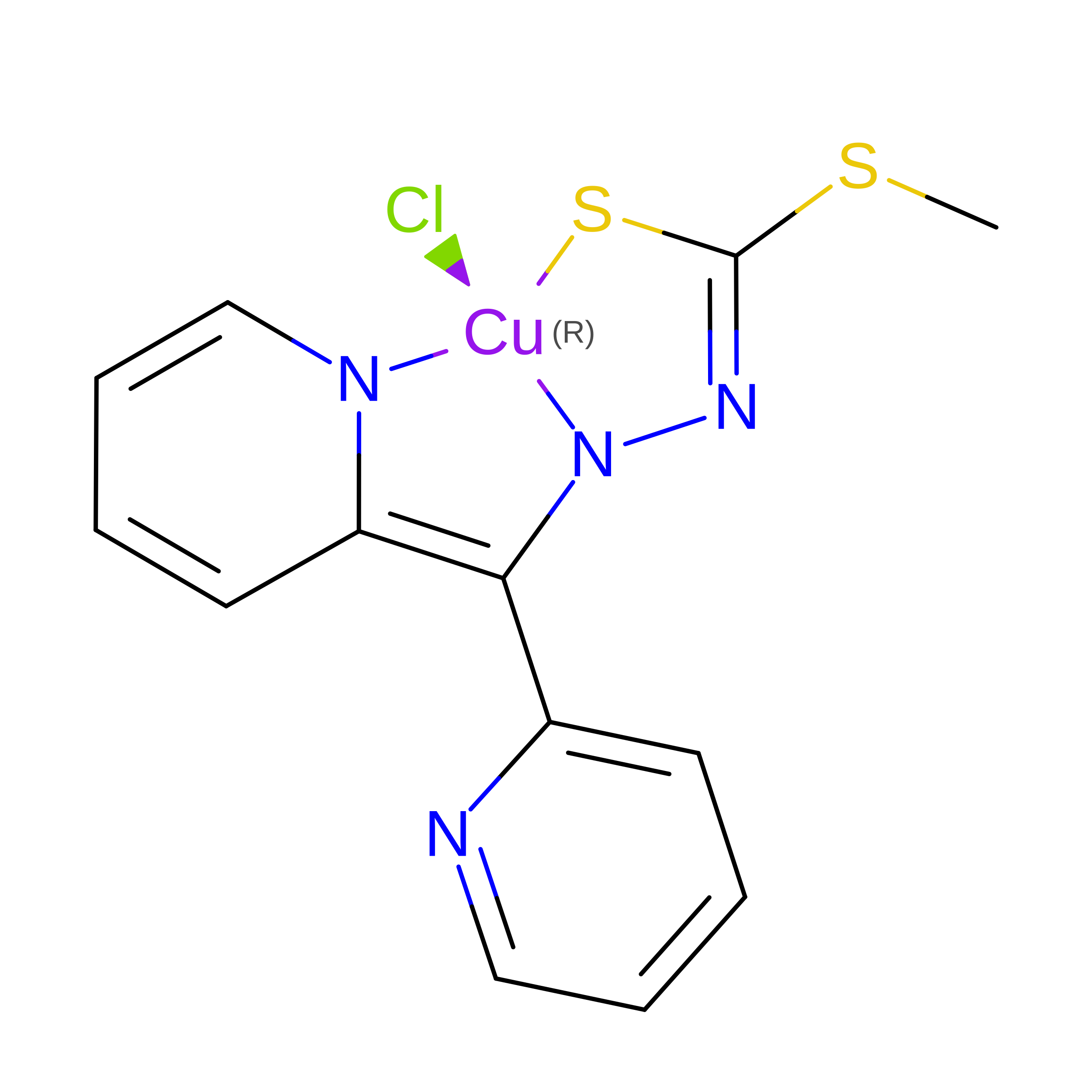
0TE

Query on 0TE


Download:Ideal Coordinates CCD File
C [auth A],
D [auth B]
chloro{methyl hydrogenato(3-)-kappa~2~N,S [pyridin-2-yl(pyridin-2(1H)-ylidene-kappaN)methyl]carbonodithiohydrazonate}copper
C13 H11 Cl Cu N4 S2
YLWQIHKUHNHPEC-UHFFFAOYSA-L

Experimental Data & Validation

Experimental Data

  • Method: X-RAY DIFFRACTION
  • Resolution: 3.79 Å
  • R-Value Free:  0.286 (Depositor), 0.280 (DCC) 
  • R-Value Work:  0.236 (Depositor), 0.242 (DCC) 
  • R-Value Observed: 0.242 (Depositor) 
Space Group: P 32 2 1
Unit Cell:
Length ( Å )Angle ( ˚ )
a = 88.72α = 90
b = 88.72β = 90
c = 185.66γ = 120
Software Package:
Software NamePurpose
SCALAdata scaling
PHASERphasing
PHENIXrefinement
PDB_EXTRACTdata extraction
Blu-Icedata collection
XDSdata reduction

Structure Validation

View Full Validation Report


Ligand Structure Quality Assessment 


Entry History 

Deposition Data

Revision History  (Full details and data files)

  • Version 1.0: 2012-08-01
    Type: Initial release
  • Version 1.1: 2012-09-12
    Changes: Database references
  • Version 1.2: 2023-09-13
    Changes: Data collection, Database references, Derived calculations, Refinement description