4ENY | pdb_00004eny

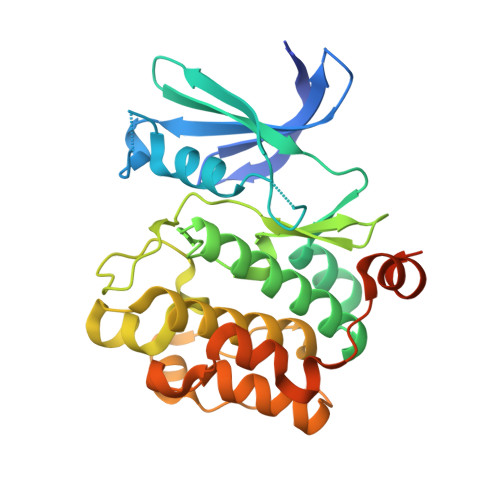
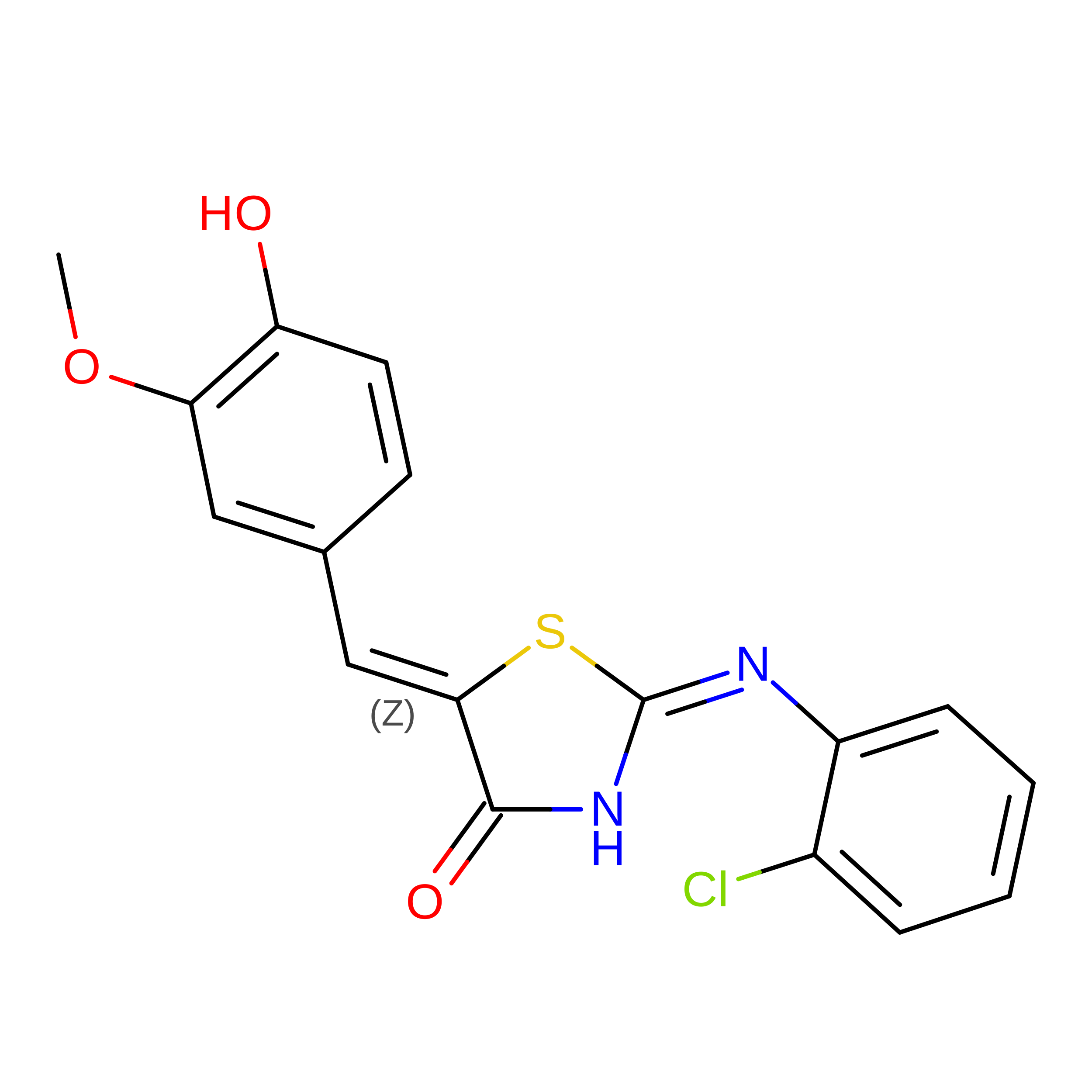
Crystal Structure of Pim-1 kinase in complex with (2E,5Z)-2-(2-chlorophenylimino)-5-(4-hydroxy-3-methoxybenzylidene)thiazolidin-4-one


Experimental Data Snapshot

  • Method: X-RAY DIFFRACTION
  • Resolution: 2.80 Å
  • R-Value Free: 
    0.224 (Depositor), 0.218 (DCC) 
  • R-Value Work: 
    0.173 (Depositor), 0.165 (DCC) 
  • R-Value Observed: 
    0.175 (Depositor) 

Starting Model: experimental
View more details

wwPDB Validation 3D Report Full Report

Validation slider image for 4ENY

Ligand Structure Quality Assessment 


This is version 1.2 of the entry. See complete history

Literature

Flexibility of the P-loop of Pim-1 kinase: observation of a novel conformation induced by interaction with an inhibitor

Parker, L.J.Watanabe, H.Tsuganezawa, K.Tomabechi, Y.Handa, N.Shirouzu, M.Yuki, H.Honma, T.Ogawa, N.Nagano, T.Yokoyama, S.Tanaka, A.

(2012) Acta Crystallogr Sect F Struct Biol Cryst Commun 68: 860-866

  • DOI: https://doi.org/10.1107/S1744309112027108
  • Primary Citation Related Structures: 
    3UMX, 4ENX, 4ENY

  • PubMed Abstract: 

    The serine/threonine kinase Pim-1 is emerging as a promising target for cancer therapeutics. Much attention has recently been focused on identifying potential Pim-1 inhibitor candidates for the treatment of haematopoietic malignancies. The outcome of a rational drug-design project has recently been reported [Nakano et al. (2012), J. Med. Chem. 55, 5151-5156]. The report described the process of optimization of the structure-activity relationship and detailed from a medicinal chemistry perspective the development of a low-potency and nonselective compound initially identified from in silico screening into a potent, selective and metabolically stable Pim-1 inhibitor. Here, the structures of the initial in silico hits are reported and the noteworthy features of the Pim-1 complex structures are described. A particular focus was placed on the rearrangement of the glycine-rich P-loop region that was observed for one of the initial compounds, (Z)-7-(azepan-1-ylmethyl)-2-[(1H-indol-3-yl)methylidene]-6-hydroxy-1-benzofuran-3(2H)-one (compound 1), and was also found in all further derivatives. This novel P-loop conformation, which appears to be stabilized by an additional interaction with the β3 strand located above the binding site, is not usually observed in Pim-1 structures.


  • Organizational Affiliation
    • RIKEN Systems and Structural Biology Center, 1-7-22 Suehiro-cho, Tsurumi, Yokohama 230-0045, Japan.

Macromolecule Content 

  • Total Structure Weight: 34.81 kDa 
  • Atom Count: 2,247 
  • Modeled Residue Count: 261 
  • Deposited Residue Count: 298 
  • Unique protein chains: 1

Macromolecules

Find similar proteins by:|  3D Structure
Entity ID: 1
MoleculeChains  Sequence LengthOrganismDetailsImage
Serine/threonine-protein kinase pim-1298Homo sapiensMutation(s): 0 
Gene Names: PIM1
EC: 2.7.11.1
UniProt & NIH Common Fund Data Resources
Find proteins for P11309 (Homo sapiens)
Explore P11309 
Go to UniProtKB:  P11309
PHAROS:  P11309
GTEx:  ENSG00000137193 
Entity Groups
Sequence Clusters30% Identity50% Identity70% Identity90% Identity95% Identity100% Identity
UniProt GroupP11309
Sequence Annotations
Expand
Reference Sequence

Experimental Data & Validation

Experimental Data

  • Method: X-RAY DIFFRACTION
  • Resolution: 2.80 Å
  • R-Value Free:  0.224 (Depositor), 0.218 (DCC) 
  • R-Value Work:  0.173 (Depositor), 0.165 (DCC) 
  • R-Value Observed: 0.175 (Depositor) 
Space Group: P 65
Unit Cell:
Length ( Å )Angle ( ˚ )
a = 96.765α = 90
b = 96.765β = 90
c = 80.963γ = 120
Software Package:
Software NamePurpose
MOSFLMdata reduction
SCALAdata scaling
PHASERphasing
PHENIXrefinement
PDB_EXTRACTdata extraction
CrystalCleardata collection

Structure Validation

View Full Validation Report


Ligand Structure Quality Assessment 


Entry History 

Deposition Data

Revision History  (Full details and data files)

  • Version 1.0: 2012-08-08
    Type: Initial release
  • Version 1.1: 2012-10-03
    Changes: Database references
  • Version 1.2: 2023-11-08
    Changes: Data collection, Database references, Derived calculations, Refinement description