4DPW | pdb_00004dpw

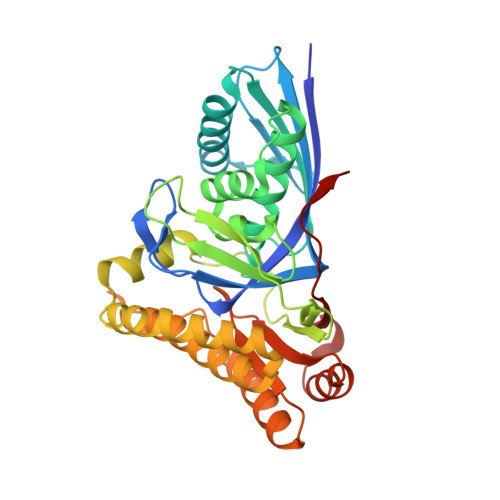
Crystal structure of Staphylococcus epidermidis D283A mevalonate diphosphate decarboxylase complexed with mevalonate diphosphate and ATPgS


Experimental Data Snapshot

  • Method: X-RAY DIFFRACTION
  • Resolution: 2.60 Å
  • R-Value Free: 
    0.251 (Depositor), 0.242 (DCC) 
  • R-Value Work: 
    0.199 (Depositor), 0.194 (DCC) 
  • R-Value Observed: 
    0.200 (Depositor) 

Starting Model: experimental
View more details

wwPDB Validation 3D Report Full Report

Validation slider image for 4DPW

Ligand Structure Quality Assessment 


This is version 1.2 of the entry. See complete history

Literature

Structural basis for nucleotide binding and reaction catalysis in mevalonate diphosphate decarboxylase.

Barta, M.L.McWhorter, W.J.Miziorko, H.M.Geisbrecht, B.V.

(2012) Biochemistry 51: 5611-5621

  • DOI: https://doi.org/10.1021/bi300591x
  • Primary Citation Related Structures: 
    4DPT, 4DPU, 4DPW, 4DPX, 4DPY, 4DU7, 4DU8

  • PubMed Abstract: 

    Mevalonate diphosphate decarboxylase (MDD) catalyzes the final step of the mevalonate pathway, the Mg(2+)-ATP dependent decarboxylation of mevalonate 5-diphosphate (MVAPP), producing isopentenyl diphosphate (IPP). Synthesis of IPP, an isoprenoid precursor molecule that is a critical intermediate in peptidoglycan and polyisoprenoid biosynthesis, is essential in Gram-positive bacteria (e.g., Staphylococcus, Streptococcus, and Enterococcus spp.), and thus the enzymes of the mevalonate pathway are ideal antimicrobial targets. MDD belongs to the GHMP superfamily of metabolite kinases that have been extensively studied for the past 50 years, yet the crystallization of GHMP kinase ternary complexes has proven to be difficult. To further our understanding of the catalytic mechanism of GHMP kinases with the purpose of developing broad spectrum antimicrobial agents that target the substrate and nucleotide binding sites, we report the crystal structures of wild-type and mutant (S192A and D283A) ternary complexes of Staphylococcus epidermidis MDD. Comparison of apo, MVAPP-bound, and ternary complex wild-type MDD provides structural information about the mode of substrate binding and the catalytic mechanism. Structural characterization of ternary complexes of catalytically deficient MDD S192A and D283A (k(cat) decreased 10(3)- and 10(5)-fold, respectively) provides insight into MDD function. The carboxylate side chain of invariant Asp(283) functions as a catalytic base and is essential for the proper orientation of the MVAPP C3-hydroxyl group within the active site funnel. Several MDD amino acids within the conserved phosphate binding loop ("P-loop") provide key interactions, stabilizing the nucleotide triphosphoryl moiety. The crystal structures presented here provide a useful foundation for structure-based drug design.


  • Organizational Affiliation
    • Division of Cell Biology and Biophysics, School of Biological Sciences, University of Missouri-Kansas City, Kansas City, MO 64110, USA.

Macromolecule Content 

  • Total Structure Weight: 301.54 kDa 
  • Atom Count: 21,044 
  • Modeled Residue Count: 2,610 
  • Deposited Residue Count: 2,656 
  • Unique protein chains: 1

Macromolecules

Find similar proteins by:|  3D Structure
Entity ID: 1
MoleculeChains  Sequence LengthOrganismDetailsImage
Mevalonate diphosphate decarboxylase
A, B, C, D, E
A, B, C, D, E, F, G, H
332Staphylococcus epidermidisMutation(s): 1 
Gene Names: mvaD
EC: 4.1.1.33
UniProt
Find proteins for Q9FD73 (Staphylococcus epidermidis)
Explore Q9FD73 
Go to UniProtKB:  Q9FD73
Entity Groups
Sequence Clusters30% Identity50% Identity70% Identity90% Identity95% Identity100% Identity
UniProt GroupQ9FD73
Sequence Annotations
Expand
Reference Sequence

Small Molecules

Ligands 4 Unique
IDChains Name / Formula / InChI Key2D Diagram3D Interactions
AGS

Query on AGS


Download:Ideal Coordinates CCD File
AA [auth H]
I [auth A]
L [auth B]
N [auth C]
P [auth D]
AA [auth H],
I [auth A],
L [auth B],
N [auth C],
P [auth D],
S [auth E],
W [auth F],
Y [auth G]
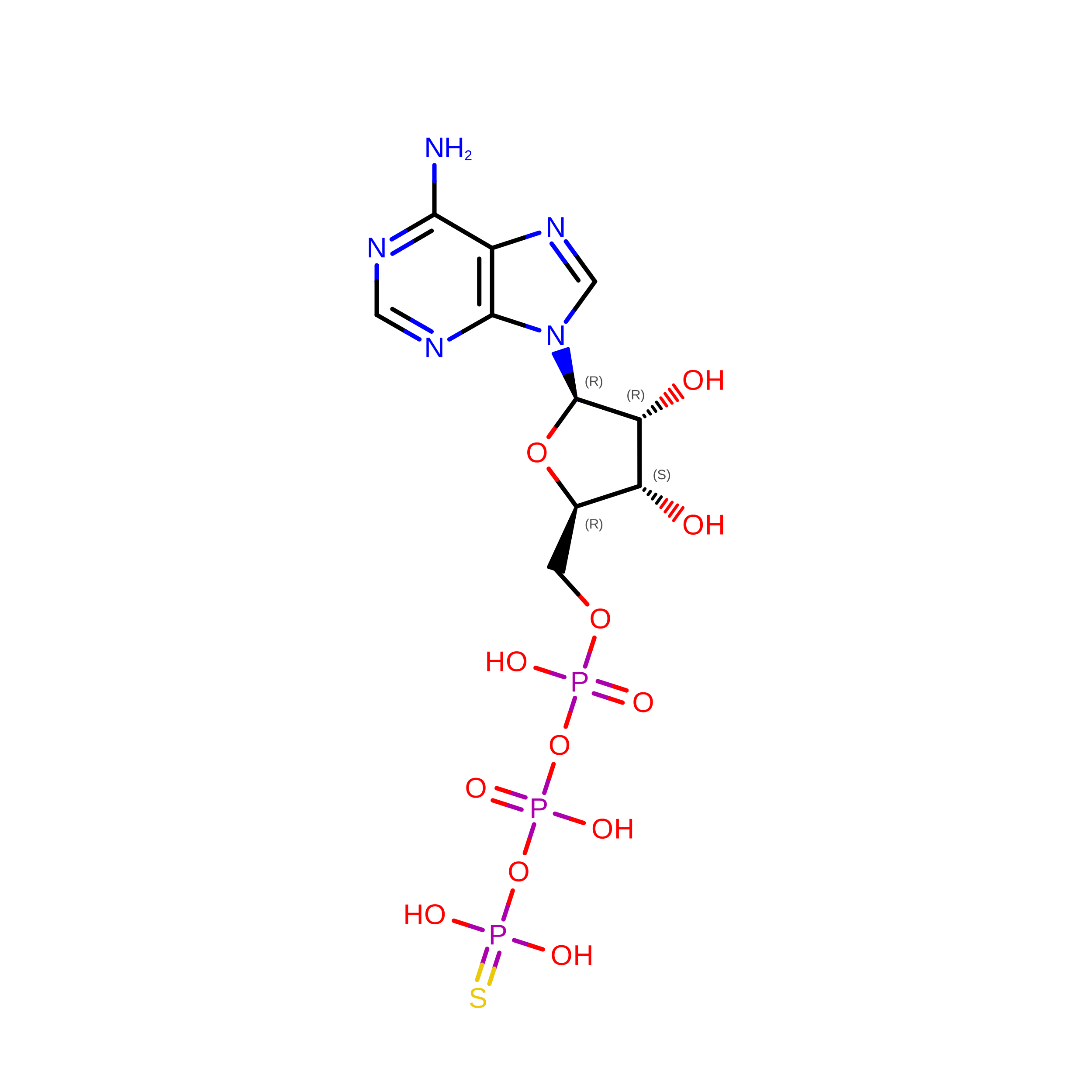
PHOSPHOTHIOPHOSPHORIC ACID-ADENYLATE ESTER
C10 H16 N5 O12 P3 S
NLTUCYMLOPLUHL-KQYNXXCUSA-N
DP6

Query on DP6


Download:Ideal Coordinates CCD File
BA [auth H]
J [auth A]
M [auth B]
O [auth C]
Q [auth D]
BA [auth H],
J [auth A],
M [auth B],
O [auth C],
Q [auth D],
T [auth E],
X [auth F],
Z [auth G]
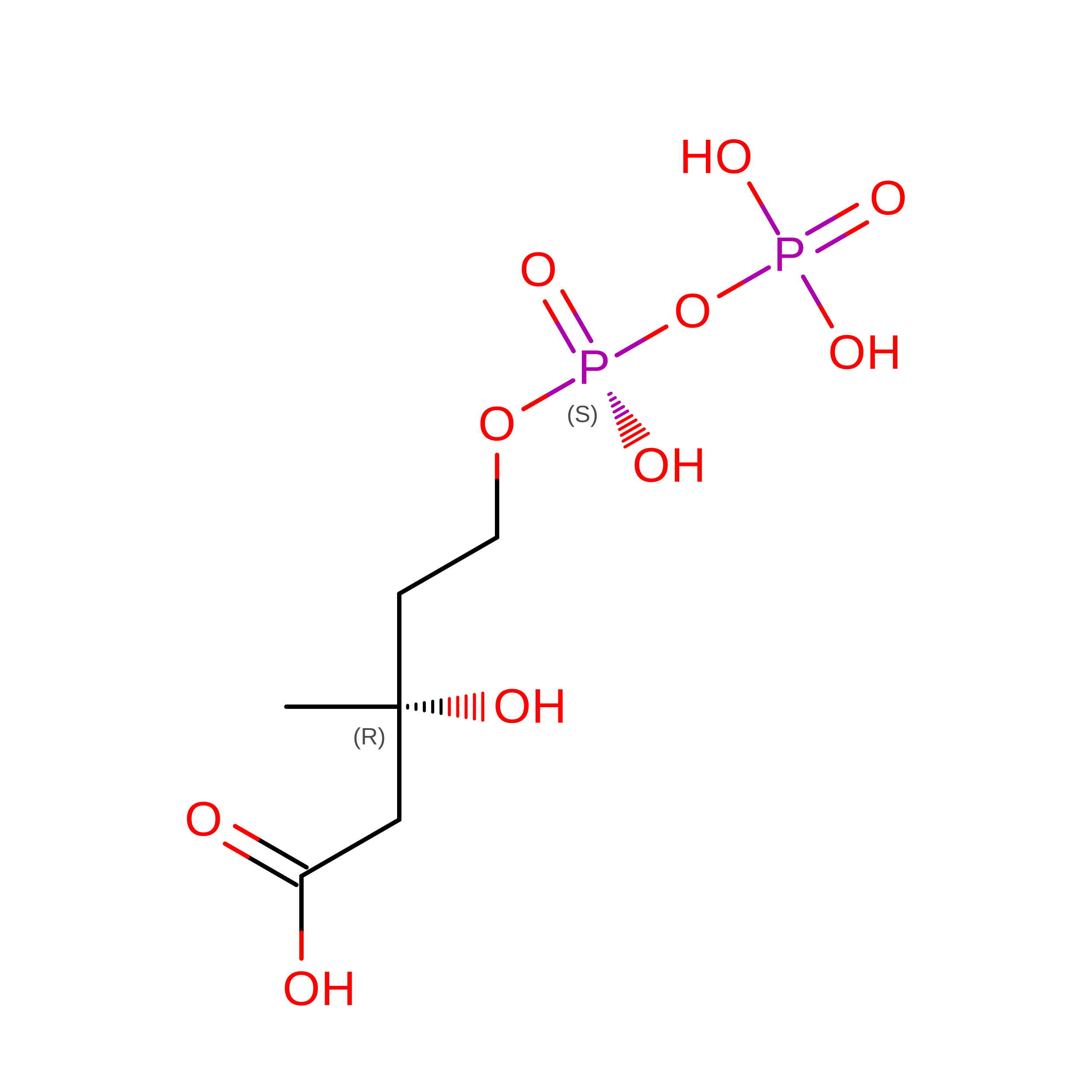
(3R)-3-HYDROXY-5-{[(R)-HYDROXY(PHOSPHONOOXY)PHOSPHORYL]OXY}-3-METHYLPENTANOIC ACID
C6 H14 O10 P2
SIGQQUBJQXSAMW-ZCFIWIBFSA-N
GOL

Query on GOL


Download:Ideal Coordinates CCD File
U [auth E]GLYCEROL
C3 H8 O3
PEDCQBHIVMGVHV-UHFFFAOYSA-N
FMT

Query on FMT


Download:Ideal Coordinates CCD File
CA [auth H],
K [auth A],
R [auth D],
V [auth E]
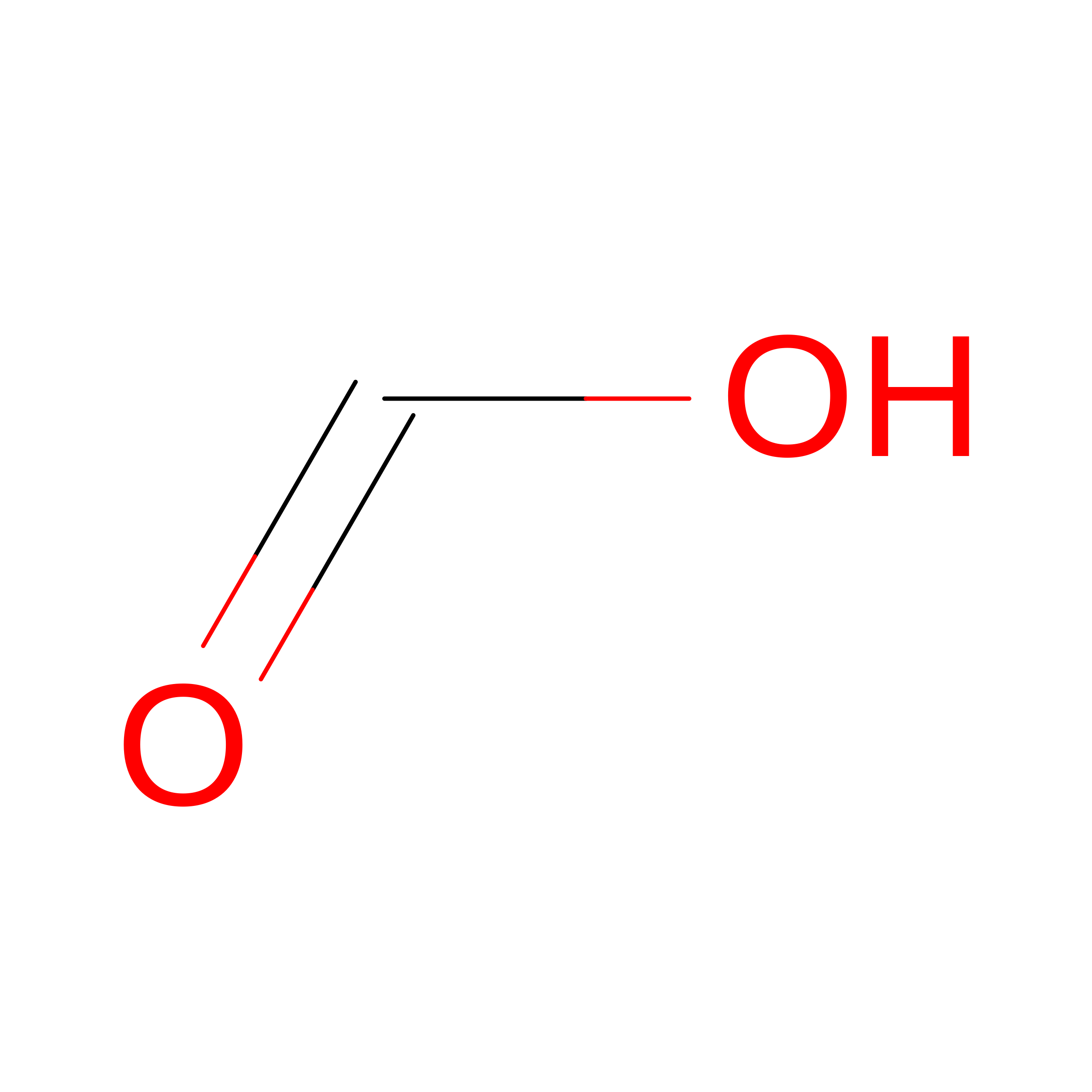
FORMIC ACID
C H2 O2
BDAGIHXWWSANSR-UHFFFAOYSA-N

Experimental Data & Validation

Experimental Data

  • Method: X-RAY DIFFRACTION
  • Resolution: 2.60 Å
  • R-Value Free:  0.251 (Depositor), 0.242 (DCC) 
  • R-Value Work:  0.199 (Depositor), 0.194 (DCC) 
  • R-Value Observed: 0.200 (Depositor) 
Space Group: P 21 21 21
Unit Cell:
Length ( Å )Angle ( ˚ )
a = 96.459α = 90
b = 99.445β = 90
c = 314.418γ = 90
Software Package:
Software NamePurpose
PHENIXrefinement
PDB_EXTRACTdata extraction
HKL-2000data collection
HKL-2000data reduction
HKL-2000data scaling
PHASERphasing

Structure Validation

View Full Validation Report


Ligand Structure Quality Assessment 


Entry History 

Deposition Data

Revision History  (Full details and data files)

  • Version 1.0: 2012-07-11
    Type: Initial release
  • Version 1.1: 2012-10-03
    Changes: Database references
  • Version 1.2: 2023-09-13
    Changes: Data collection, Database references, Derived calculations, Refinement description