4CMZ | pdb_00004cmz

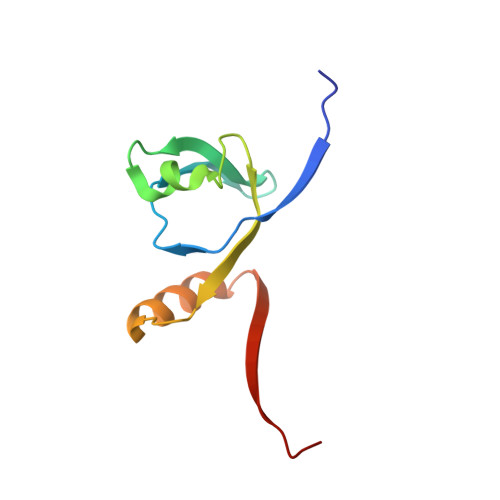
An intertwined homodimer of the PDZ homology domain of periaxin


Experimental Data Snapshot

  • Method: X-RAY DIFFRACTION
  • Resolution: 2.70 Å
  • R-Value Free: 
    0.241 (Depositor), 0.247 (DCC) 
  • R-Value Work: 
    0.203 (Depositor), 0.208 (DCC) 
  • R-Value Observed: 
    0.205 (Depositor) 

wwPDB Validation 3D Report Full Report

Validation slider image for 4CMZ

This is version 1.5 of the entry. See complete history

Literature

Periaxin and Ahnak Nucleoprotein 2 Form Intertwined Homodimers Through Domain Swapping

Han, H.Kursula, P.

(2014) J Biological Chem 289: 14121

  • DOI: https://doi.org/10.1074/jbc.M114.554816
  • Primary Citation Related Structures: 
    4CMZ, 4CN0

  • PubMed Abstract: 

    Periaxin (PRX) is an abundant protein in the peripheral nervous system, with an important role in myelination. PRX participates in large molecular complexes, most likely through the interactions of its N-terminal PSD-95/Discs-large/ZO-1 (PDZ)-like domain. We present the crystal structures of the PDZ-like domains from PRX and its homologue AHNAK nucleoprotein 2 (AHNAK2). The unique intertwined, domain-swapped dimers provide a structural basis for the homodimerization of both proteins. The core of the homodimer is formed by a 6-stranded antiparallel β sheet, with every other strand from a different chain. The AHNAK2 PDZ domain structure contains a bound class III ligand peptide. The binding pocket is preformed, and the peptide-PDZ interactions have unique aspects, including two salt bridges and weak recognition of the peptide C terminus. Tight homodimerization may be central to the scaffolding functions of PRX and AHNAK2 in molecular complexes linking the extracellular matrix to the cytoskeletal network.


  • Organizational Affiliation
    • From the Faculty of Biochemistry and Molecular Medicine and Biocenter Oulu, University of Oulu, 90014 Oulu, Finland, the German Electron Synchrotron (DESY), 22607 Hamburg, Germany, and.

Macromolecule Content 

  • Total Structure Weight: 30.14 kDa 
  • Atom Count: 2,105 
  • Modeled Residue Count: 267 
  • Deposited Residue Count: 276 
  • Unique protein chains: 1

Macromolecules

Find similar proteins by:|  3D Structure
Entity ID: 1
MoleculeChains  Sequence LengthOrganismDetailsImage
PERIAXIN
A, B, C
92Homo sapiensMutation(s): 0 
UniProt & NIH Common Fund Data Resources
Find proteins for Q9BXM0 (Homo sapiens)
Explore Q9BXM0 
Go to UniProtKB:  Q9BXM0
PHAROS:  Q9BXM0
GTEx:  ENSG00000105227 
Entity Groups
Sequence Clusters30% Identity50% Identity70% Identity90% Identity95% Identity100% Identity
UniProt GroupQ9BXM0
Sequence Annotations
Expand
Reference Sequence

Experimental Data & Validation

Experimental Data

  • Method: X-RAY DIFFRACTION
  • Resolution: 2.70 Å
  • R-Value Free:  0.241 (Depositor), 0.247 (DCC) 
  • R-Value Work:  0.203 (Depositor), 0.208 (DCC) 
  • R-Value Observed: 0.205 (Depositor) 
Space Group: P 32 2 1
Unit Cell:
Length ( Å )Angle ( ˚ )
a = 79.84α = 90
b = 79.84β = 90
c = 81.07γ = 120
Software Package:
Software NamePurpose
PHENIXrefinement
XDSdata reduction
XDSdata scaling
PHENIXphasing

Structure Validation

View Full Validation Report


Entry History 

Deposition Data

Revision History  (Full details and data files)

  • Version 1.0: 2014-04-02
    Type: Initial release
  • Version 1.1: 2014-04-09
    Changes: Database references
  • Version 1.2: 2014-08-27
    Changes: Database references
  • Version 1.3: 2014-12-17
    Changes: Data collection
  • Version 1.4: 2018-03-07
    Changes: Data collection, Source and taxonomy
  • Version 1.5: 2024-05-08
    Changes: Data collection, Database references, Other