4CEM | pdb_00004cem

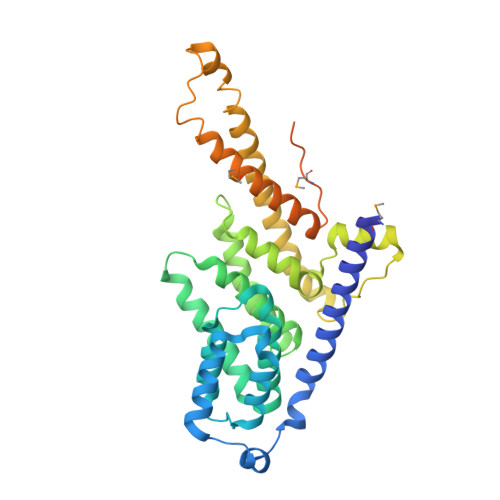
Crystal structure of the first MIF4G domain of human nonsense mediated decay factor UPF2


Experimental Data Snapshot

  • Method: X-RAY DIFFRACTION
  • Resolution: 2.60 Å
  • R-Value Free: 
    0.251 (Depositor), 0.249 (DCC) 
  • R-Value Work: 
    0.205 (Depositor), 0.212 (DCC) 
  • R-Value Observed: 
    0.208 (Depositor) 

wwPDB Validation 3D Report Full Report

Validation slider image for 4CEM

This is version 1.2 of the entry. See complete history

Literature

Structural and Functional Analysis of the Three Mif4G Domains of Nonsense-Mediated Decay Factor Upf2.

Clerici, M.Deniaud, A.Boehm, V.Gehring, N.H.Schaffitzel, C.Cusack, S.

(2014) Nucleic Acids Res 42: 2673

  • DOI: https://doi.org/10.1093/nar/gkt1197
  • Primary Citation Related Structures: 
    4CEK, 4CEM

  • PubMed Abstract: 

    Nonsense-mediated decay (NMD) is a eukaryotic quality control pathway, involving conserved proteins UPF1, UPF2 and UPF3b, which detects and degrades mRNAs with premature stop codons. Human UPF2 comprises three tandem MIF4G domains and a C-terminal UPF1 binding region. MIF4G-3 binds UPF3b, but the specific functions of MIF4G-1 and MIF4G-2 are unknown. Crystal structures show that both MIF4G-1 and MIF4G-2 contain N-terminal capping helices essential for stabilization of the 10-helix MIF4G core and that MIF4G-2 interacts with MIF4G-3, forming a rigid assembly. The UPF2/UPF3b/SMG1 complex is thought to activate the kinase SMG1 to phosphorylate UPF1 in vivo. We identify MIF4G-3 as the binding site and in vitro substrate of SMG1 kinase and show that a ternary UPF2 MIF4G-3/UPF3b/SMG1 complex can form in vitro. Whereas in vivo complementation assays show that MIF4G-1 and MIF4G-2 are essential for NMD, tethering assays reveal that UPF2 truncated to only MIF4G-3 and the UPF1-binding region can still partially accomplish NMD. Thus UPF2 MIF4G-1 and MIF4G-2 appear to have a crucial scaffolding role, while MIF4G-3 is the key module required for triggering NMD.


  • Organizational Affiliation
    • European Molecular Biology Laboratory, Grenoble Outstation, 6 rue Jules Horowitz, 38042 Grenoble Cedex 9, France, Unit of Virus Host-Cell Interactions, University of Grenoble Alpes-EMBL-CNRS, UMI 3265, 6 rue Jules Horowitz, 38042 Grenoble Cedex 9, France and University of Cologne, Institute for Genetics, Zuelpicher Street 47a, 50674 Cologne, Germany.

Macromolecule Content 

  • Total Structure Weight: 85.93 kDa 
  • Atom Count: 5,115 
  • Modeled Residue Count: 617 
  • Deposited Residue Count: 740 
  • Unique protein chains: 1

Macromolecules

Find similar proteins by:|  3D Structure
Entity ID: 1
MoleculeChains  Sequence LengthOrganismDetailsImage
REGULATOR OF NONSENSE TRANSCRIPTS 2
A, B
370Homo sapiensMutation(s): 0 
UniProt & NIH Common Fund Data Resources
Find proteins for Q9HAU5 (Homo sapiens)
Explore Q9HAU5 
Go to UniProtKB:  Q9HAU5
GTEx:  ENSG00000151461 
Entity Groups
Sequence Clusters30% Identity50% Identity70% Identity90% Identity95% Identity100% Identity
UniProt GroupQ9HAU5
Sequence Annotations
Expand
Reference Sequence

Small Molecules

Modified Residues  1 Unique
IDChains TypeFormula2D DiagramParent
MSE
Query on MSE
A, B
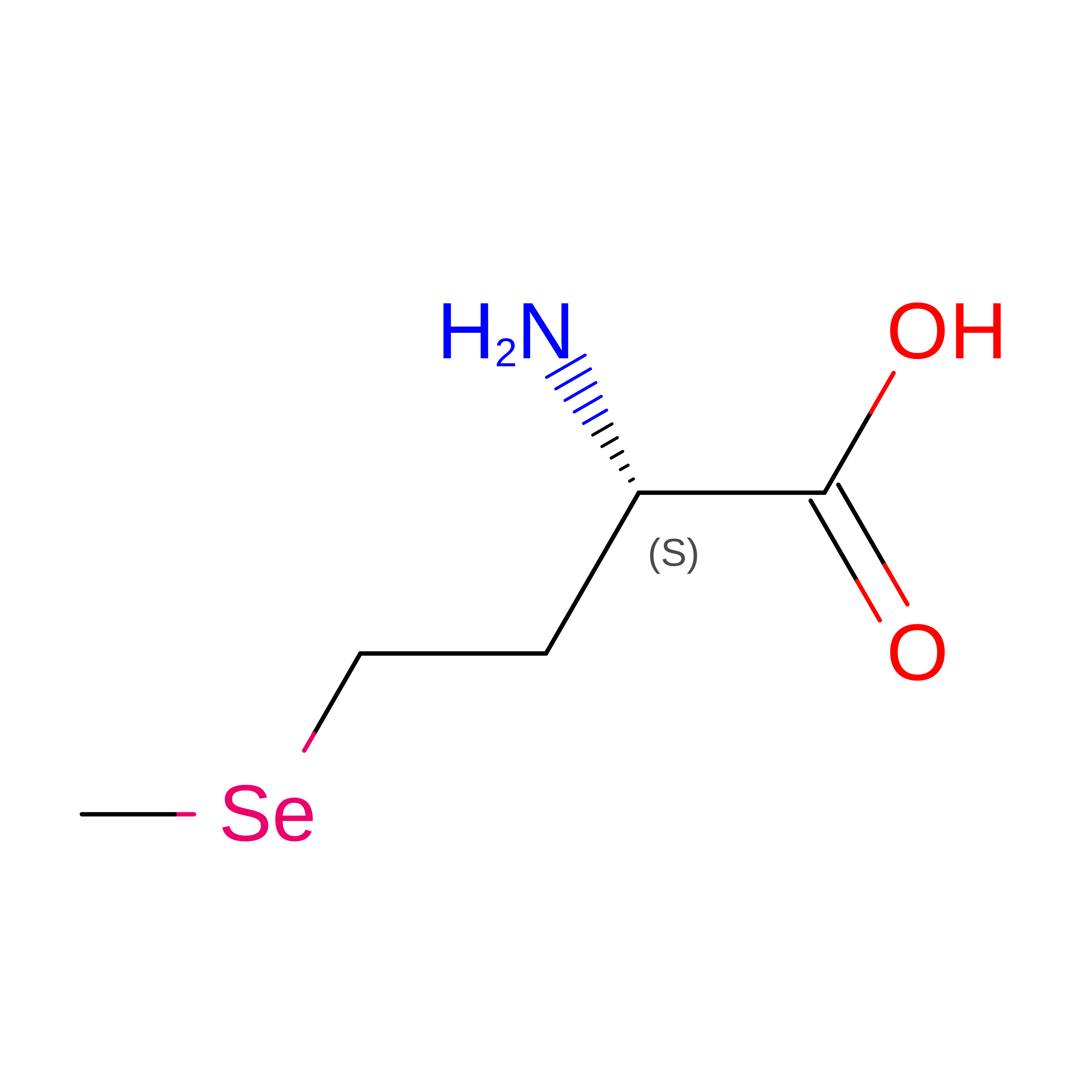
L-PEPTIDE LINKINGC5 H11 N O2 SeMET

Experimental Data & Validation

Experimental Data

  • Method: X-RAY DIFFRACTION
  • Resolution: 2.60 Å
  • R-Value Free:  0.251 (Depositor), 0.249 (DCC) 
  • R-Value Work:  0.205 (Depositor), 0.212 (DCC) 
  • R-Value Observed: 0.208 (Depositor) 
Space Group: P 65
Unit Cell:
Length ( Å )Angle ( ˚ )
a = 101.08α = 90
b = 101.08β = 90
c = 158.88γ = 120
Software Package:
Software NamePurpose
REFMACrefinement
XDSdata reduction
XSCALEdata scaling
SHELXDphasing

Structure Validation

View Full Validation Report


Entry History 

Deposition Data

Revision History  (Full details and data files)

  • Version 1.0: 2013-12-11
    Type: Initial release
  • Version 1.1: 2014-03-12
    Changes: Database references
  • Version 1.2: 2024-10-16
    Changes: Data collection, Database references, Derived calculations, Other, Structure summary