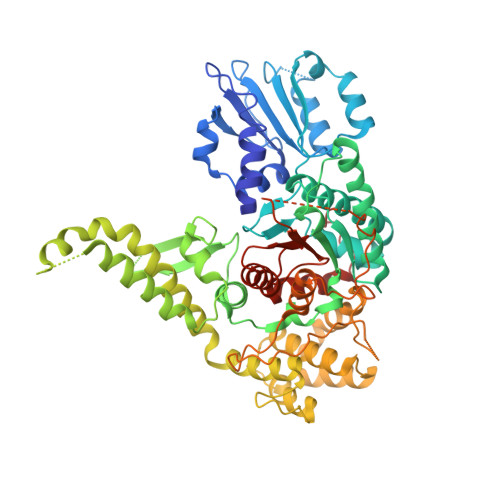
4CCA | pdb_00004cca

Structure of human Munc18-2


Experimental Data Snapshot

  • Method: X-RAY DIFFRACTION
  • Resolution: 2.60 Å
  • R-Value Free: 
    0.275 (Depositor), 0.277 (DCC) 
  • R-Value Work: 
    0.242 (Depositor), 0.249 (DCC) 
  • R-Value Observed: 
    0.244 (Depositor) 

Starting Model: experimental
View more details

wwPDB Validation 3D Report Full Report

Validation slider image for 4CCA

This is version 1.7 of the entry. See complete history

Literature

Syntaxin Binding Mechanism and Disease-Causing Mutations in Munc18-2

Hackmann, Y.Graham, S.C.Ehl, S.Hoening, S.Lehmberg, K.Arico, M.Owen, D.J.Griffiths, G.G.

(2013) Proc Natl Acad Sci U S A 110: E4482

  • DOI: https://doi.org/10.1073/pnas.1313474110
  • Primary Citation Related Structures: 
    4CCA

  • PubMed Abstract: 

    Mutations in either syntaxin 11 (Stx11) or Munc18-2 abolish cytotoxic T lymphocytes (CTL) and natural killer cell (NK) cytotoxicity, and give rise to familial hemophagocytic lymphohistiocytosis (FHL4 or FHL5, respectively). Although Munc18-2 is known to interact with Stx11, little is known about the molecular mechanisms governing the specificity of this interaction or how in vitro IL-2 activation leads to compensation of CTL and NK cytotoxicity. To understand how mutations in Munc18-2 give rise to disease, we have solved the structure of human Munc18-2 at 2.6 Å resolution and mapped 18 point mutations. The four surface mutations identified (R39P, L130S, E132A, P334L) map exclusively to the predicted syntaxin and soluble N-ethylmaleimide-sensitive factor accessory protein receptor binding sites of Munc18-2. We find that Munc18-2 binds the N-terminal peptide of Stx11 with a ~20-fold higher affinity than Stx3, suggesting a potential role in selective binding. Upon IL-2 activation, levels of Stx3 are increased, favoring Munc18-2 binding when Stx11 is absent. Similarly, Munc18-1, expressed in IL-2-activated CTL, is capable of binding Stx11. These findings provide potential explanations for restoration of Munc18-Stx function and cytotoxicity in IL-2-activated cells.


  • Organizational Affiliation
    • Cambridge Institute for Medical Research, University of Cambridge Biomedical Campus, University of Cambridge, Cambridge CB2 0XY, United Kingdom.

Macromolecule Content 

  • Total Structure Weight: 67.1 kDa 
  • Atom Count: 4,230 
  • Modeled Residue Count: 542 
  • Deposited Residue Count: 598 
  • Unique protein chains: 1

Macromolecules

Find similar proteins by:|  3D Structure
Entity ID: 1
MoleculeChains  Sequence LengthOrganismDetailsImage
SYNTAXIN-BINDING PROTEIN 2598Homo sapiensMutation(s): 0 
UniProt & NIH Common Fund Data Resources
Find proteins for Q15833 (Homo sapiens)
Explore Q15833 
Go to UniProtKB:  Q15833
PHAROS:  Q15833
GTEx:  ENSG00000076944 
Entity Groups
Sequence Clusters30% Identity50% Identity70% Identity90% Identity95% Identity100% Identity
UniProt GroupQ15833
Sequence Annotations
Expand
Reference Sequence

Small Molecules

Ligands 1 Unique
IDChains Name / Formula / InChI Key2D Diagram3D Interactions
CL

Query on CL


Download:Ideal Coordinates CCD File
B [auth A]CHLORIDE ION
Cl
VEXZGXHMUGYJMC-UHFFFAOYSA-M

Experimental Data & Validation

Experimental Data

  • Method: X-RAY DIFFRACTION
  • Resolution: 2.60 Å
  • R-Value Free:  0.275 (Depositor), 0.277 (DCC) 
  • R-Value Work:  0.242 (Depositor), 0.249 (DCC) 
  • R-Value Observed: 0.244 (Depositor) 
Space Group: P 41 21 2
Unit Cell:
Length ( Å )Angle ( ˚ )
a = 67.55α = 90
b = 67.55β = 90
c = 284.651γ = 90
Software Package:
Software NamePurpose
PHENIXrefinement
MOSFLMdata reduction
Aimlessdata scaling
PHASERphasing

Structure Validation

View Full Validation Report


Entry History 

Deposition Data

Revision History  (Full details and data files)

  • Version 1.0: 2013-10-30
    Type: Initial release
  • Version 1.1: 2013-11-06
    Changes: Atomic model, Other
  • Version 1.2: 2013-11-13
    Changes: Database references
  • Version 1.3: 2013-11-20
    Changes: Database references
  • Version 1.4: 2013-12-04
    Changes: Database references
  • Version 1.5: 2019-05-08
    Changes: Data collection, Experimental preparation, Other
  • Version 1.6: 2019-05-15
    Changes: Data collection, Experimental preparation
  • Version 1.7: 2023-12-20
    Changes: Data collection, Database references, Derived calculations, Other, Refinement description