4C4Y | pdb_00004c4y

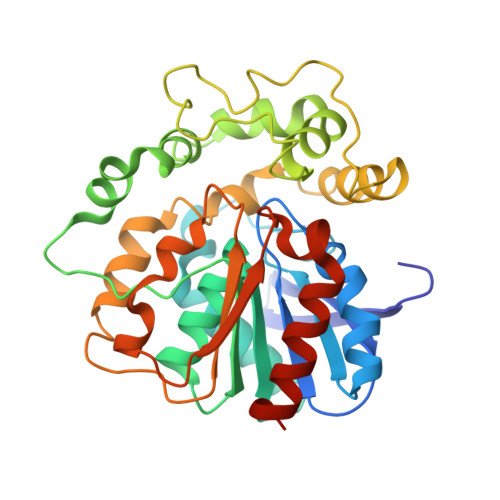
Crystal structure of human bifunctional epoxide hydroxylase 2 complexed with A4


Experimental Data Snapshot

  • Method: X-RAY DIFFRACTION
  • Resolution: 2.41 Å
  • R-Value Free: 
    0.315 (Depositor), 0.319 (DCC) 
  • R-Value Work: 
    0.258 (Depositor), 0.277 (DCC) 
  • R-Value Observed: 
    0.261 (Depositor) 

Starting Model: experimental
View more details

wwPDB Validation 3D Report Full Report

Validation slider image for 4C4Y

Ligand Structure Quality Assessment 


This is version 1.7 of the entry. See complete history

Literature

A Combination of Spin Diffusion Methods for the Determination of Protein-Ligand Complex Structural Ensembles.

Pilger, J.Mazur, A.Monecke, P.Schreuder, H.Elshorst, B.Bartoschek, S.Langer, T.Schiffer, A.Krimm, I.Wegstroth, M.Lee, D.Hessler, G.Wendt, K.Becker, S.Griesinger, C.

(2015) Angew Chem Int Ed Engl 54: 6511

  • DOI: https://doi.org/10.1002/anie.201500671
  • Primary Citation Related Structures: 
    4C4X, 4C4Y, 4C4Z, 4YXR, 4YXS

  • PubMed Abstract: 

    Structure-based drug design (SBDD) is a powerful and widely used approach to optimize affinity of drug candidates. With the recently introduced INPHARMA method, the binding mode of small molecules to their protein target can be characterized even if no spectroscopic information about the protein is known. Here, we show that the combination of the spin-diffusion-based NMR methods INPHARMA, trNOE, and STD results in an accurate scoring function for docking modes and therefore determination of protein-ligand complex structures. Applications are shown on the model system protein kinase A and the drug targets glycogen phosphorylase and soluble epoxide hydrolase (sEH). Multiplexing of several ligands improves the reliability of the scoring function further. The new score allows in the case of sEH detecting two binding modes of the ligand in its binding site, which was corroborated by X-ray analysis.


  • Organizational Affiliation
    • Abteilung für NMR-basierte Strukturbiologie, Max-Planck-Institut für biophysikalische Chemie, Am Fassberg 11, 37077 Göttingen (Germany).

Macromolecule Content 

  • Total Structure Weight: 37.6 kDa 
  • Atom Count: 2,689 
  • Modeled Residue Count: 314 
  • Deposited Residue Count: 326 
  • Unique protein chains: 1

Macromolecules

Find similar proteins by:|  3D Structure
Entity ID: 1
MoleculeChains  Sequence LengthOrganismDetailsImage
BIFUNCTIONAL EPOXIDE HYDROLASE 2326Homo sapiensMutation(s): 0 
EC: 3.3.2.10 (PDB Primary Data), 3.1.3.76 (PDB Primary Data)
UniProt & NIH Common Fund Data Resources
Find proteins for P34913 (Homo sapiens)
Explore P34913 
Go to UniProtKB:  P34913
PHAROS:  P34913
GTEx:  ENSG00000120915 
Entity Groups
Sequence Clusters30% Identity50% Identity70% Identity90% Identity95% Identity100% Identity
UniProt GroupP34913
Sequence Annotations
Expand
Reference Sequence

Small Molecules

Ligands 1 Unique
IDChains Name / Formula / InChI Key2D Diagram3D Interactions
7WI

Query on 7WI


Download:Ideal Coordinates CCD File
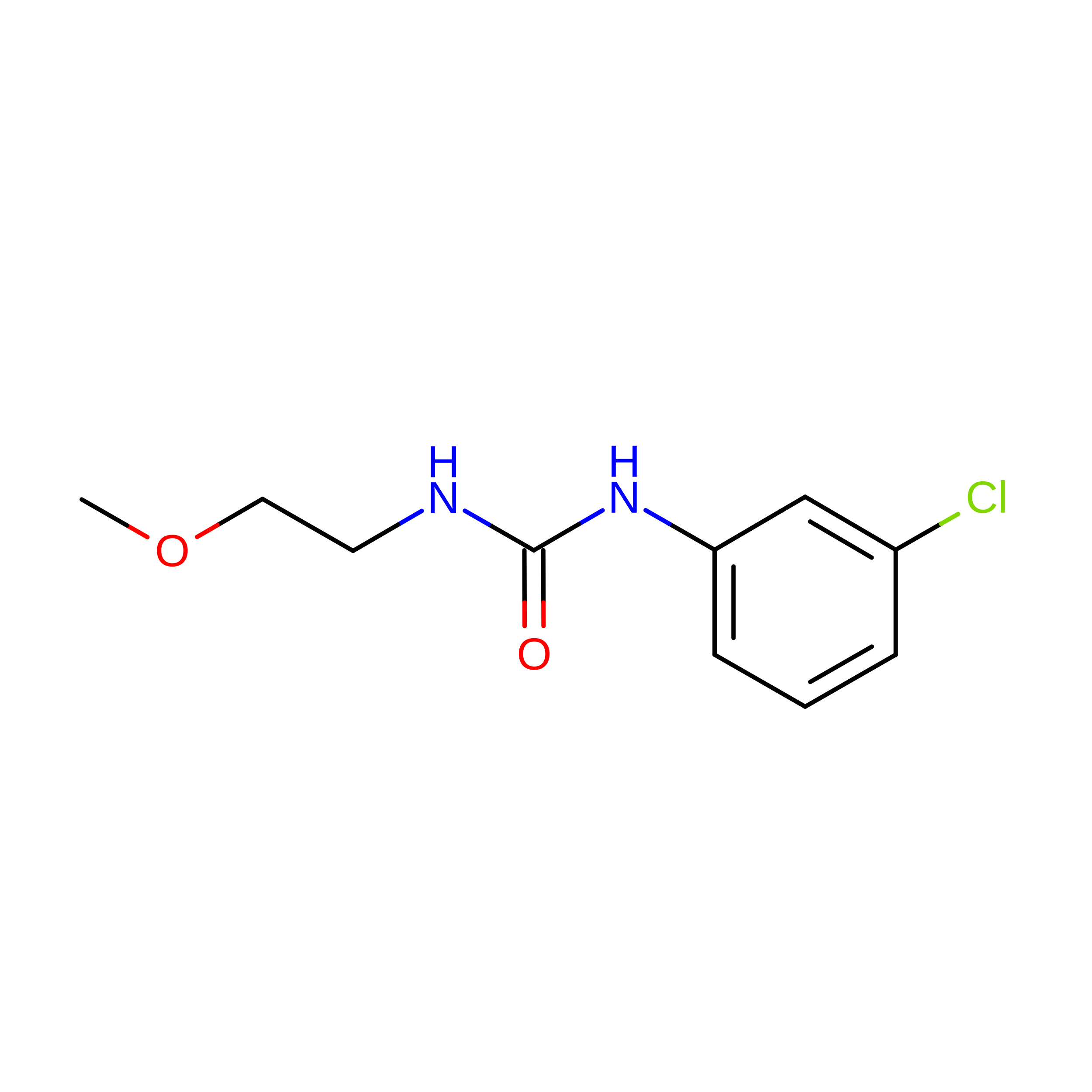
B [auth A]1-(3-chlorophenyl)-3-(2-methoxyethyl)urea
C10 H13 Cl N2 O2
OCWOGWHGSTYVMJ-UHFFFAOYSA-N

Experimental Data & Validation

Experimental Data

  • Method: X-RAY DIFFRACTION
  • Resolution: 2.41 Å
  • R-Value Free:  0.315 (Depositor), 0.319 (DCC) 
  • R-Value Work:  0.258 (Depositor), 0.277 (DCC) 
  • R-Value Observed: 0.261 (Depositor) 
Space Group: P 21 2 21
Unit Cell:
Length ( Å )Angle ( ˚ )
a = 81.64α = 90
b = 46.34β = 90
c = 80.29γ = 90
Software Package:
Software NamePurpose
BUSTERrefinement
XDSdata reduction
SCALAdata scaling
PHASERphasing

Structure Validation

View Full Validation Report


Ligand Structure Quality Assessment 


Entry History 

Revision History  (Full details and data files)

  • Version 1.0: 2014-10-01
    Type: Initial release
  • Version 1.1: 2015-04-29
    Changes: Database references
  • Version 1.2: 2015-06-10
    Changes: Database references
  • Version 1.3: 2019-05-08
    Changes: Data collection, Experimental preparation, Other
  • Version 1.4: 2019-05-15
    Changes: Data collection, Experimental preparation
  • Version 1.5: 2021-02-24
    Changes: Derived calculations, Other
  • Version 1.6: 2021-03-31
    Changes: Derived calculations
  • Version 1.7: 2023-12-20
    Changes: Data collection, Database references, Refinement description