Download Mendeley
New Tricks for Old Proteins: Single Mutations in a Nonenzymatic Protein Give Rise to Various Enzymatic Activities.
Moroz, Y.S., Dunston, T.T., Makhlynets, O.V., Moroz, O.V., Wu, Y., Yoon, J.H., Olsen, A.B., Mclaughlin, J.M., Mack, K.L., Gosavi, P.M., Van Nuland, N.A.J., Korendovych, I.V.(2015) J Am Chem Soc 137: 14905
- PubMed: 26555770 Search on PubMed
- DOI: https://doi.org/10.1021/jacs.5b07812
- Primary Citation Related Structures:
4BYA - PubMed Abstract:
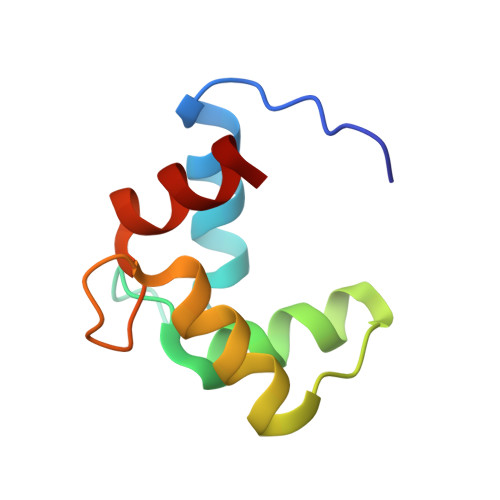
Design of a new catalytic function in proteins, apart from its inherent practical value, is important for fundamental understanding of enzymatic activity. Using a computationally inexpensive, minimalistic approach that focuses on introducing a single highly reactive residue into proteins to achieve catalysis we converted a 74-residue-long C-terminal domain of calmodulin into an efficient esterase. The catalytic efficiency of the resulting stereoselective, allosterically regulated catalyst, nicknamed AlleyCatE, is higher than that of any previously reported de novo designed esterases. The simplicity of our design protocol should complement and expand the capabilities of current state-of-art approaches to protein design. These results show that even a small nonenzymatic protein can efficiently attain catalytic activities in various reactions (Kemp elimination, ester hydrolysis, retroaldol reaction) as a result of a single mutation. In other words, proteins can be just one mutation away from becoming entry points for subsequent evolution.
- Department of Chemistry, Syracuse University , 111 College Place, Syracuse, New York 13244, United States.
Organizational Affiliation: