4BUL | pdb_00004bul

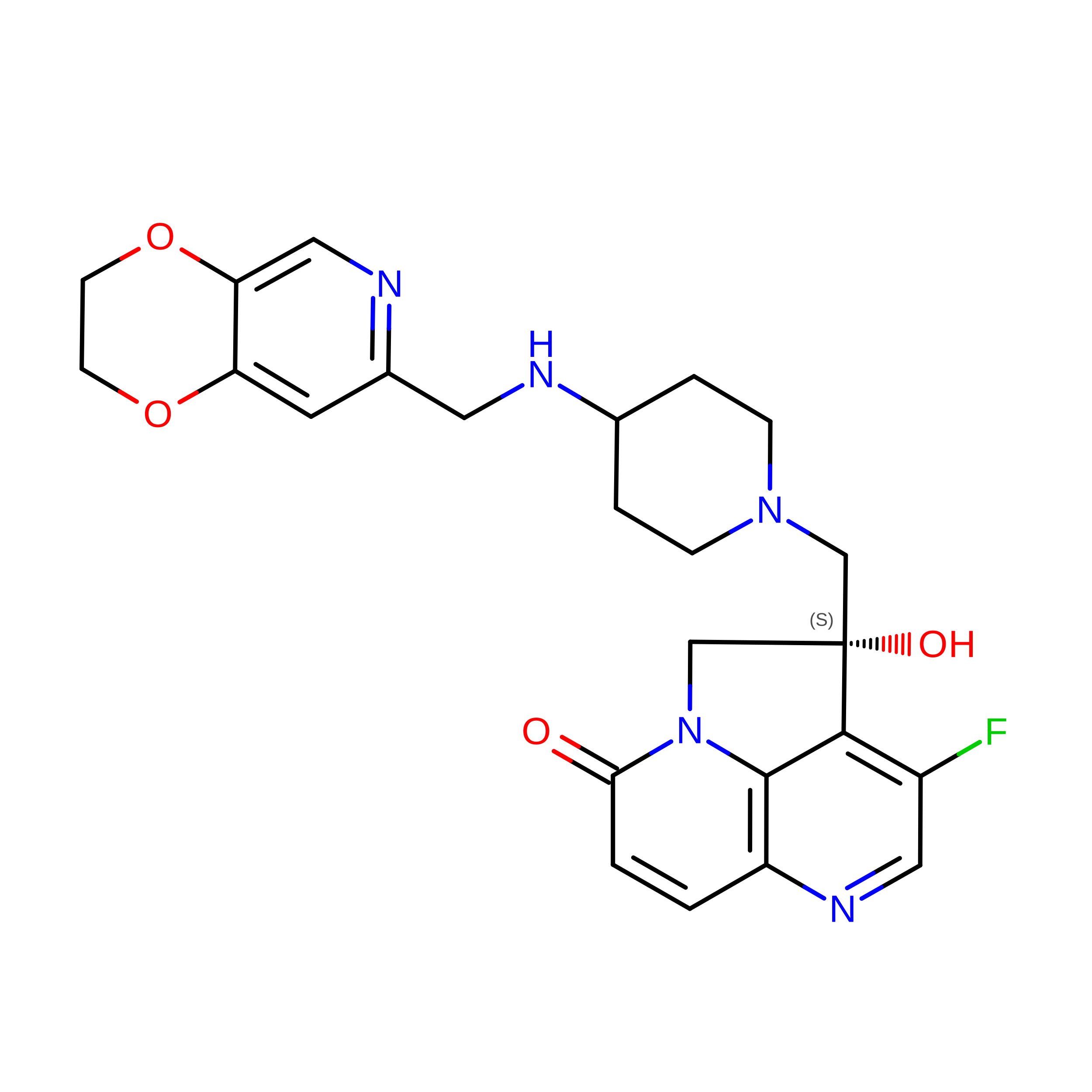
Novel hydroxyl tricyclics (e.g. GSK966587) as potent inhibitors of bacterial type IIA topoisomerases


Experimental Data Snapshot

  • Method: X-RAY DIFFRACTION
  • Resolution: 2.60 Å
  • R-Value Free: 
    0.183 (Depositor), 0.182 (DCC) 
  • R-Value Work: 
    0.144 (Depositor), 0.144 (DCC) 
  • R-Value Observed: 
    0.145 (Depositor) 

Starting Model: experimental
View more details

wwPDB Validation 3D Report Full Report

Validation slider image for 4BUL

Ligand Structure Quality Assessment 


This is version 1.4 of the entry. See complete history

Literature

Novel Hydroxyl Tricyclics (E.G., Gsk966587) as Potent Inhibitors of Bacterial Type Iia Topoisomerases.

Miles, T.J.Hennessy, A.J.Bax, B.Brooks, G.Brown, B.S.Brown, P.Cailleau, N.Chen, D.Dabbs, S.Davies, D.T.Esken, J.M.Giordano, I.Hoover, J.L.Huang, J.Jones, G.E.Kusalakumari Sukmar, S.K.Spitzfaden, C.Markwell, R.E.Minthorn, E.A.Rittenhouse, S.Gwynn, M.N.Pearson, N.D.

(2013) Bioorg Med Chem Lett 23: 5437

  • DOI: https://doi.org/10.1016/j.bmcl.2013.07.013
  • Primary Citation Related Structures: 
    4BUL

  • PubMed Abstract: 

    During the course of our research to find novel mode of action antibacterials, we discovered a series of hydroxyl tricyclic compounds that showed good potency against Gram-positive and Gram-negative pathogens. These compounds inhibit bacterial type IIA topoisomerases. Herein we will discuss structure-activity relationships in this series and report advanced studies on compound 1 (GSK966587) which demonstrates good PK and in vivo efficacy properties. X-ray crystallographic studies were used to provide insight into the structural basis for the difference in antibacterial potency between enantiomers.


  • Organizational Affiliation
    • Diseases of the Developing World CEDD, GlaxoSmithKline, Madrid, Spain. tim.j.miles@gsk.com

Macromolecule Content 

  • Total Structure Weight: 181.45 kDa 
  • Atom Count: 12,809 
  • Modeled Residue Count: 1,425 
  • Deposited Residue Count: 1,464 
  • Unique protein chains: 1
  • Unique nucleic acid chains: 2

Macromolecules


Find similar proteins by:|  3D Structure
Entity ID: 1
MoleculeChains  Sequence LengthOrganismDetailsImage
DNA GYRASE SUBUNIT B, DNA GYRASE SUBUNIT AA,
B [auth C]
692Staphylococcus aureusMutation(s): 1 
EC: 5.99.1.3 (PDB Primary Data), 5.6.2.2 (UniProt)
UniProt
Find proteins for P66937 (Staphylococcus aureus (strain N315))
Explore P66937 
Go to UniProtKB:  P66937
Find proteins for Q99XG5 (Staphylococcus aureus (strain N315))
Explore Q99XG5 
Go to UniProtKB:  Q99XG5
Entity Groups
Sequence Clusters30% Identity50% Identity70% Identity90% Identity95% Identity100% Identity
UniProt GroupsQ99XG5P66937
Sequence Annotations
Expand
Reference Sequence
Find similar nucleic acids by:  Sequence
Entity ID: 2
MoleculeChains LengthOrganismImage
5'-D(*TP*GP*TP*GP*CP*GP*GP*TP*GP*TP*AP*CP*CP*TP *AP*CP*GP*GP*CP*T)-3'C [auth E],
E [auth G]
20synthetic construct
Sequence Annotations
Expand
Reference Sequence
Find similar nucleic acids by:  Sequence
Entity ID: 3
MoleculeChains LengthOrganismImage
5'-D(*AP*GP*CP*CP*GP*TP*AP*GP*GP*TP*AP*CP*AP*CP *CP*GP*CP*AP*C)-3'D [auth F],
F [auth H]
20synthetic construct
Sequence Annotations
Expand
Reference Sequence

Experimental Data & Validation

Experimental Data

  • Method: X-RAY DIFFRACTION
  • Resolution: 2.60 Å
  • R-Value Free:  0.183 (Depositor), 0.182 (DCC) 
  • R-Value Work:  0.144 (Depositor), 0.144 (DCC) 
  • R-Value Observed: 0.145 (Depositor) 
Space Group: P 61
Unit Cell:
Length ( Å )Angle ( ˚ )
a = 93.871α = 90
b = 93.871β = 90
c = 416.439γ = 120
Software Package:
Software NamePurpose
REFMACrefinement
MOSFLMdata reduction
SCALAdata scaling
REFMACphasing

Structure Validation

View Full Validation Report


Ligand Structure Quality Assessment 


Entry History 

Revision History  (Full details and data files)

  • Version 1.0: 2013-08-07
    Type: Initial release
  • Version 1.1: 2013-09-04
    Changes: Database references
  • Version 1.2: 2013-09-18
    Changes: Database references
  • Version 1.3: 2017-03-15
    Changes: Source and taxonomy
  • Version 1.4: 2023-12-20
    Changes: Data collection, Database references, Derived calculations, Other, Refinement description