4BHT | pdb_00004bht

Structural Determinants of Cofactor Specificity and Domain Flexibility in Bacterial Glutamate Dehydrogenases


Experimental Data Snapshot

  • Method: X-RAY DIFFRACTION
  • Resolution: 2.50 Å
  • R-Value Free: 
    0.227 (Depositor), 0.232 (DCC) 
  • R-Value Work: 
    0.159 (Depositor), 0.165 (DCC) 
  • R-Value Observed: 
    0.163 (Depositor) 

Starting Model: experimental
View more details

wwPDB Validation 3D Report Full Report

Validation slider image for 4BHT

This is version 1.5 of the entry. See complete history

Literature

Structure of Nadp(+) -Dependent Glutamate Dehydrogenase from Escherichia Coli: Reflections on the Basis of Coenzyme Specificity in the Family of Glutamate Dehydrogenases.

Sharkey, M.A.Oliveira, T.F.Engel, P.C.Khan, A.R.

(2013) FEBS J 280: 4681

  • DOI: https://doi.org/10.1111/febs.12439
  • Primary Citation Related Structures: 
    4BHT

  • PubMed Abstract: 

    Glutamate dehydrogenases (GDHs; EC 1.4.1.2-4) catalyse the oxidative deamination of L-glutamate to α-ketoglutarate, using NAD(+) and/or NADP(+) as a cofactor. Subunits of homo-hexameric bacterial enzymes comprise a substrate-binding domain I followed by a nucleotide-binding domain II. The reaction occurs in a catalytic cleft between the two domains. Although conserved residues in the nucleotide-binding domains of various dehydrogenases have been linked to cofactor preferences, the structural basis for specificity in the GDH family remains poorly understood. Here, the refined crystal structure of Escherichia coli GDH in the absence of reactants is described at 2.5-Å resolution. Modelling of NADP(+) in domain II reveals the potential contribution of positively charged residues from a neighbouring α-helical hairpin to phosphate recognition. In addition, a serine that follows the P7 aspartate is presumed to form a hydrogen bond with the 2'-phosphate. Mutagenesis and kinetic analysis confirms the importance of these residues in NADP(+) recognition. Surprisingly, one of the positively charged residues is conserved in all sequences of NAD(+)-dependent enzymes, but the conformations adopted by the corresponding regions in proteins whose structure has been solved preclude their contribution to the coordination of the 2'-ribose phosphate of NADP(+). These studies clarify the sequence-structure relationships in bacterial GDHs, revealing that identical residues may specify different coenzyme preferences, depending on the structural context. Primary sequence alone is therefore not a reliable guide for predicting coenzyme specificity. We also consider how it is possible for a single sequence to accommodate both coenzymes in the dual-specificity GDHs of animals.


  • Organizational Affiliation
    • School of Biomolecular and Biomedical Science, Conway Institute, University College Dublin, Ireland.

Macromolecule Content 

  • Total Structure Weight: 293.9 kDa 
  • Atom Count: 21,144 
  • Modeled Residue Count: 2,649 
  • Deposited Residue Count: 2,682 
  • Unique protein chains: 1

Macromolecules

Find similar proteins by:|  3D Structure
Entity ID: 1
MoleculeChains  Sequence LengthOrganismDetailsImage
NADP-SPECIFIC GLUTAMATE DEHYDROGENASE
A, B, C, D, E
A, B, C, D, E, F
447Escherichia coliMutation(s): 0 
EC: 1.4.1.4
UniProt
Find proteins for P00370 (Escherichia coli (strain K12))
Explore P00370 
Go to UniProtKB:  P00370
Entity Groups
Sequence Clusters30% Identity50% Identity70% Identity90% Identity95% Identity100% Identity
UniProt GroupP00370
Sequence Annotations
Expand
Reference Sequence

Small Molecules

Ligands 3 Unique
IDChains Name / Formula / InChI Key2D Diagram3D Interactions
EPE

Query on EPE


Download:Ideal Coordinates CCD File
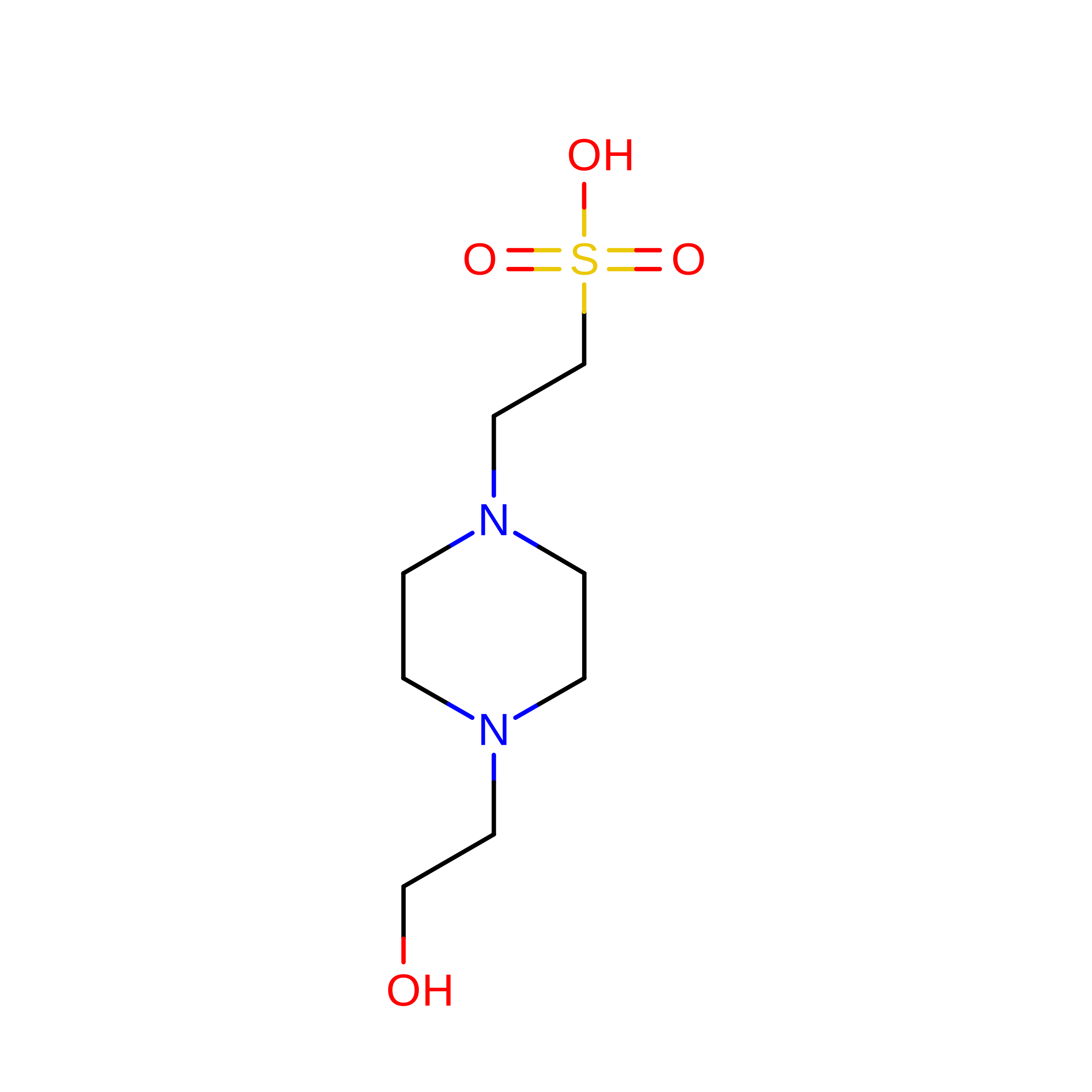
Q [auth C]4-(2-HYDROXYETHYL)-1-PIPERAZINE ETHANESULFONIC ACID
C8 H18 N2 O4 S
JKMHFZQWWAIEOD-UHFFFAOYSA-N
PG4

Query on PG4


Download:Ideal Coordinates CCD File
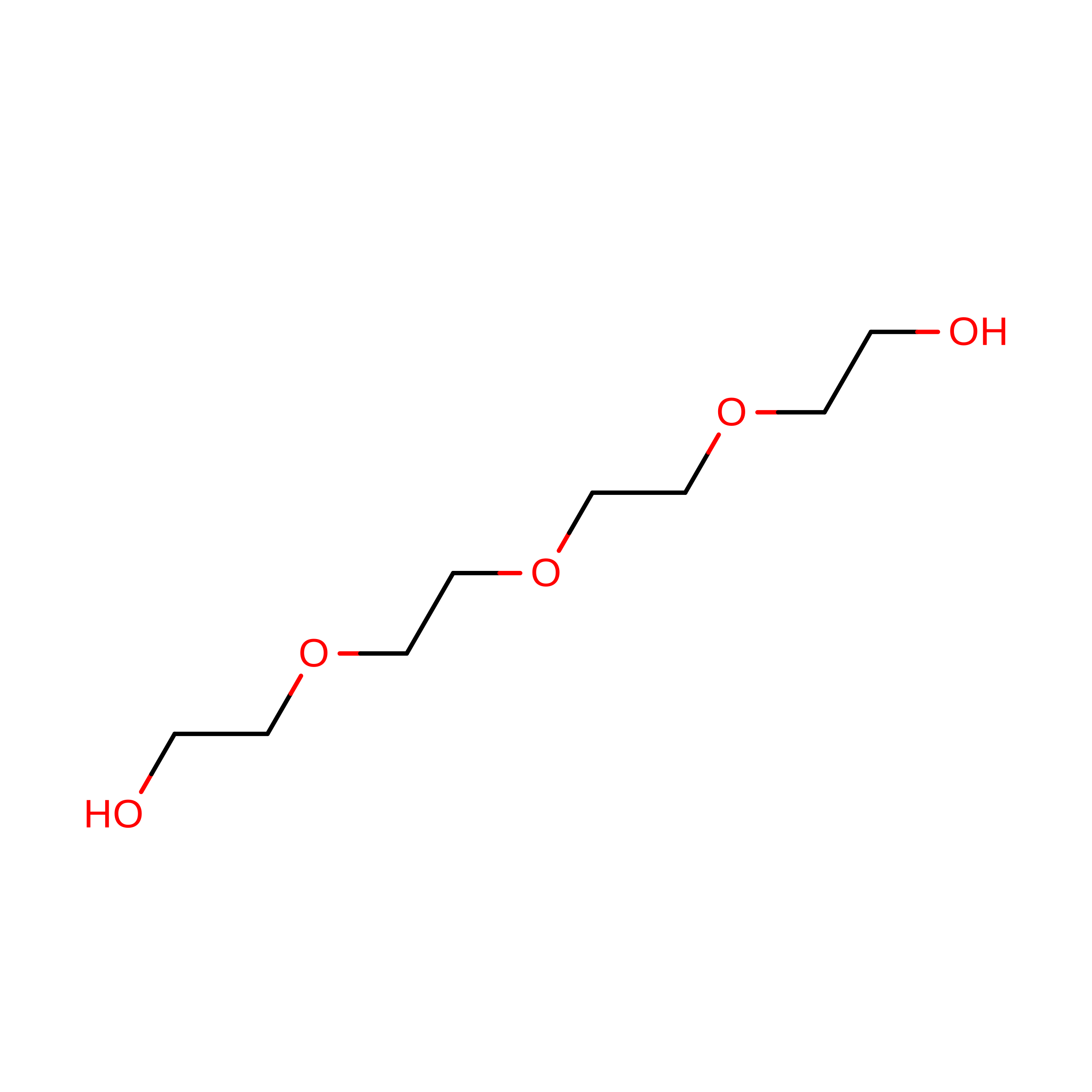
X [auth E]TETRAETHYLENE GLYCOL
C8 H18 O5
UWHCKJMYHZGTIT-UHFFFAOYSA-N
GOL

Query on GOL


Download:Ideal Coordinates CCD File
G [auth A]
H [auth A]
I [auth A]
J [auth A]
K [auth A]
G [auth A],
H [auth A],
I [auth A],
J [auth A],
K [auth A],
L [auth A],
M [auth A],
N [auth C],
O [auth C],
P [auth C],
R [auth D],
S [auth D],
T [auth D],
U [auth E],
V [auth E],
W [auth E],
Y [auth F],
Z [auth F]
GLYCEROL
C3 H8 O3
PEDCQBHIVMGVHV-UHFFFAOYSA-N

Experimental Data & Validation

Experimental Data

  • Method: X-RAY DIFFRACTION
  • Resolution: 2.50 Å
  • R-Value Free:  0.227 (Depositor), 0.232 (DCC) 
  • R-Value Work:  0.159 (Depositor), 0.165 (DCC) 
  • R-Value Observed: 0.163 (Depositor) 
Space Group: P 21 21 21
Unit Cell:
Length ( Å )Angle ( ˚ )
a = 100.975α = 90
b = 152.861β = 90
c = 169.366γ = 90
Software Package:
Software NamePurpose
PHENIXrefinement
DENZOdata reduction
SCALEPACKdata scaling
PHASERphasing

Structure Validation

View Full Validation Report


Entry History 

Deposition Data

Revision History  (Full details and data files)

  • Version 1.0: 2013-06-19
    Type: Initial release
  • Version 1.1: 2013-07-03
    Changes: Atomic model, Other
  • Version 1.2: 2013-07-24
    Changes: Atomic model
  • Version 1.3: 2013-08-07
    Changes: Database references
  • Version 1.4: 2013-09-11
    Changes: Database references
  • Version 1.5: 2023-12-20
    Changes: Data collection, Database references, Derived calculations, Other, Refinement description