4B90 | pdb_00004b90

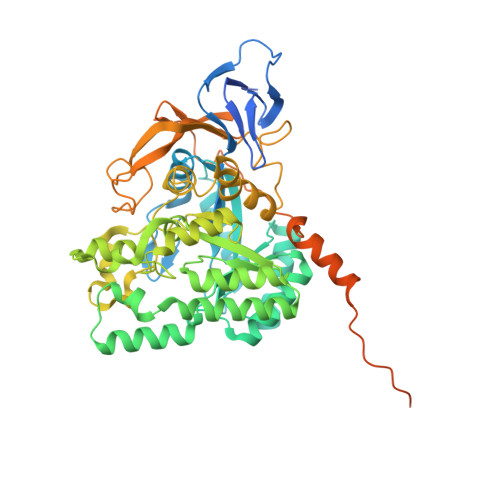
Crystal structure of WT human CRMP-5


Experimental Data Snapshot

  • Method: X-RAY DIFFRACTION
  • Resolution: 2.20 Å
  • R-Value Free: 
    0.221 (Depositor), 0.225 (DCC) 
  • R-Value Work: 
    0.180 (Depositor), 0.183 (DCC) 
  • R-Value Observed: 
    0.182 (Depositor) 

Starting Model: experimental
View more details

wwPDB Validation 3D Report Full Report

Validation slider image for 4B90

This is version 1.2 of the entry. See complete history

Literature

Insights Into the Oligomerization of Crmps: Crystal Structure of Human Collapsin Response Mediator Protein 5.

Ponnusamy, R.Lohkamp, B.

(2013) J Neurochem 125: 855

  • DOI: https://doi.org/10.1111/jnc.12188
  • Primary Citation Related Structures: 
    4B90, 4B91, 4B92

  • PubMed Abstract: 

    Collapsin response mediator protein-5 (CRMP-5) is the latest identified member of the CRMP cytosolic phosphoprotein family, which is crucial for neuronal development and repair. CRMPs exist as homo- and/or hetero-tetramers in vivo and participate in signaling transduction, cytoskeleton rearrangements, and endocytosis. CRMP-5 antagonizes many of the other CRMPs' functions either by directly interacting with them or by competing for their binding partners. We determined the crystal structures of a full length and a truncated version of human CRMP-5, both of which form a homo-tetramer similar to those observed in CRMP-1 and CRMP-2. However, solution studies indicate that CRMP-5 and CRMP-1 form weaker homo-tetramers compared with CRMP-2, and that divalent cations, Ca(2+) and Mg(2+), destabilize oligomers of CRMP-5 and CRMP-1, but promote CRMP-2 oligomerization. On the basis of comparative analysis of the CRMP-5 crystal structure, we identified residues that are crucial for determining the preference for hetero-oligomer or homo-oligomer formation. We also show that in spite of being the CRMP family member most closely related to dihydropyrimidinase, CRMP-5 does not have any detectable amidohydrolase activity. The presented findings provide new detailed insights into the structure, oligomerization, and regulation of CRMPs.


  • Organizational Affiliation
    • Department of Medical Biochemistry and Biophysics, Karolinska Institutet, Stockholm, Sweden.

Macromolecule Content 

  • Total Structure Weight: 128.25 kDa 
  • Atom Count: 7,716 
  • Modeled Residue Count: 970 
  • Deposited Residue Count: 1,172 
  • Unique protein chains: 1

Macromolecules

Find similar proteins by:|  3D Structure
Entity ID: 1
MoleculeChains  Sequence LengthOrganismDetailsImage
DIHYDROPYRIMIDINASE-RELATED PROTEIN 5
A, B
586Homo sapiensMutation(s): 0 
UniProt & NIH Common Fund Data Resources
Find proteins for Q9BPU6 (Homo sapiens)
Explore Q9BPU6 
Go to UniProtKB:  Q9BPU6
PHAROS:  Q9BPU6
GTEx:  ENSG00000157851 
Entity Groups
Sequence Clusters30% Identity50% Identity70% Identity90% Identity95% Identity100% Identity
UniProt GroupQ9BPU6
Sequence Annotations
Expand
Reference Sequence

Experimental Data & Validation

Experimental Data

  • Method: X-RAY DIFFRACTION
  • Resolution: 2.20 Å
  • R-Value Free:  0.221 (Depositor), 0.225 (DCC) 
  • R-Value Work:  0.180 (Depositor), 0.183 (DCC) 
  • R-Value Observed: 0.182 (Depositor) 
Space Group: P 41 21 2
Unit Cell:
Length ( Å )Angle ( ˚ )
a = 90.15α = 90
b = 90.15β = 90
c = 247.76γ = 90
Software Package:
Software NamePurpose
REFMACrefinement
MOSFLMdata reduction
SCALAdata scaling
PHASERphasing

Structure Validation

View Full Validation Report


Entry History 

Deposition Data

Revision History  (Full details and data files)

  • Version 1.0: 2013-02-13
    Type: Initial release
  • Version 1.1: 2013-06-19
    Changes: Database references
  • Version 1.2: 2023-12-20
    Changes: Data collection, Database references, Derived calculations, Other, Refinement description