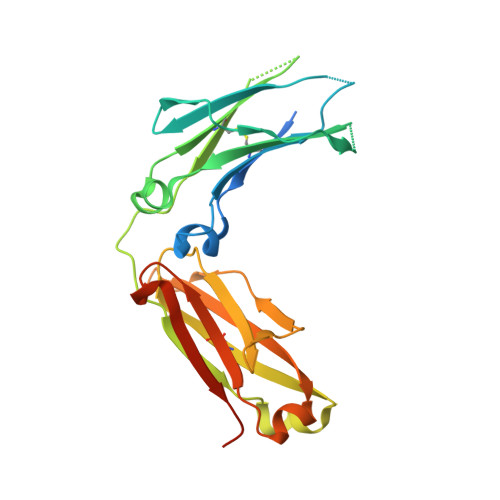
4ACP | pdb_00004acp

Deactivation of human IgG1 Fc by endoglycosidase treatment


Experimental Data Snapshot

  • Method: X-RAY DIFFRACTION
  • Resolution: 2.49 Å
  • R-Value Free: 
    0.234 (Depositor), 0.236 (DCC) 
  • R-Value Work: 
    0.195 (Depositor), 0.196 (DCC) 
  • R-Value Observed: 
    0.197 (Depositor) 

Starting Model: experimental
View more details

wwPDB Validation 3D Report Full Report

Validation slider image for 4ACP

Ligand Structure Quality Assessment 


This is version 1.4 of the entry. See complete history

Literature

Selective Deactivation of Serum Igg: A General Strategy for the Enhancement of Monoclonal Antibody Receptor Interactions.

Baruah, K.Bowden, T.A.Krishna, B.A.A Dwek, R.Crispin, M.Scanlan, C.N.

(2012) J Mol Biology 420: 1

  • DOI: https://doi.org/10.1016/j.jmb.2012.04.002
  • Primary Citation Related Structures: 
    4ACP

  • PubMed Abstract: 

    Serum IgG is a potent inhibitor of monoclonal antibody (mAb) binding to the cell-surface Fcγ receptors (FcγRs), which mediate cytotoxic and phagocytic effector functions. Here, we show that this competition can be eliminated, selectively, by the introduction to serum of (i) an enzyme that displaces Fc from FcγRs and (ii) a modification present in the therapeutic mAb that renders it resistant to that enzyme. Specifically, we show that (i) EndoS (endoglycosidase S) cleaves only complex-type glycans of the type found on IgG but (ii) is inactive against an engineered IgG Fc with oligomannose-type glycans. EndoS thus reduces FcγR binding of serum IgG, but not that of engineered mAb. Introduction of both the engineered mAb and endoglycosidase in serum leads to a dramatic increase in FcγR binding compared to the introduction of mAb in serum alone. Antibody receptor refocusing is a general technique for boosting the effector signal of therapeutic antibodies.


  • Organizational Affiliation
    • Oxford Glycobiology Institute, Department of Biochemistry, University of Oxford, Oxford, UK.

Macromolecule Content 

  • Total Structure Weight: 54.25 kDa 
  • Atom Count: 3,291 
  • Modeled Residue Count: 406 
  • Deposited Residue Count: 480 
  • Unique protein chains: 1

Macromolecules

Find similar proteins by:|  3D Structure
Entity ID: 1
MoleculeChains  Sequence LengthOrganismDetailsImage
IG GAMMA-1 CHAIN C REGION
A, B
240Homo sapiensMutation(s): 0 
UniProt & NIH Common Fund Data Resources
Find proteins for P01857 (Homo sapiens)
Explore P01857 
Go to UniProtKB:  P01857
PHAROS:  P01857
GTEx:  ENSG00000211896 
Entity Groups
Sequence Clusters30% Identity50% Identity70% Identity90% Identity95% Identity100% Identity
UniProt GroupP01857
Glycosylation
Glycosylation Sites: 1Go to GlyGen: P01857-2
Sequence Annotations
Expand
Reference Sequence

Small Molecules

Ligands 1 Unique
IDChains Name / Formula / InChI Key2D Diagram3D Interactions
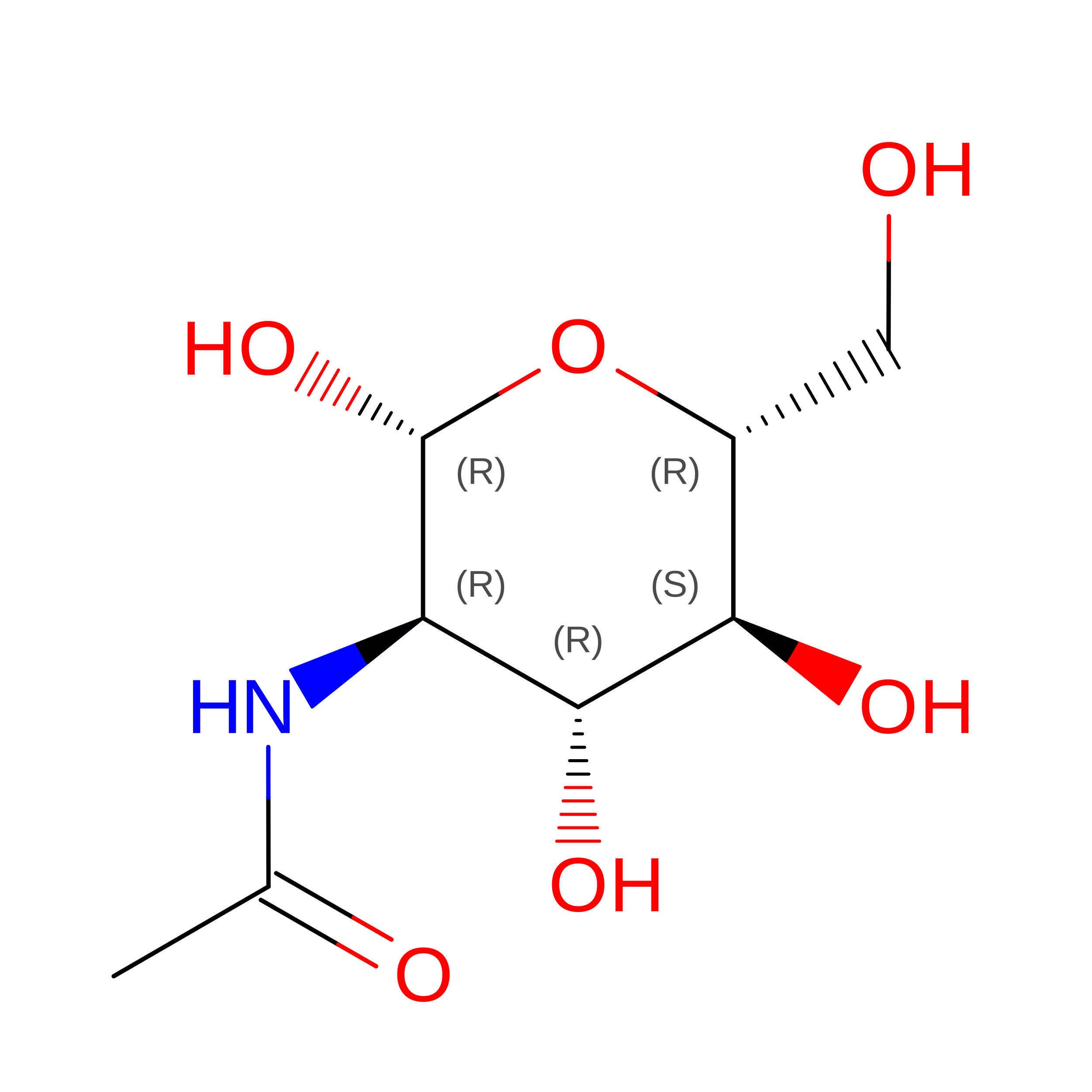
NAG

Query on NAG


Download:Ideal Coordinates CCD File
C [auth B]2-acetamido-2-deoxy-beta-D-glucopyranose
C8 H15 N O6
OVRNDRQMDRJTHS-FMDGEEDCSA-N

Experimental Data & Validation

Experimental Data

  • Method: X-RAY DIFFRACTION
  • Resolution: 2.49 Å
  • R-Value Free:  0.234 (Depositor), 0.236 (DCC) 
  • R-Value Work:  0.195 (Depositor), 0.196 (DCC) 
  • R-Value Observed: 0.197 (Depositor) 
Space Group: C 1 2 1
Unit Cell:
Length ( Å )Angle ( ˚ )
a = 69.29α = 90
b = 110.857β = 107.92
c = 77.508γ = 90
Software Package:
Software NamePurpose
REFMACrefinement
HKL-2000data reduction
SCALEPACKdata scaling
PHASERphasing

Structure Validation

View Full Validation Report


Ligand Structure Quality Assessment 


Entry History 

Deposition Data

Revision History  (Full details and data files)

  • Version 1.0: 2012-04-25
    Type: Initial release
  • Version 1.1: 2012-06-13
    Changes: Other
  • Version 1.2: 2020-07-29
    Type: Remediation
    Reason: Carbohydrate remediation
    Changes: Data collection, Derived calculations, Other, Structure summary
  • Version 1.3: 2023-12-20
    Changes: Data collection, Database references, Refinement description, Structure summary
  • Version 1.4: 2024-11-20
    Changes: Structure summary