4A0S | pdb_00004a0s

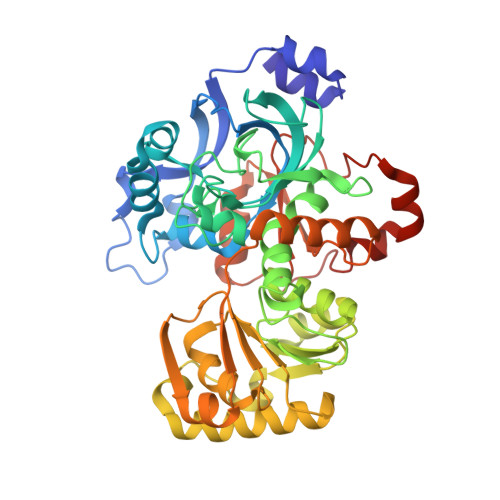
STRUCTURE OF THE 2-OCTENOYL-COA CARBOXYLASE REDUCTASE CINF IN COMPLEX WITH NADP AND 2-OCTENOYL-COA


Experimental Data Snapshot

  • Method: X-RAY DIFFRACTION
  • Resolution: 1.90 Å
  • R-Value Free: 
    0.250 (Depositor), 0.302 (DCC) 
  • R-Value Work: 
    0.199 (Depositor), 0.256 (DCC) 
  • R-Value Observed: 
    0.202 (Depositor) 

Starting Model: experimental
View more details

wwPDB Validation 3D Report Full Report

Validation slider image for 4A0S

Ligand Structure Quality Assessment 


This is version 1.3 of the entry. See complete history

Literature

Unusual carbon fixation gives rise to diverse polyketide extender units.

Quade, N.Huo, L.Rachid, S.Heinz, D.W.Muller, R.

(2011) Nat Chem Biol 8: 117-124

  • DOI: https://doi.org/10.1038/nchembio.734
  • Primary Citation Related Structures: 
    4A0S, 4A10

  • PubMed Abstract: 

    Polyketides are structurally diverse and medically important natural products that have various biological activities. During biosynthesis, chain elongation uses activated dicarboxylic acid building blocks, and their availability therefore limits side chain variation in polyketides. Recently, the crotonyl-CoA carboxylase-reductase (CCR) class of enzymes was identified in primary metabolism and was found to be involved in extender-unit biosynthesis of polyketides. These enzymes are, in theory, capable of forming dicarboxylic acids that show any side chain from the respective unsaturated fatty acid precursor. To our knowledge, we here report the first crystal structure of a CCR, the hexylmalonyl-CoA synthase from Streptomyces sp. JS360, in complex with its substrate. Structural analysis and biochemical characterization of the enzyme, including active site mutations, are reported. Our analysis reveals how primary metabolic CCRs can evolve to produce various dicarboxylic acid building blocks, setting the stage to use CCRs for the production of unique extender units and, consequently, altered polyketides.


  • Organizational Affiliation
    • Department of Molecular Structural Biology, Helmholtz Centre for Infection Research, Braunschweig, Germany.

Macromolecule Content 

  • Total Structure Weight: 198.67 kDa 
  • Atom Count: 15,766 
  • Modeled Residue Count: 1,778 
  • Deposited Residue Count: 1,788 
  • Unique protein chains: 1

Macromolecules

Find similar proteins by:|  3D Structure
Entity ID: 1
MoleculeChains  Sequence LengthOrganismDetailsImage
OCTENOYL-COA REDUCTASE/CARBOXYLASE
A, B, C, D
447Streptomyces cinnabarigriseusMutation(s): 0 
UniProt
Find proteins for F0V3Z3 (Streptomyces cinnabarigriseus)
Explore F0V3Z3 
Go to UniProtKB:  F0V3Z3
Entity Groups
Sequence Clusters30% Identity50% Identity70% Identity90% Identity95% Identity100% Identity
UniProt GroupF0V3Z3
Sequence Annotations
Expand
Reference Sequence

Small Molecules

Ligands 2 Unique
IDChains Name / Formula / InChI Key2D Diagram3D Interactions
CO8

Query on CO8


Download:Ideal Coordinates CCD File
E [auth A],
H [auth B],
J [auth C],
L [auth D]
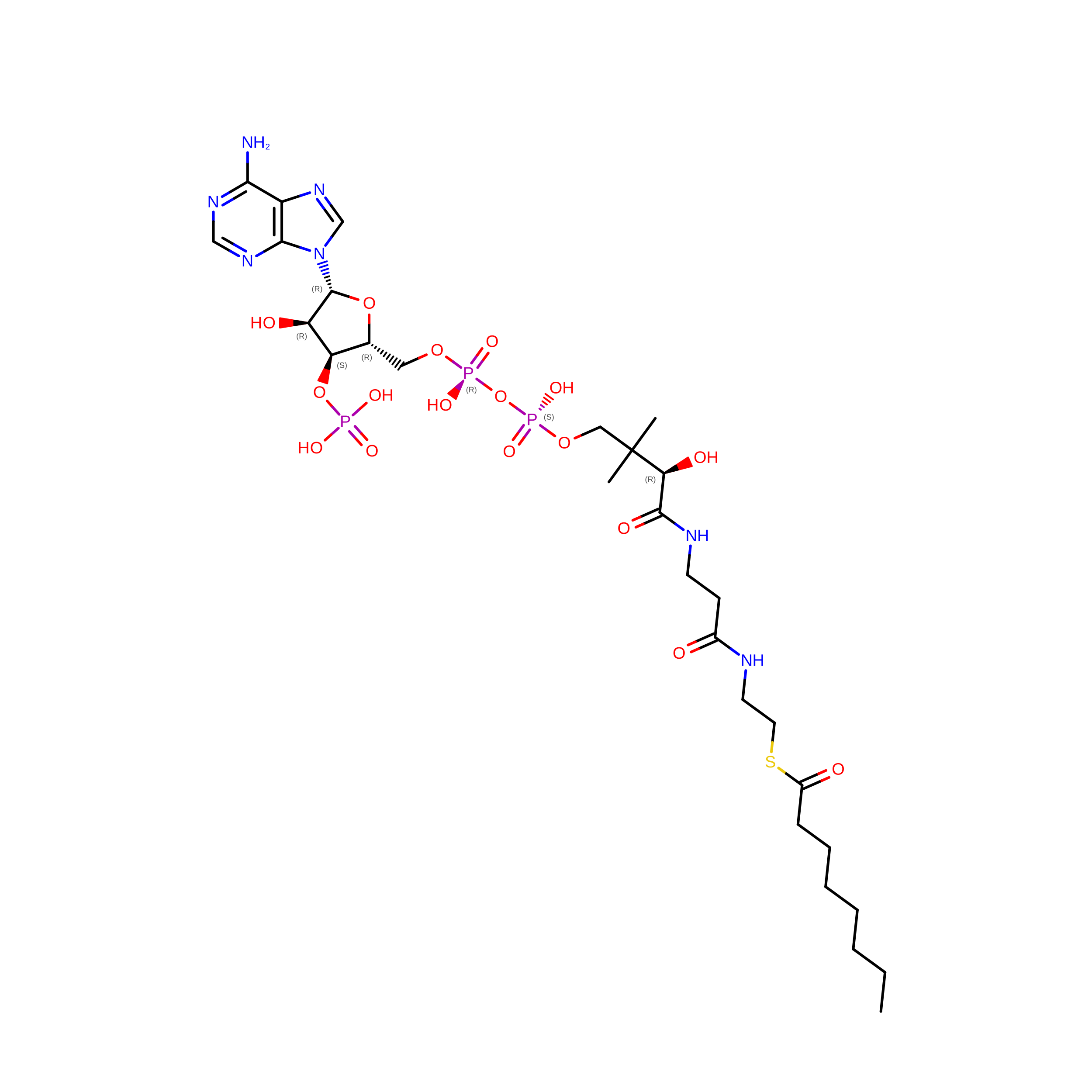
OCTANOYL-COENZYME A
C29 H50 N7 O17 P3 S
KQMZYOXOBSXMII-CECATXLMSA-N
NAP

Query on NAP


Download:Ideal Coordinates CCD File
F [auth A],
G [auth B],
I [auth C],
K [auth D]
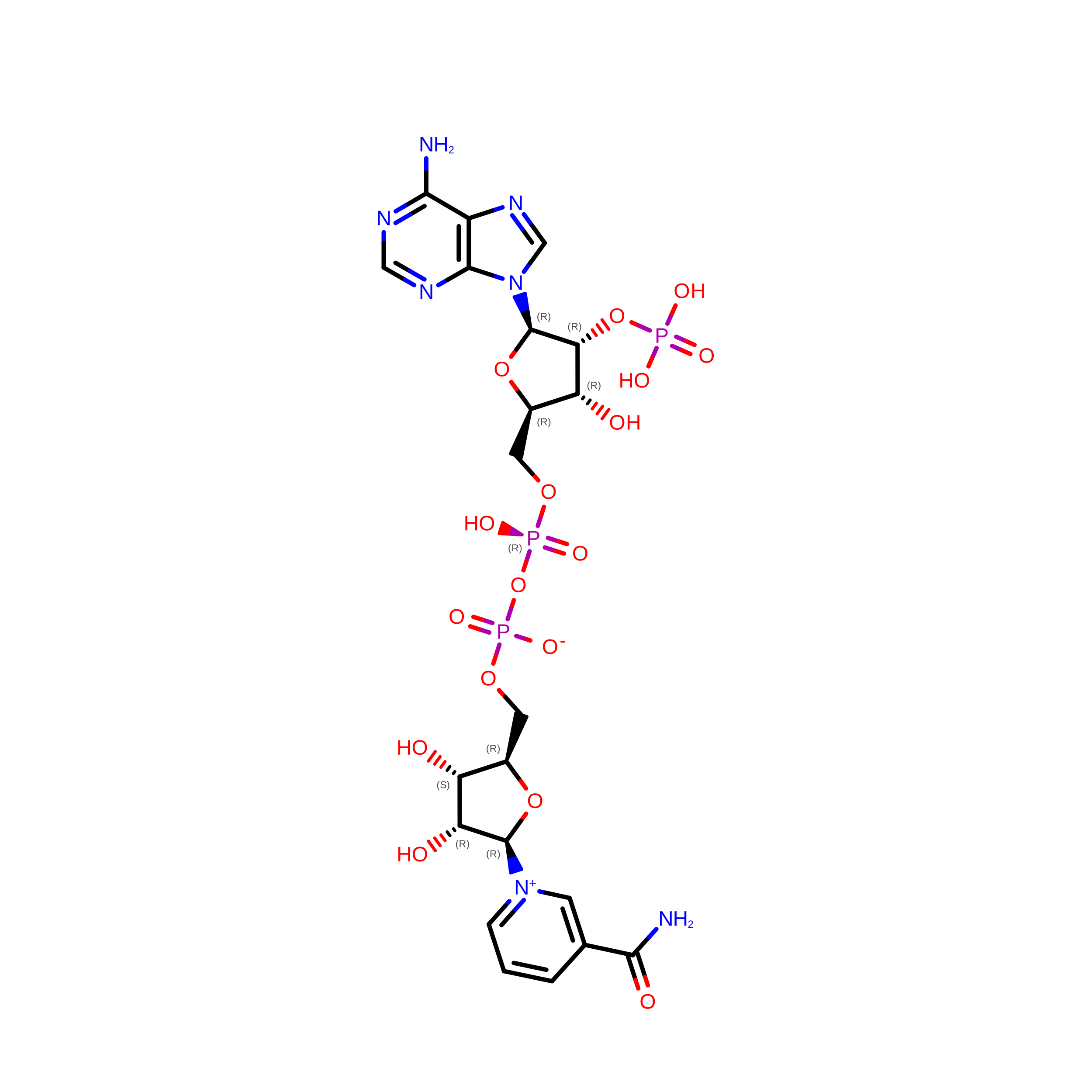
NADP NICOTINAMIDE-ADENINE-DINUCLEOTIDE PHOSPHATE
C21 H28 N7 O17 P3
XJLXINKUBYWONI-NNYOXOHSSA-N

Experimental Data & Validation

Experimental Data

  • Method: X-RAY DIFFRACTION
  • Resolution: 1.90 Å
  • R-Value Free:  0.250 (Depositor), 0.302 (DCC) 
  • R-Value Work:  0.199 (Depositor), 0.256 (DCC) 
  • R-Value Observed: 0.202 (Depositor) 
Space Group: P 1 21 1
Unit Cell:
Length ( Å )Angle ( ˚ )
a = 96.01α = 90
b = 83.3β = 110.96
c = 122.74γ = 90
Software Package:
Software NamePurpose
REFMACrefinement
XDSdata reduction
XSCALEdata scaling
MOLREPphasing

Structure Validation

View Full Validation Report


Ligand Structure Quality Assessment 


Entry History 

Deposition Data

Revision History  (Full details and data files)

  • Version 1.0: 2011-12-07
    Type: Initial release
  • Version 1.1: 2011-12-28
    Changes: Other
  • Version 1.2: 2019-01-16
    Changes: Data collection, Database references, Derived calculations
  • Version 1.3: 2023-12-20
    Changes: Data collection, Database references, Derived calculations, Other, Refinement description