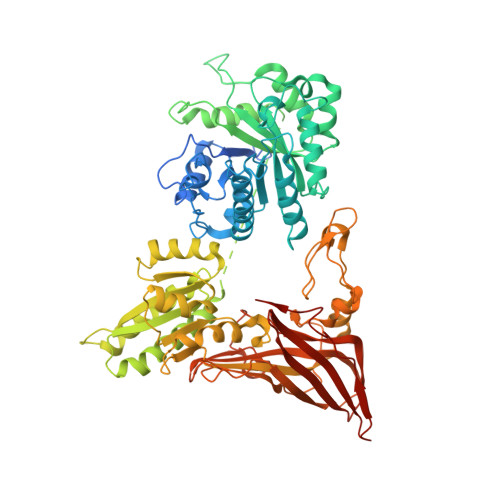
3UA4 | pdb_00003ua4

Crystal Structure of Protein Arginine Methyltransferase PRMT5


Experimental Data Snapshot

  • Method: X-RAY DIFFRACTION
  • Resolution: 3.00 Å
  • R-Value Free: 
    0.288 (Depositor), 0.287 (DCC) 
  • R-Value Work: 
    0.232 (Depositor), 0.232 (DCC) 
  • R-Value Observed: 
    0.235 (Depositor) 

Starting Model: experimental
View more details

wwPDB Validation 3D Report Full Report

Validation slider image for 3UA4

This is version 1.2 of the entry. See complete history

Literature

Structural insights into protein arginine symmetric dimethylation by PRMT5

Sun, L.Wang, M.Lv, Z.Yang, N.Liu, Y.Bao, S.Gong, W.Xu, R.M.

(2011) Proc Natl Acad Sci U S A 108: 20538-20543

  • DOI: https://doi.org/10.1073/pnas.1106946108
  • Primary Citation Related Structures: 
    3UA3, 3UA4

  • PubMed Abstract: 

    Symmetric and asymmetric dimethylation of arginine are isomeric protein posttranslational modifications with distinct biological effects, evidenced by the methylation of arginine 3 of histone H4 (H4R3): symmetric dimethylation of H4R3 leads to repression of gene expression, while asymmetric dimethylation of H4R3 is associated with gene activation. The enzymes catalyzing these modifications share identifiable sequence similarities, but the relationship between their catalytic mechanisms is unknown. Here we analyzed the structure of a prototypic symmetric arginine dimethylase, PRMT5, and discovered that a conserved phenylalanine in the active site is critical for specifying symmetric addition of methyl groups. Changing it to a methionine significantly elevates the overall methylase activity, but also converts PRMT5 to an enzyme that catalyzes both symmetric and asymmetric dimethylation of arginine. Our results demonstrate a common catalytic mechanism intrinsic to both symmetric and asymmetric arginine dimethylases, and show that steric constrains in the active sites play an essential role in determining the product specificity of arginine methylases. This discovery also implies a potentially regulatable outcome of arginine dimethylation that may provide versatile control of eukaryotic gene expression.


  • Organizational Affiliation
    • National Laboratory of Biomacromolecules, Institute of Biophysics, Chinese Academy of Sciences, Beijing 100101, China.

Macromolecule Content 

  • Total Structure Weight: 169.59 kDa 
  • Atom Count: 10,345 
  • Modeled Residue Count: 1,268 
  • Deposited Residue Count: 1,490 
  • Unique protein chains: 1

Macromolecules

Find similar proteins by:|  3D Structure
Entity ID: 1
MoleculeChains  Sequence LengthOrganismDetailsImage
Protein arginine N-methyltransferase 5
A, B
745Caenorhabditis elegansMutation(s): 0 
Gene Names: prmt-5
EC: 2.1.1.125 (PDB Primary Data), 2.1.1.320 (UniProt)
UniProt
Find proteins for P46580 (Caenorhabditis elegans)
Explore P46580 
Go to UniProtKB:  P46580
Entity Groups
Sequence Clusters30% Identity50% Identity70% Identity90% Identity95% Identity100% Identity
UniProt GroupP46580
Sequence Annotations
Expand
Reference Sequence

Small Molecules

Ligands 1 Unique
IDChains Name / Formula / InChI Key2D Diagram3D Interactions
GOL

Query on GOL


Download:Ideal Coordinates CCD File
C [auth B]GLYCEROL
C3 H8 O3
PEDCQBHIVMGVHV-UHFFFAOYSA-N

Experimental Data & Validation

Experimental Data

  • Method: X-RAY DIFFRACTION
  • Resolution: 3.00 Å
  • R-Value Free:  0.288 (Depositor), 0.287 (DCC) 
  • R-Value Work:  0.232 (Depositor), 0.232 (DCC) 
  • R-Value Observed: 0.235 (Depositor) 
Space Group: P 21 21 21
Unit Cell:
Length ( Å )Angle ( ˚ )
a = 100.56α = 90
b = 129.49β = 90
c = 149.719γ = 90
Software Package:
Software NamePurpose
MAR345dtbdata collection
PHENIXmodel building
PHENIXrefinement
HKL-2000data reduction
HKL-2000data scaling
PHENIXphasing

Structure Validation

View Full Validation Report


Entry History 

Deposition Data

Revision History  (Full details and data files)

  • Version 1.0: 2011-12-14
    Type: Initial release
  • Version 1.1: 2011-12-28
    Changes: Database references
  • Version 1.2: 2023-11-01
    Changes: Data collection, Database references, Derived calculations, Refinement description