3QS3

Crystal structure of the biofilm forming subunit of the E. coli common pilus: donor strand complemented (DSC) EcpA


Experimental Data Snapshot

  • Method: X-RAY DIFFRACTION
  • Resolution: 2.10 Å
  • R-Value Free: 0.200 
  • R-Value Work: 0.167 
  • R-Value Observed: 0.170 

wwPDB Validation 3D Report Full Report


This is version 1.3 of the entry. See complete history


Literature

Structural insights into the biogenesis and biofilm formation by the Escherichia coli common pilus.

Garnett, J.A.Martinez-Santos, V.I.Saldana, Z.Pape, T.Hawthorne, W.Chan, J.Simpson, P.J.Cota, E.Puente, J.L.Giron, J.A.Matthews, S.

(2012) Proc Natl Acad Sci U S A 109: 3950-3955

  • DOI: 10.1073/pnas.1106733109
  • Structures With Same Primary Citation

  • PubMed Abstract: 
  • Bacteria have evolved a variety of mechanisms for developing community-based biofilms. These bacterial aggregates are of clinical importance, as they are a major source of recurrent disease. Bacterial surface fibers (pili) permit adherence to biotic ...

    Bacteria have evolved a variety of mechanisms for developing community-based biofilms. These bacterial aggregates are of clinical importance, as they are a major source of recurrent disease. Bacterial surface fibers (pili) permit adherence to biotic and abiotic substrates, often in a highly specific manner. The Escherichia coli common pilus (ECP) represents a remarkable family of extracellular fibers that are associated with both disease-causing and commensal strains. ECP plays a dual role in early-stage biofilm development and host cell recognition. Despite being the most common fimbrial structure, relatively little is known regarding its biogenesis, architecture, and function. Here we report atomic-resolution insight into the biogenesis and architecture of ECP. We also derive a structural model for entwined ECP fibers that not only illuminates interbacteria communication during biofilm formation but also provides a useful foundation for the design of novel nanofibers.


    Organizational Affiliation

    Centre for Structural Biology, Department of Biological Sciences, Imperial College London, South Kensington, London SW7 2AZ, United Kingdom.


Macromolecules

Find similar proteins by: Sequence  |  Structure

Entity ID: 1
MoleculeChainsSequence LengthOrganismDetails
Fimbrillin matB homolog, EcpD
A, B, C, D, E, F, G, H, I, J, K, L
191Escherichia coli CFT073Mutation(s): 0 
Gene Names: matBecpD
Find proteins for Q8FKL3 (Escherichia coli O6:H1 (strain CFT073 / ATCC 700928 / UPEC))
Go to UniProtKB:  Q8FKL3
Find proteins for Q8CWB9 (Escherichia coli O6:H1 (strain CFT073 / ATCC 700928 / UPEC))
Go to UniProtKB:  Q8CWB9
Small Molecules
Ligands 1 Unique
IDChainsName / Formula / InChI Key2D Diagram3D Interactions
FLC
Query on FLC

Download CCD File 
B, D, F, G, I, K
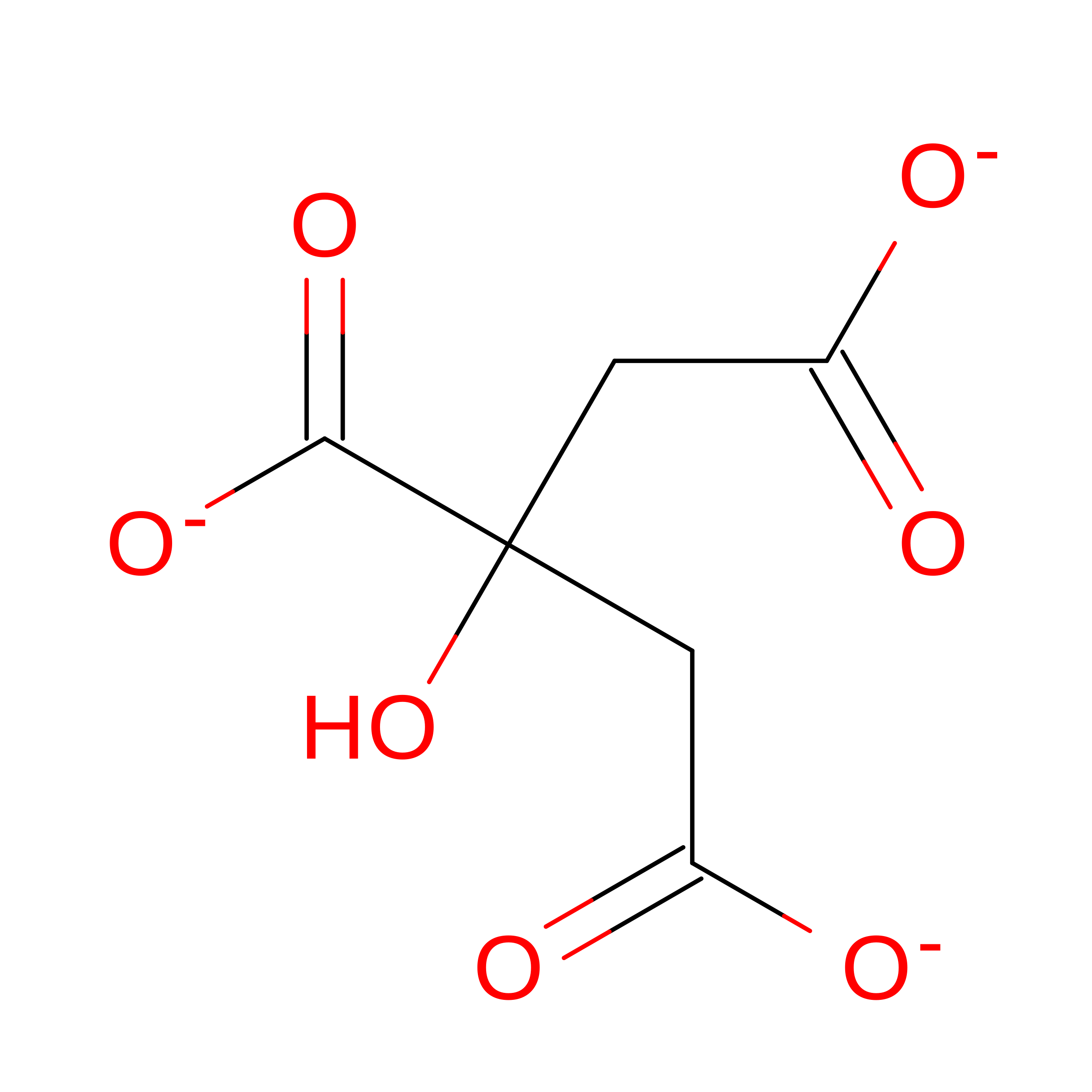
CITRATE ANION
C6 H5 O7
KRKNYBCHXYNGOX-UHFFFAOYSA-K
 Ligand Interaction
Experimental Data & Validation

Experimental Data

  • Method: X-RAY DIFFRACTION
  • Resolution: 2.10 Å
  • R-Value Free: 0.200 
  • R-Value Work: 0.167 
  • R-Value Observed: 0.170 
  • Space Group: P 65
Unit Cell:
Length ( Å )Angle ( ˚ )
a = 101.79α = 90
b = 101.79β = 90
c = 387.34γ = 120
Software Package:
Software NamePurpose
ADSCdata collection
PHASERphasing
REFMACrefinement
MOSFLMdata reduction
SCALAdata scaling

Structure Validation

View Full Validation Report


Entry History 

Deposition Data

Revision History 

  • Version 1.0: 2012-02-22
    Type: Initial release
  • Version 1.1: 2012-03-07
    Changes: Database references
  • Version 1.2: 2012-03-21
    Changes: Database references
  • Version 1.3: 2017-08-09
    Changes: Refinement description, Source and taxonomy