3BAM | pdb_00003bam

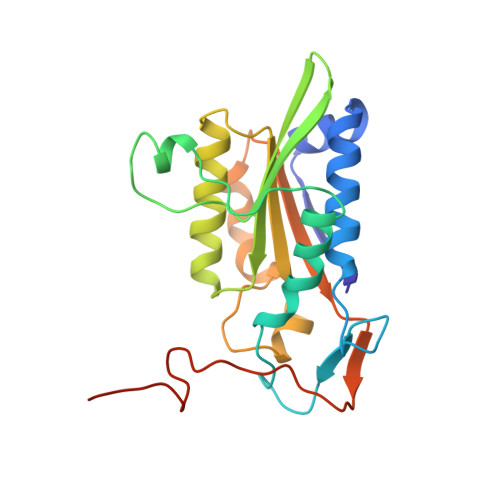
RESTRICTION ENDONUCLEASE BAMHI COMPLEX WITH DNA AND MANGANESE IONS (POST-REACTIVE COMPLEX)


Experimental Data Snapshot

  • Method: X-RAY DIFFRACTION
  • Resolution: 1.80 Å
  • R-Value Free: 
    0.268 (Depositor) 
  • R-Value Work: 
    0.226 (Depositor) 
  • R-Value Observed: 
    0.226 (Depositor) 

Starting Model: experimental
View more details

wwPDB Validation 3D Report Full Report

Validation slider image for 3BAM

This is version 1.3 of the entry. See complete history

Literature

The role of metals in catalysis by the restriction endonuclease BamHI.

Viadiu, H.Aggarwal, A.K.

(1998) Nat Struct Biol 5: 910-916

  • DOI: https://doi.org/10.1038/2352
  • Primary Citation Related Structures: 
    2BAM, 3BAM

  • PubMed Abstract: 

    Type II restriction enzymes are characterized by their remarkable specificity and simplicity. They require only divalent metals (such as Mg2+ or Mn2+) as cofactors to catalyze the hydrolysis of DNA. However, most of the structural work on endonucleases has been performed in the absence of metals, leaving unanswered questions about their mechanisms of DNA cleavage. Here we report structures of the endonuclease BamHI-DNA complex, determined in the presence of Mn2+ and Ca2+, that describe the enzyme at different stages of catalysis. Overall, the results support a two-metal mechanism of DNA cleavage for BamHI which is distinct from that of EcoRV.


  • Organizational Affiliation
    • Department of Biochemistry and Molecular Biophysics, Columbia University, New York, New York 10032, USA.

Macromolecule Content 

  • Total Structure Weight: 56.59 kDa 
  • Atom Count: 4,177 
  • Modeled Residue Count: 438 
  • Deposited Residue Count: 450 
  • Unique protein chains: 1
  • Unique nucleic acid chains: 3

Macromolecules


Find similar proteins by:|  3D Structure
Entity ID: 4
MoleculeChains  Sequence LengthOrganismDetailsImage
PROTEIN (RESTRICTION ENDONUCLEASE BAMHI)D [auth A],
E [auth B]
213Bacillus amyloliquefaciensMutation(s): 0 
EC: 3.1.21.4
UniProt
Find proteins for P23940 (Bacillus amyloliquefaciens)
Explore P23940 
Go to UniProtKB:  P23940
Entity Groups
Sequence Clusters30% Identity50% Identity70% Identity90% Identity95% Identity100% Identity
UniProt GroupP23940
Sequence Annotations
Expand
Reference Sequence
Find similar nucleic acids by:  Sequence
Entity ID: 1
MoleculeChains LengthOrganismImage
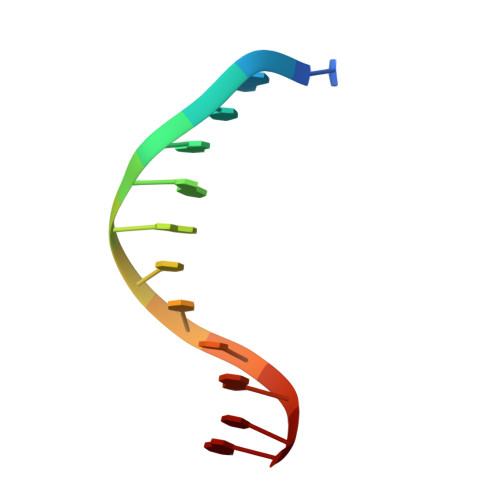
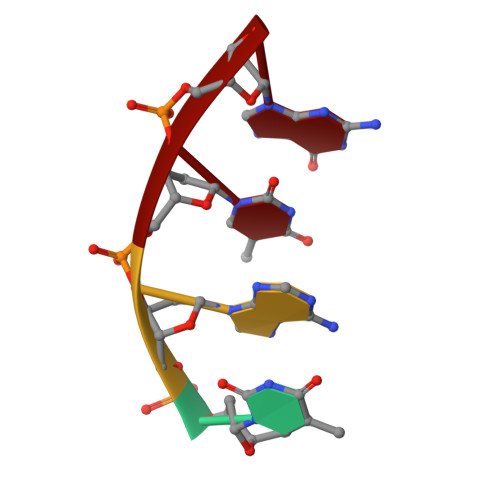
DNA (5'-D(*TP*AP*TP*GP*GP*AP*TP*CP*CP*AP*TP*A)-3')A [auth C]12N/A
Sequence Annotations
Expand
Reference Sequence
Find similar nucleic acids by:  Sequence
Entity ID: 2
MoleculeChains LengthOrganismImage
DNA (5'-D(*TP*AP*TP*G)-3')B [auth D]4N/A
Sequence Annotations
Expand
Reference Sequence
Find similar nucleic acids by:  Sequence
Entity ID: 3
MoleculeChains LengthOrganismImage
DNA (5'-D(P*GP*AP*TP*CP*CP*AP*TP*A)-3')C [auth E]8N/A
Sequence Annotations
Expand
Reference Sequence

Small Molecules

Experimental Data & Validation

Experimental Data

  • Method: X-RAY DIFFRACTION
  • Resolution: 1.80 Å
  • R-Value Free:  0.268 (Depositor) 
  • R-Value Work:  0.226 (Depositor) 
  • R-Value Observed: 0.226 (Depositor) 
Space Group: P 21 21 21
Unit Cell:
Length ( Å )Angle ( ˚ )
a = 106.4α = 90
b = 79.6β = 90
c = 67.6γ = 90
Software Package:
Software NamePurpose
X-PLORmodel building
X-PLORrefinement
DENZOdata reduction
SCALEPACKdata scaling
X-PLORphasing

Structure Validation

View Full Validation Report


Entry History 

Deposition Data

Revision History  (Full details and data files)

  • Version 1.0: 1999-01-13
    Type: Initial release
  • Version 1.1: 2007-10-16
    Changes: Version format compliance
  • Version 1.2: 2011-07-13
    Changes: Version format compliance
  • Version 1.3: 2023-08-30
    Changes: Data collection, Database references, Derived calculations, Refinement description