3WB8 | pdb_00003wb8

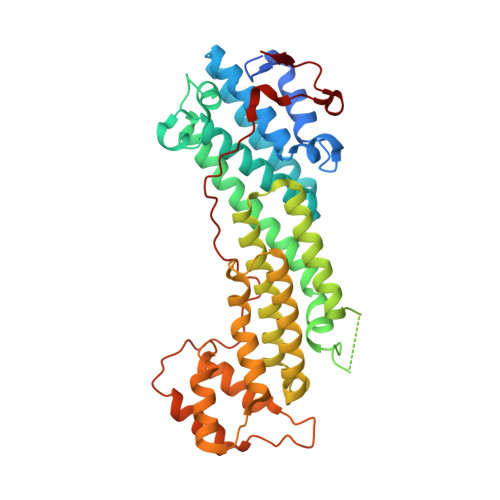
Crystal Structure of MyoVa-GTD


Experimental Data Snapshot

  • Method: X-RAY DIFFRACTION
  • Resolution: 2.50 Å
  • R-Value Free: 
    0.225 (Depositor), 0.227 (DCC) 
  • R-Value Work: 
    0.173 (Depositor), 0.177 (DCC) 
  • R-Value Observed: 
    0.176 (Depositor) 

wwPDB Validation 3D Report Full Report

Validation slider image for 3WB8

This is version 1.2 of the entry. See complete history

Literature

Structural basis of cargo recognitions for class V myosins

Wei, Z.Liu, X.Yu, C.Zhang, M.

(2013) Proc Natl Acad Sci U S A 110: 11314-11319

  • DOI: https://doi.org/10.1073/pnas.1306768110
  • Primary Citation Related Structures: 
    3WB8, 4KP3

  • PubMed Abstract: 

    Class V myosins (MyoV), the most studied unconventional myosins, recognize numerous cargos mainly via the motor's globular tail domain (GTD). Little is known regarding how MyoV-GTD recognizes such a diverse array of cargos specifically. Here, we solved the crystal structures of MyoVa-GTD in its apo-form and in complex with two distinct cargos, melanophilin and Rab interacting lysosomal protein-like 2. The apo-MyoVa-GTD structure indicates that most mutations found in patients with Griscelli syndrome, microvillus inclusion disease, or cancers or in "dilute" rodents likely impair the folding of GTD. The MyoVa-GTD/cargo complex structure reveals two distinct cargo-binding surfaces, one primarily via charge-charge interaction and the other mainly via hydrophobic interactions. Structural and biochemical analysis reveal the specific cargo-binding specificities of various isoforms of mammalian MyoV as well as very different cargo recognition mechanisms of MyoV between yeast and higher eukaryotes. The MyoVa-GTD structures resolved here provide a framework for future functional studies of vertebrate class V myosins.


  • Organizational Affiliation
    • Division of Life Science, State Key Laboratory of Molecular Neuroscience, Hong Kong University of Science and Technology, Kowloon, Hong Kong, China.

Macromolecule Content 

  • Total Structure Weight: 370.34 kDa 
  • Atom Count: 23,277 
  • Modeled Residue Count: 2,861 
  • Deposited Residue Count: 3,232 
  • Unique protein chains: 1

Macromolecules

Find similar proteins by:|  3D Structure
Entity ID: 1
MoleculeChains  Sequence LengthOrganismDetailsImage
Unconventional myosin-Va
A, B, C, D, E
A, B, C, D, E, F, G, H
404Mus musculusMutation(s): 0 
Gene Names: Myo5a
UniProt & NIH Common Fund Data Resources
Find proteins for Q99104 (Mus musculus)
Explore Q99104 
Go to UniProtKB:  Q99104
IMPC:  MGI:105976
Entity Groups
Sequence Clusters30% Identity50% Identity70% Identity90% Identity95% Identity100% Identity
UniProt GroupQ99104
Sequence Annotations
Expand
Reference Sequence

Small Molecules

Ligands 1 Unique
IDChains Name / Formula / InChI Key2D Diagram3D Interactions
EDO

Query on EDO


Download:Ideal Coordinates CCD File
AA [auth G]
BA [auth G]
CA [auth H]
DA [auth H]
I [auth A]
AA [auth G],
BA [auth G],
CA [auth H],
DA [auth H],
I [auth A],
J [auth A],
K [auth A],
L [auth A],
M [auth B],
N [auth B],
O [auth C],
P [auth C],
Q [auth C],
R [auth D],
S [auth D],
T [auth D],
U [auth E],
V [auth E],
W [auth F],
X [auth F],
Y [auth F],
Z [auth G]
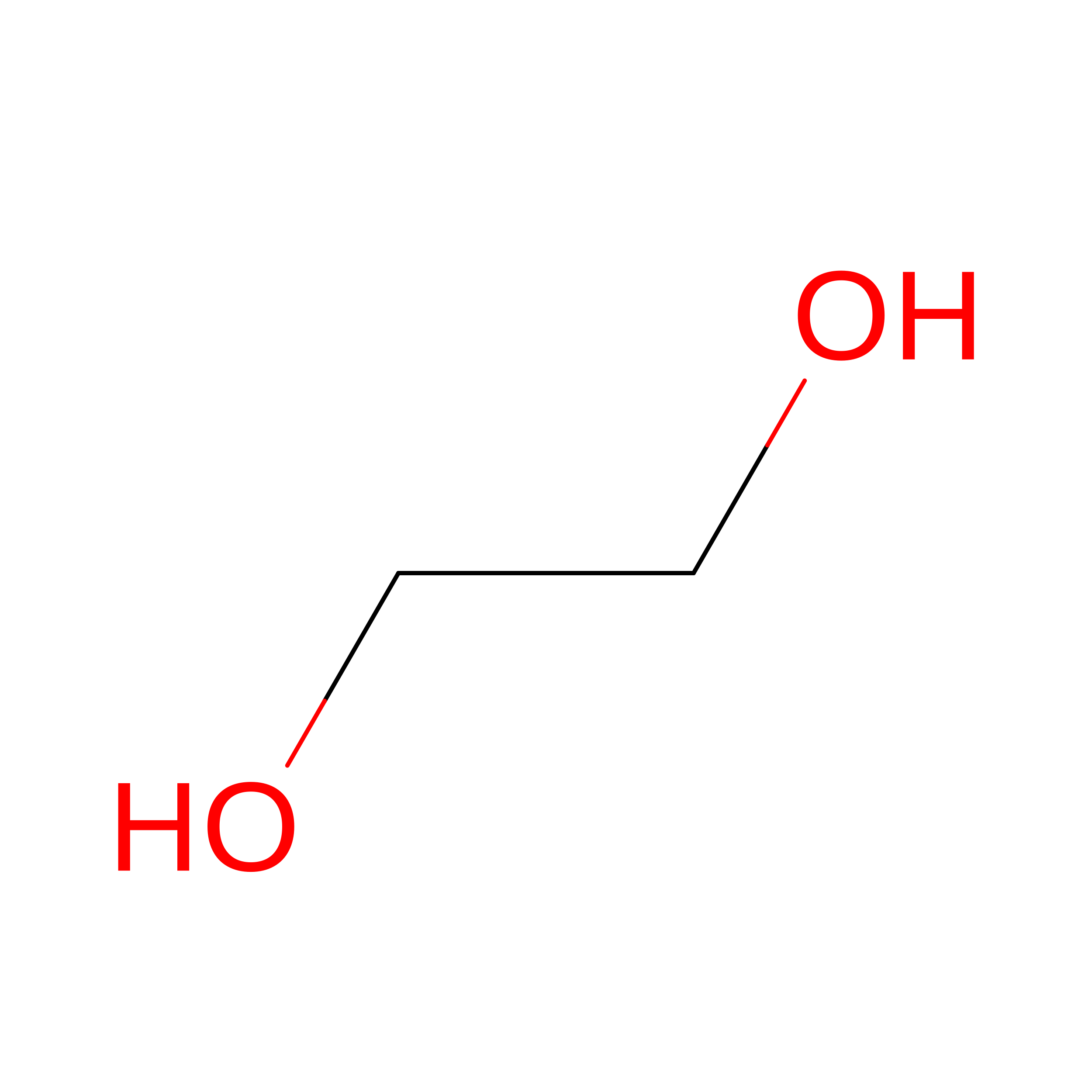
1,2-ETHANEDIOL
C2 H6 O2
LYCAIKOWRPUZTN-UHFFFAOYSA-N

Experimental Data & Validation

Experimental Data

  • Method: X-RAY DIFFRACTION
  • Resolution: 2.50 Å
  • R-Value Free:  0.225 (Depositor), 0.227 (DCC) 
  • R-Value Work:  0.173 (Depositor), 0.177 (DCC) 
  • R-Value Observed: 0.176 (Depositor) 
Space Group: P 1 21 1
Unit Cell:
Length ( Å )Angle ( ˚ )
a = 68.984α = 90
b = 165.355β = 90.06
c = 173.02γ = 90
Software Package:
Software NamePurpose
PHENIXrefinement
PDB_EXTRACTdata extraction
Blu-Icedata collection
HKL-2000data reduction
HKL-2000data scaling
AutoSolphasing

Structure Validation

View Full Validation Report


Entry History 

Deposition Data

Revision History  (Full details and data files)

  • Version 1.0: 2013-07-10
    Type: Initial release
  • Version 1.1: 2013-08-14
    Changes: Database references
  • Version 1.2: 2024-03-20
    Changes: Data collection, Database references, Derived calculations