3W2R | pdb_00003w2r

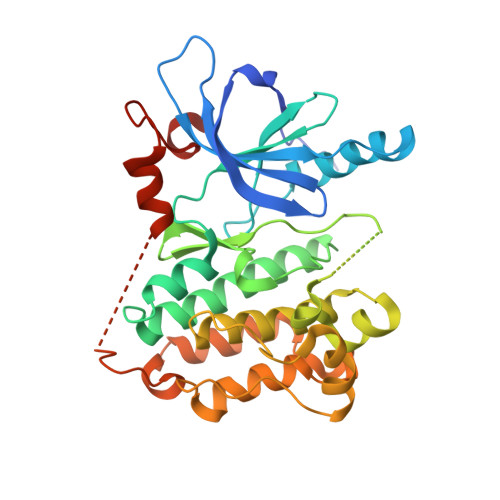
EGFR Kinase domain T790M/L858R mutant with compound 4


Experimental Data Snapshot

  • Method: X-RAY DIFFRACTION
  • Resolution: 2.05 Å
  • R-Value Free: 
    0.275 (Depositor), 0.264 (DCC) 
  • R-Value Work: 
    0.217 (Depositor), 0.212 (DCC) 
  • R-Value Observed: 
    0.220 (Depositor) 

Starting Model: experimental
View more details

wwPDB Validation 3D Report Full Report

Validation slider image for 3W2R

Ligand Structure Quality Assessment 


This is version 1.3 of the entry. See complete history

Literature

Structure-Based Approach for the Discovery of Pyrrolo[3,2-d]pyrimidine-Based EGFR T790M/L858R Mutant Inhibitors.

Sogabe, S.Kawakita, Y.Igaki, S.Iwata, H.Miki, H.Cary, D.R.Takagi, T.Takagi, S.Ohta, Y.Ishikawa, T.

(2013) ACS Med Chem Lett 4: 201-205

  • DOI: https://doi.org/10.1021/ml300327z
  • Primary Citation Related Structures: 
    3W2O, 3W2P, 3W2Q, 3W2R, 3W2S

  • PubMed Abstract: 

    The epidermal growth factor receptor (EGFR) family plays a critical role in vital cellular processes and in various cancers. Known EGFR inhibitors exhibit distinct antitumor responses against the various EGFR mutants associated with nonsmall-cell lung cancer. The L858R mutation enhances clinical sensitivity to gefitinib and erlotinib as compared with wild type and reduces the relative sensitivity to lapatinib. In contrast, the T790M mutation confers drug resistance to gefitinib and erlotinib. We determined crystal structures of the wild-type and T790M/L858R double mutant EGFR kinases with reversible and irreversible pyrrolo[3,2-d]pyrimidine inhibitors based on analogues of TAK-285 and neratinib. In these structures, M790 adopts distinct conformations to accommodate different inhibitors, whereas R858 allows conformational variations of the activation loop. These results provide structural insights for understanding the structure-activity relationships that should contribute to the development of potent inhibitors against drug-sensitive or -resistant EGFR mutations.


  • Organizational Affiliation
    • Pharmaceutical Research Division, Takeda Pharmaceutical Company Limited , 26-1, Muraoka-Higashi 2-chome, Fujisawa, Kanagawa 251-8555, Japan.

Macromolecule Content 

  • Total Structure Weight: 38.65 kDa 
  • Atom Count: 2,514 
  • Modeled Residue Count: 297 
  • Deposited Residue Count: 331 
  • Unique protein chains: 1

Macromolecules

Find similar proteins by:|  3D Structure
Entity ID: 1
MoleculeChains  Sequence LengthOrganismDetailsImage
Epidermal growth factor receptor331Homo sapiensMutation(s): 2 
Gene Names: EGFRERBBERBB1HER1
EC: 2.7.10.1
UniProt & NIH Common Fund Data Resources
Find proteins for P00533 (Homo sapiens)
Explore P00533 
Go to UniProtKB:  P00533
PHAROS:  P00533
GTEx:  ENSG00000146648 
Entity Groups
Sequence Clusters30% Identity50% Identity70% Identity90% Identity95% Identity100% Identity
UniProt GroupP00533
Sequence Annotations
Expand
Reference Sequence

Small Molecules

Ligands 2 Unique
IDChains Name / Formula / InChI Key2D Diagram3D Interactions
W2R

Query on W2R


Download:Ideal Coordinates CCD File
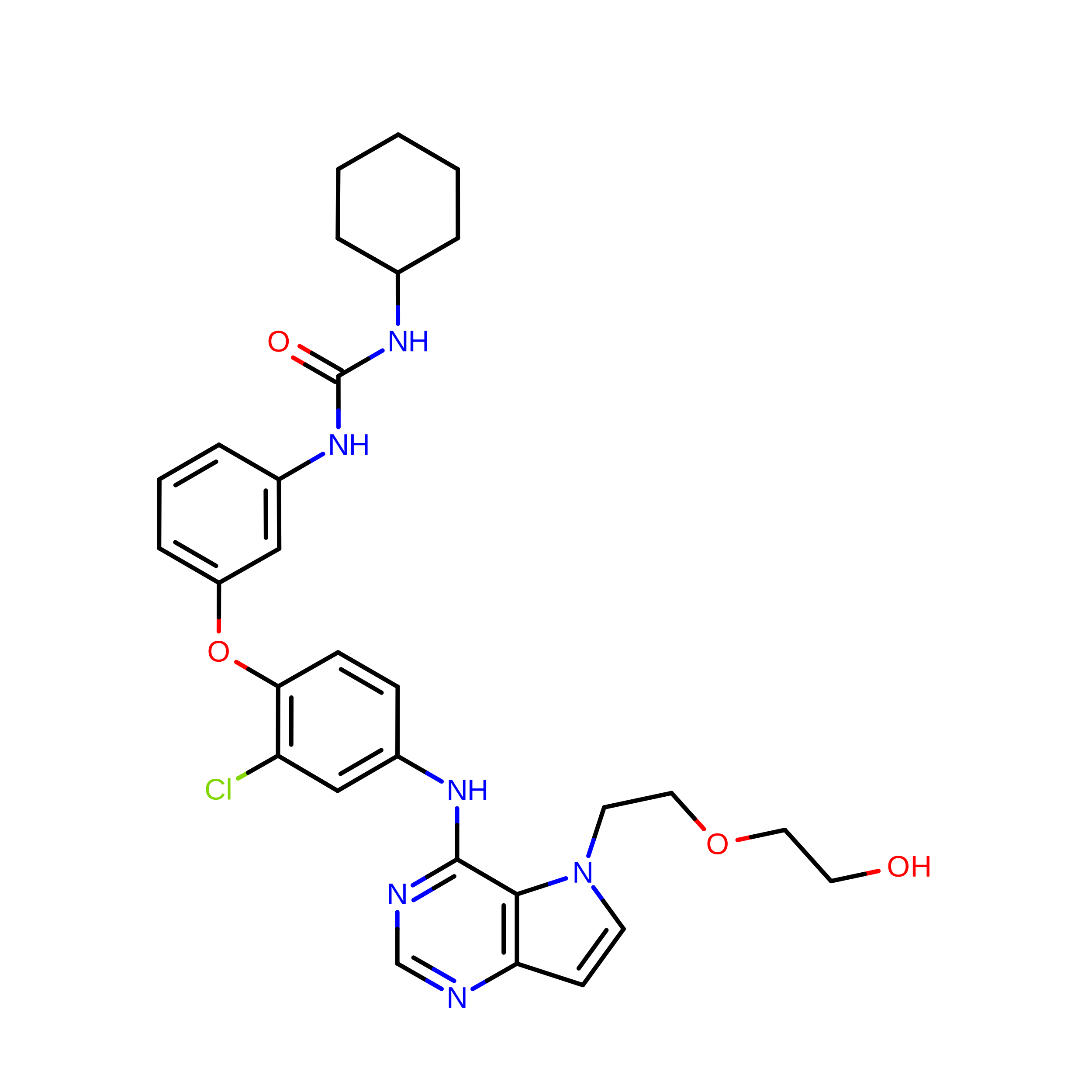
B [auth A]1-{3-[2-chloro-4-({5-[2-(2-hydroxyethoxy)ethyl]-5H-pyrrolo[3,2-d]pyrimidin-4-yl}amino)phenoxy]phenyl}-3-cyclohexylurea
C29 H33 Cl N6 O4
WDGCQQKABPWBPZ-UHFFFAOYSA-N
EDO

Query on EDO


Download:Ideal Coordinates CCD File
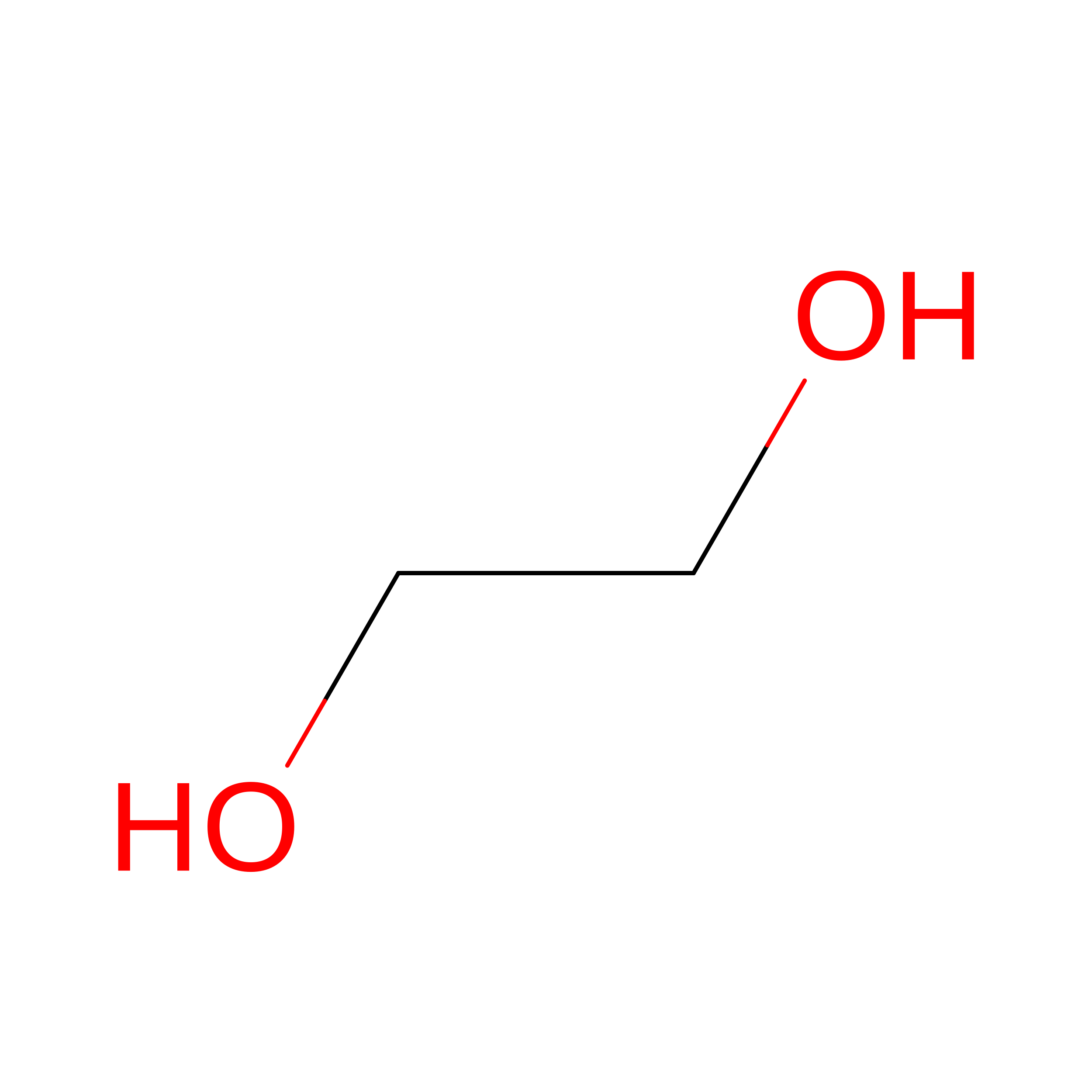
C [auth A]1,2-ETHANEDIOL
C2 H6 O2
LYCAIKOWRPUZTN-UHFFFAOYSA-N

Experimental Data & Validation

Experimental Data

  • Method: X-RAY DIFFRACTION
  • Resolution: 2.05 Å
  • R-Value Free:  0.275 (Depositor), 0.264 (DCC) 
  • R-Value Work:  0.217 (Depositor), 0.212 (DCC) 
  • R-Value Observed: 0.220 (Depositor) 
Space Group: P 43 21 2
Unit Cell:
Length ( Å )Angle ( ˚ )
a = 61.161α = 90
b = 61.161β = 90
c = 169.719γ = 90
Software Package:
Software NamePurpose
ADSCdata collection
MOLREPphasing
REFMACrefinement
HKL-2000data reduction
HKL-2000data scaling

Structure Validation

View Full Validation Report


Ligand Structure Quality Assessment 


Entry History 

Deposition Data

Revision History  (Full details and data files)

  • Version 1.0: 2013-01-16
    Type: Initial release
  • Version 1.1: 2013-08-21
    Changes: Database references
  • Version 1.2: 2019-12-25
    Changes: Database references
  • Version 1.3: 2023-11-08
    Changes: Data collection, Database references, Derived calculations, Refinement description