3VU9 | pdb_00003vu9

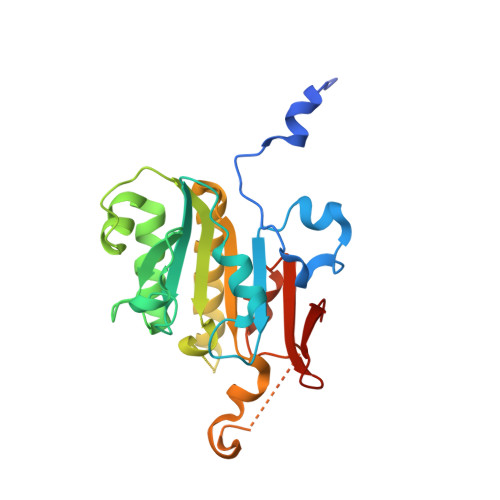
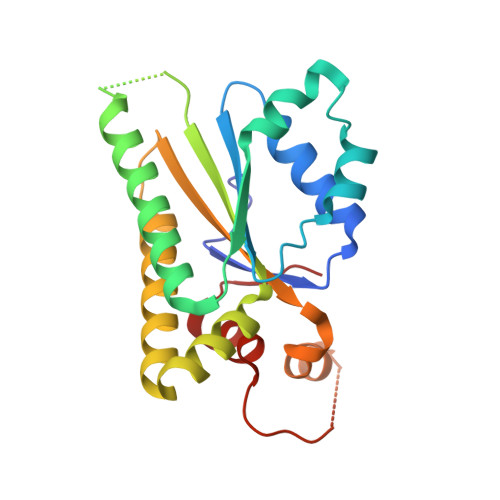
Crystal Structure of Psy3-Csm2 complex


Experimental Data Snapshot

  • Method: X-RAY DIFFRACTION
  • Resolution: 1.75 Å
  • R-Value Free: 
    0.231 (Depositor), 0.179 (DCC) 
  • R-Value Work: 
    0.182 (Depositor), 0.182 (DCC) 
  • R-Value Observed: 
    0.185 (Depositor) 

wwPDB Validation 3D Report Full Report

Validation slider image for 3VU9

This is version 1.3 of the entry. See complete history

Literature

A new protein complex promoting the assembly of Rad51 filaments

Sasanuma, H.Tawaramoto, M.S.Lao, J.P.Hosaka, H.Sanda, E.Suzuki, M.Yamashita, E.Hunter, N.Shinohara, M.Nakagawa, A.Shinohara, A.

(2013) Nat Commun 4: 1676-1676

  • DOI: https://doi.org/10.1038/ncomms2678
  • Primary Citation Related Structures: 
    3VU9

  • PubMed Abstract: 

    During homologous recombination, eukaryotic RecA homologue Rad51 assembles into a nucleoprotein filament on single-stranded DNA to catalyse homologous pairing and DNA-strand exchange with a homologous template. Rad51 nucleoprotein filaments are highly dynamic and regulated via the coordinated actions of various accessory proteins including Rad51 mediators. Here, we identify a new Rad51 mediator complex. The PCSS complex, comprising budding yeast Psy3, Csm2, Shu1 and Shu2 proteins, binds to recombination sites and is required for Rad51 assembly and function during meiosis. Within the hetero-tetramer, Psy3-Csm2 constitutes a core sub-complex with DNA-binding activity. In vitro, purified Psy3-Csm2 stabilizes the Rad51-single-stranded DNA complex independently of nucleotide cofactor. The mechanism of Rad51 stabilization is inferred by our high-resolution crystal structure, which reveals Psy3-Csm2 to be a structural mimic of the Rad51-dimer, a fundamental unit of the Rad51-filament. Together, these results reveal a novel molecular mechanism for this class of Rad51-mediators, which includes the human Rad51 paralogues.


  • Organizational Affiliation
    • Institute for Protein Research, Graduate School of Science, Osaka University, Suita 565-0871, Japan.

Macromolecule Content 

  • Total Structure Weight: 53.67 kDa 
  • Atom Count: 3,651 
  • Modeled Residue Count: 406 
  • Deposited Residue Count: 458 
  • Unique protein chains: 2

Macromolecules

Find similar proteins by:|  3D Structure
Entity ID: 1
MoleculeChains  Sequence LengthOrganismDetailsImage
Platinum sensitivity protein 3245Saccharomyces cerevisiae S288CMutation(s): 0 
Gene Names: PSY3YLR376CL8039.17
UniProt
Find proteins for Q12318 (Saccharomyces cerevisiae (strain ATCC 204508 / S288c))
Explore Q12318 
Go to UniProtKB:  Q12318
Entity Groups
Sequence Clusters30% Identity50% Identity70% Identity90% Identity95% Identity100% Identity
UniProt GroupQ12318
Sequence Annotations
Expand
Reference Sequence
Find similar proteins by:|  3D Structure
Entity ID: 2
MoleculeChains  Sequence LengthOrganismDetailsImage
Chromosome segregation in meiosis protein 2213Saccharomyces cerevisiae S288CMutation(s): 0 
Gene Names: CSM2YIL132C
UniProt
Find proteins for P40465 (Saccharomyces cerevisiae (strain ATCC 204508 / S288c))
Explore P40465 
Go to UniProtKB:  P40465
Entity Groups
Sequence Clusters30% Identity50% Identity70% Identity90% Identity95% Identity100% Identity
UniProt GroupP40465
Sequence Annotations
Expand
Reference Sequence

Experimental Data & Validation

Experimental Data

  • Method: X-RAY DIFFRACTION
  • Resolution: 1.75 Å
  • R-Value Free:  0.231 (Depositor), 0.179 (DCC) 
  • R-Value Work:  0.182 (Depositor), 0.182 (DCC) 
  • R-Value Observed: 0.185 (Depositor) 
Space Group: C 1 2 1
Unit Cell:
Length ( Å )Angle ( ˚ )
a = 134.56α = 90
b = 50.403β = 102.92
c = 76.35γ = 90
Software Package:
Software NamePurpose
SOLVEphasing
REFMACrefinement
MOSFLMdata reduction
SCALAdata scaling

Structure Validation

View Full Validation Report


Entry History 

Deposition Data

Revision History  (Full details and data files)

  • Version 1.0: 2013-04-10
    Type: Initial release
  • Version 1.1: 2013-06-26
    Changes: Database references
  • Version 1.2: 2017-11-22
    Changes: Refinement description
  • Version 1.3: 2024-03-20
    Changes: Data collection, Database references, Derived calculations