Download Mendeley
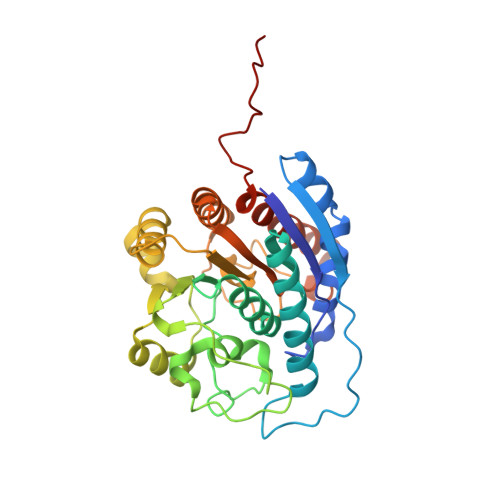
Crystal structures of complexes with cobalt-reconstituted human arginase I.
D'Antonio, E.L., Christianson, D.W.(2011) Biochemistry 50: 8018-8027
- PubMed: 21870783 Search on PubMedSearch on PubMed Central
- DOI: https://doi.org/10.1021/bi201101t
- Primary Citation Related Structures:
3TF3, 3TH7, 3THE, 3THH, 3THJ - PubMed Abstract:
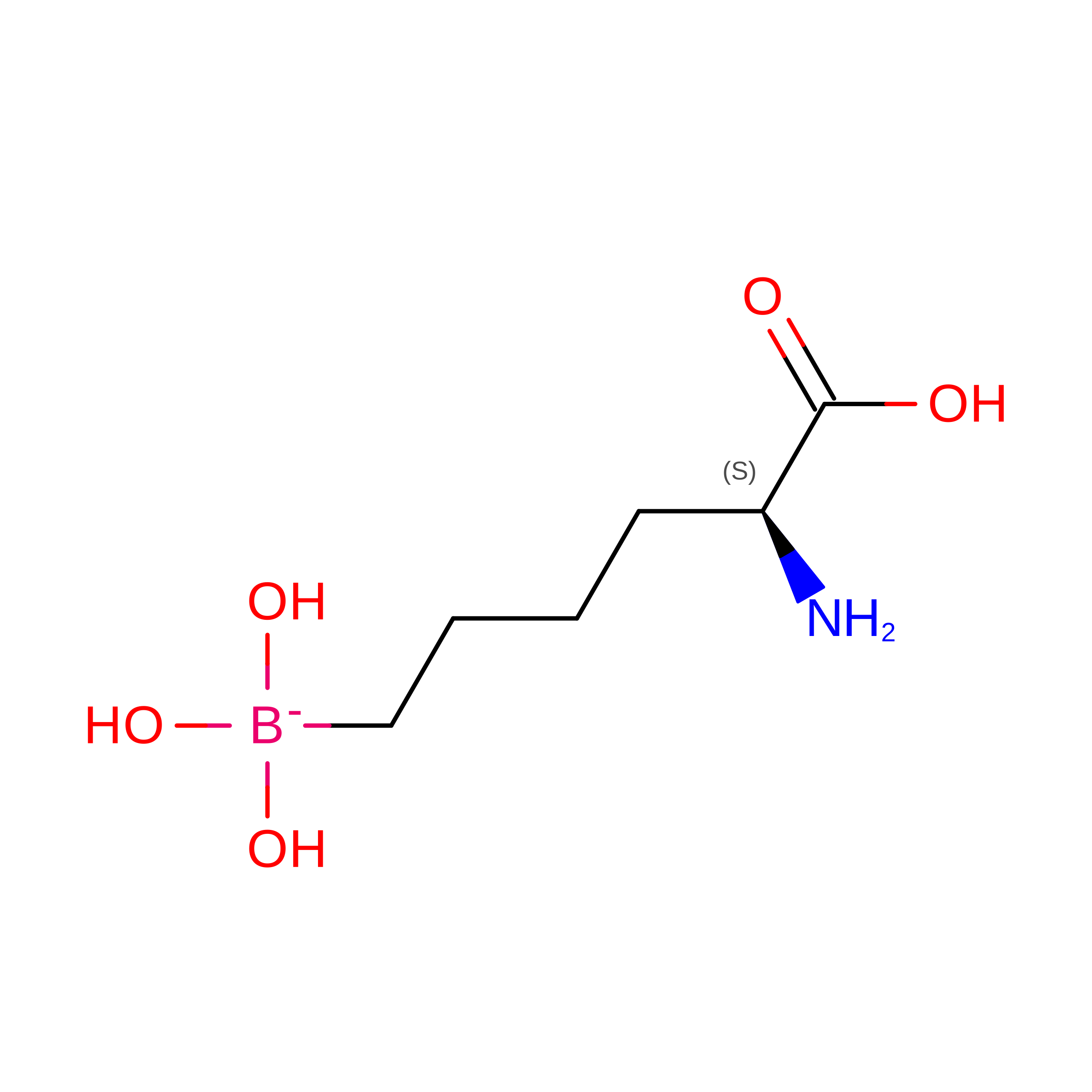
The binuclear manganese metalloenzyme human arginase I (HAI) is a potential protein drug for cancer chemotherapy, in that it is capable of depleting extracellular l-Arg levels in the microenvironment of tumor cells that require this nutrient to thrive. Substitution of the native Mn(2+)(2) cluster with a Co(2+)(2) cluster in the active site yields an enzyme with enhanced catalytic activity at physiological pH (∼7.4) that could serve as an improved protein drug for L-Arg depletion therapy [Stone, E. M., Glazer, E. S., Chantranupong, L., Cherukuri, P., Breece, R. M., Tierney, D. L., Curley, S. A., Iverson, B. L., and Georgiou, G. (2010) ACS Chem. Biol. 5, 333-342]. A different catalytic mechanism is proposed for Co(2+)(2)-HAI compared with that of Mn(2+)(2)-HAI, including an unusual Nε-Co(2+) coordination mode, to rationalize the lower K(M) value of L-Arg and the lower K(i) value of L-Orn. However, we now report that no unusual metal coordination modes are observed in the cobalt-reconstituted enzyme. The X-ray crystal structures of unliganded Co(2+)(2)-HAI determined at 2.10 Å resolution (pH 7.0) and 1.97 Å resolution (pH 8.5), as well as the structures of Co(2+)(2)-HAI complexed with the reactive substrate analogue 2(S)-amino-6-boronohexanoic acid (ABH, pH 7.0) and the catalytic product L-Orn (pH 7.0) determined at 1.85 and 1.50 Å resolution, respectively, are essentially identical to the corresponding structures of Mn(2+)(2)-HAI. Therefore, in the absence of significant structural differences between Co(2+)(2)-HAI and Mn(2+)(2)-HAI, we suggest that a higher concentration of metal-bridging hydroxide ion at physiological pH for Co(2+)(2)-HAI, a consequence of the lower pK(a) of a Co(2+)-bound water molecule compared with a Mn(2+)-bound water molecule, strengthens electrostatic interactions with cationic amino acids and accounts for enhanced affinity as reflected in the lower K(M) value of L-Arg and the lower K(i) value of L-Orn.
- Roy and Diana Vagelos Laboratories, Department of Chemistry, University of Pennsylvania, Philadelphia, Pennsylvania 19104-6323, USA.
Organizational Affiliation: